
Faith and Mission
Over recent weeks, our College community has shared several faith experiences that have supported connection, reflection and service.
The Year 7 St Omer Experience, including an overnight camp and reflection day, is an important part of students’ transition to Secondary. St Omer is named after the French town where one of our founders, MaryWard, established her ministry. Mary Ward spoke of keeping her circle of friends open, always leaving room for others to belong. This idea sits at the heart of the St Omer Experience, which focuses on building relationships, getting to know one another and developing a sense of belonging within the College community.
The Reflection Day theme, A Community in Christ, invited students to reflect on how community shapes who we are. Family is the first community we experience and where we learn how to live and love with others. Our school community builds on this understanding as we encounter new members of God’s family and learn how to live Christ’s call to love in our daily interactions.
Our Year 9 students are participating in the Way of the Cross, organised by our College Liturgist and supported by various staff members. Through prayer and engagement with the stations, students reflect on the final hours of Jesus’ Passion. Personal reflections encouraged students to consider themes of suffering, compassion and hope, and how these connect with their own lives and experiences.
In the Chapel, our Primary students continue to place their Quiet Acts of Kindness into the kindness jars. These simple but intentional actions highlight the importance of everyday kindness and remind us that faith is often lived through small, unseen choices to care for others.
Last week, our community also gathered for the launch of Pope Francis: The Disruptive Pilgrim’s Guide. The evening invited reflection on Pope Francis’ call to live faith with courage, humility, and a willingness to be challenged by the Gospel. The book encourages readers to see faith as an active journey, grounded in service, justice and compassion for others. A video recording of the launch is available below.
On 8 March, we recognise International Women's Day, a time to reflect on the contribution of women and, in our context, the women of faith who have influenced us. Their leadership, witness and service continue to shape our understanding of God, the Church and our call to serve others.
Together, these experiences continue to strengthen us as a community growing and living in Christ.

Janeen Murphy
Deputy Principal Faith and Mission
Australian Ignatian Trail Contemplative walk, South Australia
14-20 April 2026
For those who maybe interested in a more immersive experience of Contemplative Walking - Jesuit Ignatian Spirituality Australia has a 4 days/6 nights walk in South Australia. Please go to the following website to register your interest:
https://jisa.org.au/australian-ignatian-trail/
Community Mass
Thank you to Year 12 students who prepared this morning’s Community Mass, where we proclaimed the readings of the Third Sunday in Lent, including the account of the Samaritan woman at the well. A reflection on this Gospel by Dr Pina Ford is below.
Next Friday, Community Mass will be prepared by students in Year 10. Everyone is welcome; just arrive at the Chapel in time for an 8:00am start.
If you have any questions regarding our Friday Eucharist, please contact Mary-Anne Lumley: mary-anne.lumley@johnxxiii.edu.au
Community Mass details
- College Chapel
- Fridays in term time
- Starts at 8:00am concludes at 8:30am
Sacraments

Do you have a child in Year 3, 4 or 6?
Families are encouraged to enrol their child in their parish without delay. Next week, many parishes will be closing their enrolments for 2026. The College website has links to sacrament program information from some of our local parishes.
Students will be preparing for the sacraments of Reconciliation in Year 3, First Holy Communion in Year 4 and Confirmation in Year 6.
Preparing for the sacraments is a three-way collaboration of family, parish and school. This means that parents exercise their right in choosing to enrol their child in the parish; the school provides the learning experiences to prepare the children, and the parish arranges the celebration of the sacrament. Parishes require that students be enrolled.
Parents often have questions about the Sacrament program, so please don’t hesitate to ask. Below are some useful points of contact:
- The priest or sacrament coordinator in your local parish
- John XXIII College website
- The Archdiocesan website: Parishes & Mass Times
Mary-Anne Lumley: mary-anne.lumley@johnxxiii.edu.au or via phone on
08 9383 0513
Good News for 3rd Sunday in Lent
Below is a shortened version of Dr Ford’s reflection. The full version may be found here.
The Gospel of John proclaims that in Jesus God became flesh and fully shared the human condition. In the story of the Samaritan woman, this vulnerability is clear. Jesus is tired and thirsty, sitting by a well without even a bucket to draw water. Yet alongside his physical thirst, what is revealed is the longing of the Son of God for intimate friendship with humanity - a relationship that offers fullness of life to those who are most in need.
The Samaritan woman comes to the well carrying not only her jar but her own life story, with its burdens and longings. She arrives alone, at the hottest time of day, when no one else would be there. This detail invites questions. Whom is she avoiding? Who avoids her? What wounds or losses shape her life? She comes seeking water, but within her is the same deep thirst shared by all people: to be known, understood, to belong, and to be loved.
At first, the woman is cautious; like many of us, she has learned not to trust easily. Jesus surprises her by speaking to her. Jews did not associate with Samaritans, and men did not engage women in public conversation. The disciples themselves later express astonishment at seeing Jesus speaking with a woman – this was the greater of the two scandals. The woman knows that she is disqualified on both counts and she voices her amazement: ‘How is it that you, a Jew, ask a drink of me, a woman of Samaria?’
Jesus is fully present to her. He listens, speaks, and engages her as if no one else exists. She senses that her life matters to him. She even playfully teases his vulnerability by scoffing at his offer of miraculous water when he cannot even get himself a drink! Barriers fall away, and a dialogue that is both deeply personal and theological is shared —the longest conversation Jesus has with anyone in the Gospels.
Their conversation echoes their mutual deep thirst – lying just below the surface, for love and communion. The Catechism draws on this extraordinary moment to explain prayer:
The wonder of prayer is revealed beside the well where we come seeking water: there, Christ comes to meet every human being. It is he who first seeks us and asks us for a drink. Jesus thirsts; his asking arises from the depths of God's desire for us. Whether we realise it or not, prayer is the encounter of God's thirst with ours. God thirsts that we may thirst for God… (Catechism of the Catholic Church 2560 -2561)
The conversation takes a deep turn when Jesus asks the woman to call her husband. Trusting the love with which this is asked, she does not evade the question but reaches into her painful inner truth and answers simply, ‘I have no husband.’ Jesus affirms her honesty without condemning her. In their culture she had little say about being married to the man she was with but could not have physically survived without him. And given that only the man had the right to divorce his wife, the Samaritan woman’s having had five husbands would have meant repeated abandonment or bereavement. She would have lost any children from a divorce – they continued to be the husband’s property.
The woman is relieved and overjoyed to be so fully known. The painful dimensions of her life, like the water drawn from the well, come to the surface and are received with love. She calls Jesus a prophet and later invites others to share her experience: ‘Come and see a man who told me everything I have ever done.’ This is the only Gospel account of an entire community coming to faith through someone who was themself evangelised. Yet the villagers must encounter Jesus personally; faith cannot rest on another’s testimony. It is the woman that Jesus is affirming, and her response is universalised, when he speaks of the true worshippers who, not tied to a particular place or condition, open themselves to a transforming relationship ‘in Spirit and in truth’.
The Orthodox Church honours the Samaritan woman as St Photina, ‘the light-filled one.’ In a world filled with fear of the ‘other’ and resorting more and more to political and religious fundamentalism and violence, it helps if we recognise her not by gender or background, but by her willingness to receive God’s relentless but patient love and share it with joy. Like her, we are simply invited to respond. When we do, our own thirst—and the thirst of the world—begins to be quenched.
© Ford, Pina. "Third Sunday of Lent - 8 March 2026." Pastoral Liturgy 56, no. 2 (2026): 42-48. https://researchonline.nd.edu.au/pastoral-liturgy/vol56/iss2/10
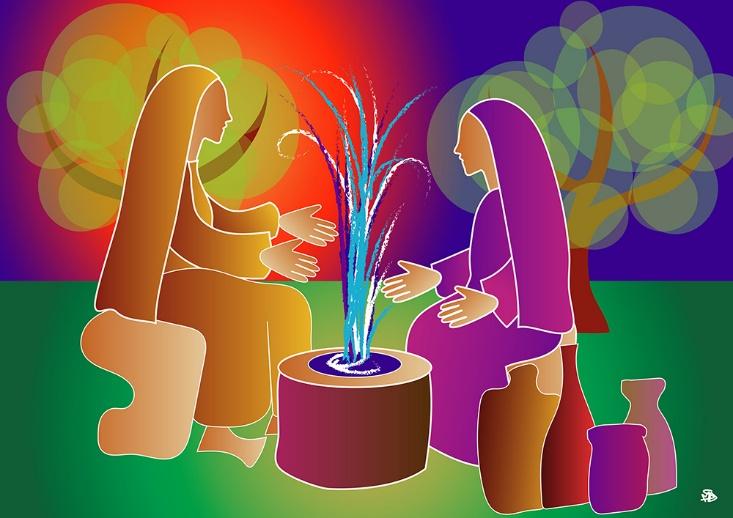
Image: Susan Daily ibvm
Image: Susan Daily ibvm
This statement holds the essence of a pastoral letter written by Bishop Michael Morrissey of Geraldton, on behalf of the Australian Catholic Bishops’ Conference, in advance of International Women’s Day this Sunday.