
Deputy Principal
Student Development & Wellbeing - Mrs Michelle Licina

Deputy Principal
Student Development & Wellbeing - Mrs Michelle Licina

Only a few books have really stuck with me that I return to repeatedly: James Clear’s ‘Atomic Habits’; Hugh Van Cuylenburg’s ‘The Resilience Project’ and everything written by Brene Brown. Recently, I have added to the collection.
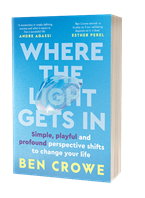
I have read Ben Crowe’s ‘Where the Light Gets In’ from cover to cover and have the audiobook playing in the car. Crowe is one of the most in-demand professional mentors and leadership coaches. His clients include Ash Barty, Dylan Alcott, Stephanie Gilmore, Richmond Football Club and many international organisations and clients. The apt title about light is based upon his philosophy that growth, breakthroughs and personal transformations happen in the small ‘cracks’ created when we shift our perspective. Similarly, light is a powerful metaphor of something good or life-giving as used in the ancient religions of Christianity, Judaism and Hinduism and modern psychology and literature.
In ‘Perspective Shift #3: From Not Enough to I Am Enough – Own Your Story’, something captured my attention. In 1967, researchers at the University of California explored the values of popular TV shows aimed at children between eight and twelve. They were curious to know how sixteen core values may ebb and flow in importance when charted across time. It’s what happened over 50 years – where we are now – that is jarring. In 1967, ‘belonging to a community’ and a desire for a close-knit group of friends ranked as the most important value. This intrinsic motivator held the top spot for nearly 40 of these years. In 2007, the shift was seismic. The extrinsic motivation of ‘fame’ became the highest priority for this age group. For the previous 40 years, fame had ranked close to the bottom at 15th place. While fame rose to the top, having a close group of friends plummeted to 11th. Sadly, this correlates with the dramatic rise in global mental health challenges for this age group.
Crowe calls out media, social media and advertising industries as the ‘three most dangerous storytellers’ of who we are and what we believe. With phones firmly attached to hands, the day-to-day existence of our young people becomes a constant blitz of macro fears and highlight reels. It is not a strong foundation for positive self-belief.
Mt Alvernia has long held this view, and it is reflected in our ‘no phones’ policy and preferably no smart devices at all. This is also part of our plan to offer respite from that narrative within our walls, and offer opportunities for connection, curiosity and ownership of who they truly are and what they value. It provides the gift of time to understand the distinction between beliefs that serve them well and those that don’t.
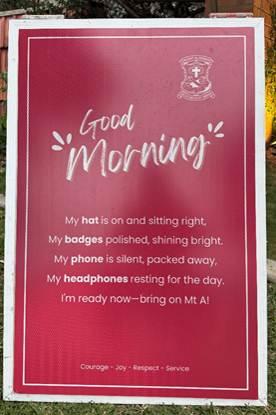
We – schools, parents and caregivers – are all struggling to have our young people put their phones away and connect with the humans and world around them. I wonder if the power of our partnership can create the perspective shift that Crowe recommends? At our entry gates, we have a sign written in kind language to remind our girls of this request
(see image). However, most times it does not seem to be working.
So, perhaps the family/College partnership can start right here.
On the drive to school, make the car a tech-free zone with phones away for conversation and connection. Upon arrival at school, ask your daughter to open her bag to place her hat on her head and put her phone and headphones away. If catching public transport, encourage your daughter to be prepared for the day – our learner attribute of ‘readiness’ - by putting phones and earphones away before entering the school gates.
This step may be the ‘small crack’ we need to widen together, to allow our girls to grow their roots before their wings.
Who is with me?
Works Cited:
Crowe, B. (2026). Where the light gets in: Simple, playful and profound perspective shifts to change your life. HarperCollins Australia.
Uhls, Y. T., & UCLA Center for Scholars & Storytellers. (2021, March 15). The rise and fall of fame: Tracking the landscape of values portrayed on television from 1967 to 2017. University of California, Los Angeles. https://www.uclahealth.org/news/release/tweens-and-tv-uclas-50year-survey-reveals-the-values-kids-learn-from-popular-shows