
Religious Education

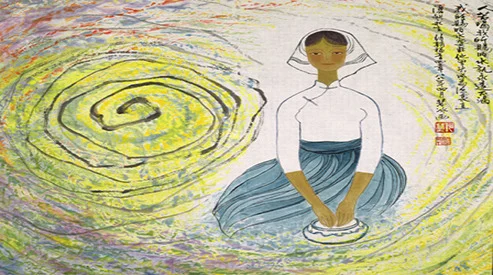
Living Water
Sunday, March 8 is the third Sunday in Lent. The Gospel reading for this Sunday is Jesus meets the Samaritan woman at the well.
Imagine high noon in the high, rocky desert region of Samaria. The arid landscape is practically shimmering beneath the burning sun. Jesus and his disciples, weary and thirsty from a day’s journeying, stop outside the city of Sychar. Jesus sends his disciples into the city for food and waits for them in the withering heat, taking a seat near the town’s well – the one made famous by ancestor Jacob.
He notices a lone woman emerge from the city gate and make her way toward the well. She is carrying a large earthenware jug balanced on her shoulder. Jesus knows what an odd thing this is. Ordinarily women came to the well early in the morning, when the day was still cool, to draw water for the day – and of course, to socialise and gossip.
We meet this woman at a well. This is not an incidental detail of the story! Wells are important places in the Bible. They often form the backdrop for narrative drama. Especially in the Hebrew Bible, the well is a classic setup for important plot points: when people gather at a well, something important is about to happen. They are often a place of revelation, rich in spiritual and emotional meaning.
If we could ask her, perhaps she would tell us about how a series of husbands had cast her off – which was easy for men to do in those days – or maybe they all just died. (We don’t know!) Perhaps this woman would like to tell us what it’s like to be a perpetual outsider: a marginalized woman in a marginalized people group, the Samaritans: a woman doubly excluded. Or she might have a few choice words to say about the women of the town, who fall mysteriously silent and exchange meaningful glances when she comes around the corner.
But then one day everything changed. One day when she went to draw water from Jacob’s well, she discovered she wasn’t alone out there. There was someone waiting for her at the well: a dusty traveller, looking weary from the journey. His sandals and tunic were covered in brown dust, there was sweat on his brow, and he looked thirsty and tired. And then he spoke to her, which, technically, he shouldn’t have done at all: a Jew and a Samarian, a man and a woman, all alone at the well. “Woman, give me a drink,” he says.
The meeting quickly turns into a genuine and authentic encounter of two persons, a meeting of two passionate hearts and minds. The conversation that Jesus has with the woman at the well in John chapter 4 is the longest Jesus has with anyone, anywhere recorded in the gospels. The conversation is leisurely and rich in detail; and it turns out both Jesus and the woman of Samaria have plenty to reveal.
She is spiritually thirsty as well. When she hears what Jesus is offering she is immediately ready for the living water that he promises. “Sir, give me this living water, that I may never be thirsty or have to keep coming here to draw water.” A woman with no name and a hurtful past discovers that someone has “found” her and loved her at last: not unlike when Jacob saw Rachel at the well and wept for love of her. The well at noon on a hot day in Samaria becomes, a place of grace and encounter, where this woman’s deepest spiritual and emotional thirsts are quenched in Jesus.
And Jesus, who thirsts to reveal who he is to God’s people, but who is not having an easy time of it with the Pharisees and the Jews of his day, has found another disciple in the Samaritan woman. He has found in her someone with eyes to see and ears to hear: a woman ready to see God in him. Not everyone wanted the water Jesus was offering. Not everyone wanted to hear who Jesus really was: the Messiah, the Christ. But this woman does! Her spiritual thirst gives her open ears and an open heart.
Reference: St. Ignatius. Samaritan Woman at the Well
Vicky Pejic
Religious Education Leader