
From Alison Dietrich
Deputy Principal - Wellbeing
From Alison Dietrich
Deputy Principal - Wellbeing
Welcome back to Term 3! I hope you all enjoyed a restful break and that students are returning to school ready for a busy and rewarding second half of the year.
Power to Kids Professional Development Day
At the start of this term, all staff at the College took part in a full-day professional learning session delivered through the Power to Kids in Schools program, run by the MacKillop Institute. The day equipped our staff with practical tools and a shared, common language to support respectful, trauma-informed conversations with young people about relationships. We explored strategies covering school-wide education, early identification of concerns and connecting students with the right support services when concerns arise.
This training reflects our ongoing commitment to child safety. Safeguarding our students is the responsibility of every adult in our school community and days like this ensure our staff are confident, well-equipped and consistent in how they support students to feel safe, respected and heard.
You can read more about the Power to Kids program here: Power to Kids in Schools | MacKillop Institute
Student Attendance: A Positive Trend
Attendance continues to be one of the strongest predictors of student learning and long-term wellbeing and we are pleased to share that our whole-school attendance data shows an encouraging trend over the past two years.
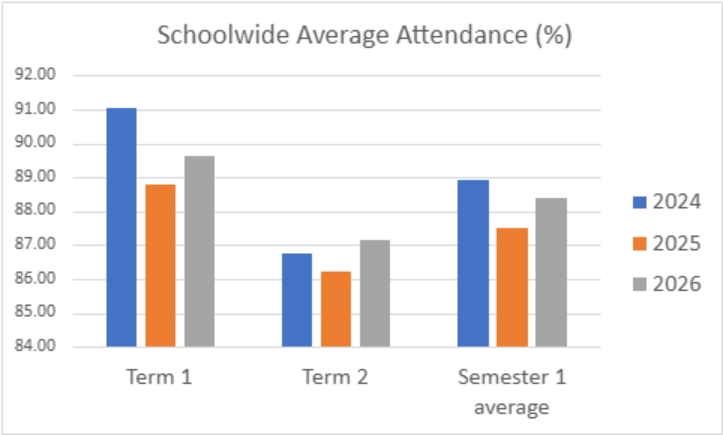
Both Term 1 and Term 2 attendance in 2026 are tracking above the same terms in previous years. While the overall increase from 2025 is approximately 1%, and may appear small at first glance, it represents a significant improvement in school attendance and indicates that we are now seeing a positive upward trend. It is particularly encouraging that our Term 2 attendance in 2026 exceeded both our 2024 and 2025 results. This suggests that the work our whole community, staff, students and families together, has been doing around engagement and connection to school is having an impact.
Research consistently shows the correlation between regular school attendance and positive academic and life outcomes. Even small, regular absences add up over a school year and across a student's schooling, which is why attending school every day is so important. Thank you to our families for the role you play in supporting your children to get to school regularly. It's making a real difference.
A Change to Behaviour of Concern (BOC) Records
We'd also like to let families know about a change to how Behaviour of Concern (BOC) records are documented at St Augustine's College. From this term, families will no longer receive an automated written notification each time a BOC is recorded for their child.
This is a change to the document, not to our communication practice. You will continue to hear from us if your child has a BOC. This could be in the form of a phone call, a conversation at pick-up, an email or a meeting - whatever best suits the situation. Including you in that conversation is important as it helps us work in partnership and best support your child.
If you have any questions about this change, please don't hesitate to reach out to the College.
Understanding Bullying: A Shared Commitment in CESL Schools
In Catholic Education Sandhurst, we are committed to creating safe, inclusive and respectful learning environments where every child and young person feels valued, connected and supported.
An important part of this work is helping our communities understand what bullying is - and what it is not.
Bullying is more than a disagreement, conflict or one-off incident between students. The definition used across our schools is:
“Bullying is the repeated and intentional behaviour of causing fear, distress or harm towards another person that involves an imbalance of power. It can involve humiliation, domination, intimidation, victimisation and harassment.”
This definition highlights several important elements of bullying:
Repeated behaviour – it happens more than once or has the potential to continue.
Intentional harm – the behaviour is deliberate.
Power imbalance – one person or group has power over another, whether physical, social or emotional.
Bullying can occur in person or online and may include verbal, social, physical or cyberbullying behaviours.
The recent Australian Government Rapid Review into Antibullying in Schools reinforced the importance of schools, families and communities working together to prevent bullying and respond early when concerns arise. The review highlighted that effective bullying prevention is strengthened through positive relationships, student voice, wellbeing supports and strong partnerships between schools and families.
Within CESL schools, our approach is guided by the belief that every person is made in the image of God and deserves to be treated with dignity, compassion and respect. We are called to foster communities where people feel safe, included and connected, and where relationships are nurtured through empathy, restorative practices and a shared responsibility for wellbeing.
Parents and carers play an important role in supporting children and young people to navigate friendships, relationships and conflict. Some ways families can help include:
encouraging open and calm conversations about school and friendships
helping children identify respectful relationship behaviours
supporting children to seek help when they feel unsafe or excluded
modelling respectful communication at home and online
working collaboratively with schools when concerns arise
At times, children may experience conflict, friendship challenges or disagreements that can be upsetting but may not meet the definition of bullying. Schools work carefully to understand each situation and provide appropriate support, restoration and guidance for all students involved.
If parents, carers or students have concerns about bullying or student wellbeing, the first point of contact should be the classroom teacher or teacher advisor. Early communication and partnership between home and school helps ensure concerns can be understood, responded to and supported in a timely and collaborative way .
Together, through our shared commitment to wellbeing, respectful relationships and the values of our Sandhurst community, we can continue to create school environments where every child and young person feels safe, known and able to flourish.
Wishing everyone a wonderful start to Term 3.
Kind regards,
Alison Dietrich
Deputy Principal
Wellbeing