CURRICULUM
News from Kris O'Farrell
Director of Studies
CURRICULUM
News from Kris O'Farrell
Director of Studies
At Saints we understand that boys learn best in environments that are clear, consistent and purposeful. Dr Judi Newman, a leading Australian educational researcher, emphasises that when learning environments are predictable and well structured, students are better able to manage cognitive load, freeing their thinking for deeper learning rather than organisational stress.
The brain has a limited capacity to process new information. When classroom expectations, lesson routines and transitions are consistent, students are not distracted by uncertainty. Instead, they can focus their attention on understanding, problem-solving and applying new ideas. For boys in particular, clear routines support engagement, confidence and self-regulation.
Dr Newman highlights that strong learning habits are built through explicit routines and deliberate practice. At St Augustine’s, one way we support this is by consistently using the student diary. The diary is more than an organisational tool; it helps students plan, record homework, set goals and reflect on their learning. These practices support independence and encourage students to take ownership of their academic progress.
We set homework intentionally. When assigned a purpose, homework reinforces classroom learning and helps students consolidate their understanding. Combined with goal setting and reflection, homework becomes a meaningful extension of learning rather than a compliance task. These habits support students in developing perseverance and pride in their work, qualities that contribute to success well beyond the classroom.
Recommended homework times each evening are as follows:
This approach aligns strongly with our Marist characteristic of love of work, which calls our students to approach learning with purpose, perseverance and care. By providing structure, clear expectations and consistent routines, we support our boys to work to their ability and potential.
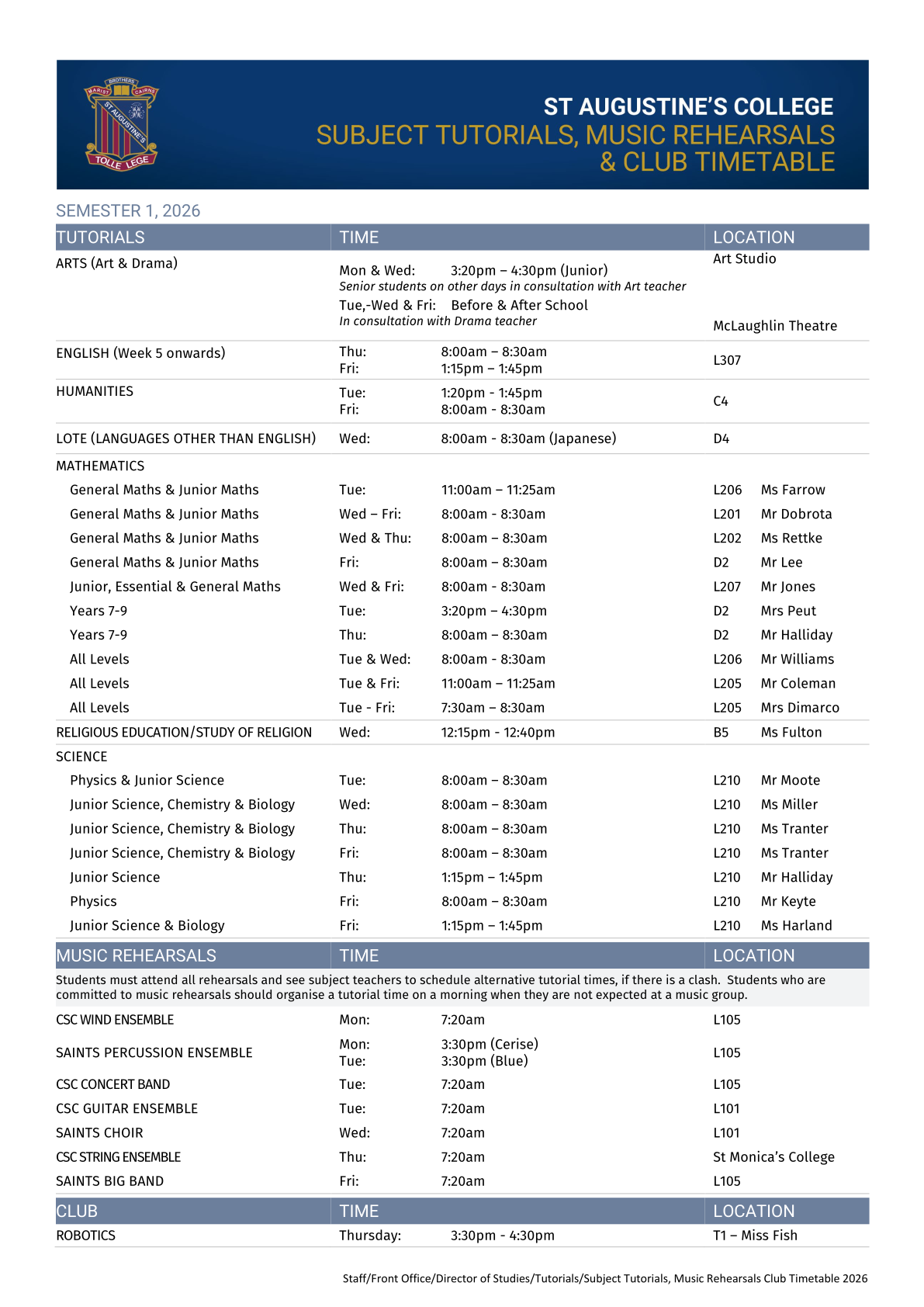
Mr John Brimstone - Head of Department
A new year brings new excitement for students and increasing enthusiasm for their involvement in classes. This semester the HPE Department will continue to provide a variety of experiences across a wide range of physical activities. To provide these quality experiences, there are several things we would like you to know about our classes.
Use of off-site facilities
To enhance the HPE Program, classes will use many local sporting facilities. This means that during your son’s practical HPE lessons, he may travel off the campus on the College bus or by foot. This semester, these locations include: Barlow Park, the showgrounds, Your Fitness Gym, Cairns Golf Club, West Cairns Bowls Club, Cairns Basketball Stadium and the Cairns Youth Centre. If you have any concerns about this, please don’t hesitate to contact me by email - jbrimstone@cns.catholic.edu.au
At least one spare sports uniform is needed for practical classes
If your son is doing HPE, he will be participating in at least two practical lessons a week. In these lessons boys are required to wear their full sports uniform. Couple this with Wednesday sport and he will be using this uniform frequently. Therefore, it is important that he has more than one uniform to ensure he can participate in all classes.
Bringing a hat to practical lessons
The prevalence of skin cancer in Australia is confronting. We live in a part of the country where the sun’s ultraviolet rays are extreme and unforgiving. Often our HPE lessons are outdoors, exposing us to this harmful environment. Therefore, it is compulsory for all students to own and wear a Saints hat when participating in outdoor physical activity. It is also recommended that your son’s hat is clearly marked with his name, whether this be written in permanent marker, or even embroidered, to avoid loss or confusion.
Thanks in advance for your support of the Saints H&PE Department.