DEPUTY PRINCIPAL - TEACHING & LEARNING REPORT
MR NATHAN LANE - DEPUTY PRINCIPAL: TEACHING & LEARNING
DEPUTY PRINCIPAL - TEACHING & LEARNING REPORT
MR NATHAN LANE - DEPUTY PRINCIPAL: TEACHING & LEARNING

Vision for Teaching and Learning at St Mary MacKillop College - a statement that drives the development of a high performance learning culture at SMMC
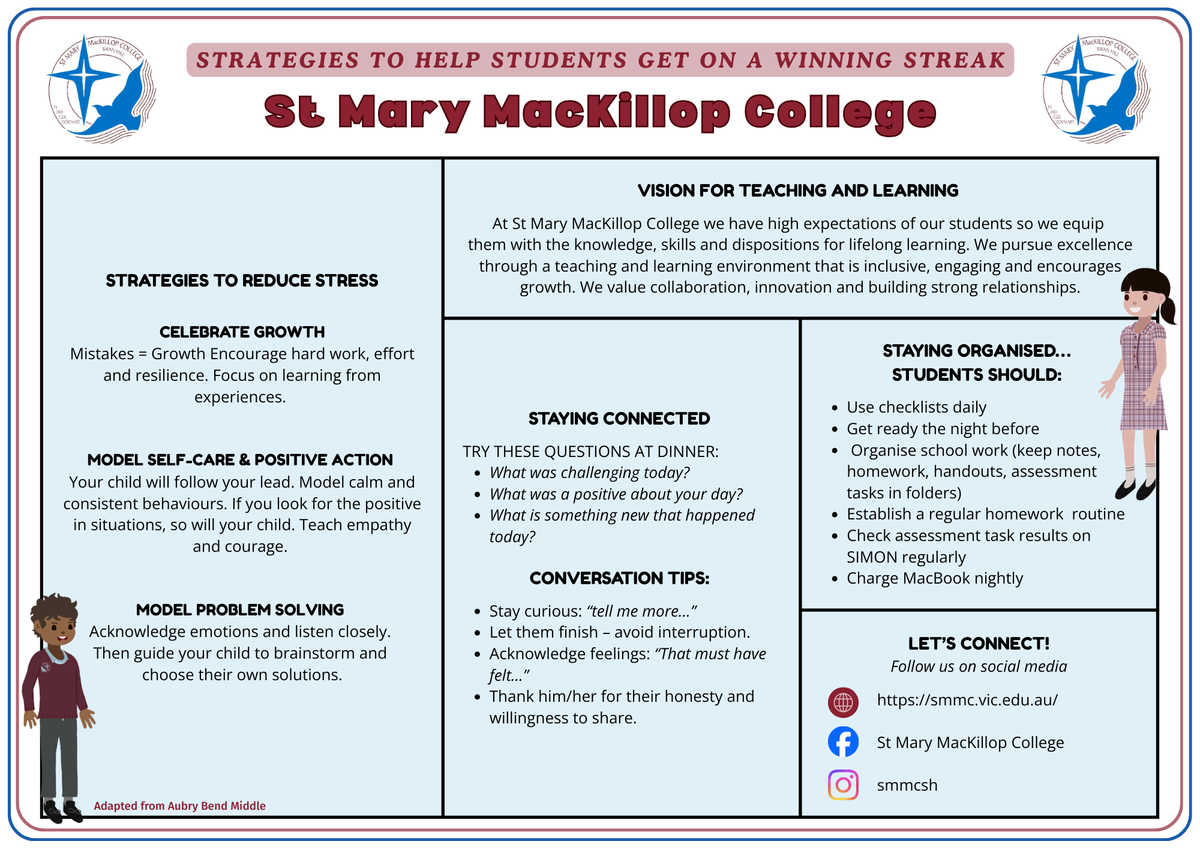
At St Mary MacKillop College we have high expectations of our students as we equip them with the knowledge, skills and dispositions for lifelong learning. We pursue excellence through a teaching and learning environment that is inclusive, engaging and encourages growth. We value collaboration, innovation and building strong relationships.
A very Happy New Year to our community. A big welcome to our new students and families, and a welcome back to our students and families already in our amazing community. It was wonderful to see our Year 7, 11 and 12 students return to school on Friday 30 January, and the remaining year levels on Monday 2 February. It was also exciting to see our new Year 7s arrive and start their six years of secondary schooling.
We know that parent engagement is a key ingredient for success in student learning, and we look forward to meeting with parents at the following events this term: MacBook Parent Information Evening, Year 7 Welcome BBQ, Year 7 TA interview afternoon, and the Year 11 and 12 Parent Teacher Student Interviews. There will be many other opportunities throughout the year for parents to be involved in their child’s education. We thank parents for your support and for your valuable partnership as we work together to educate your child.
This year our school theme is ‘conscious compassion’. As I write this newsletter article, I am reflecting on what ‘conscious compassion’ means in the context of education. When I Googled ‘conscious compassion in education’, the AI Overview on Google provided the following: ‘Conscious compassion in education is the deliberate, proactive practice of empathy, kindness, and understanding toward oneself, students, and colleagues to foster a supportive learning environment. It shifts from purely competitive, high-stakes models to nurturing emotional resilience, well-being, and social-emotional growth. This approach reduces stress and boosts academic success by making students feel valued, safe, and connected’. The words that stand out for me in this are empathy, kindness, supportive, resilience, valued, safe and connected. These words very much align with our vision, mission and values. We will explore the theme of ‘conscious compassion’ with our students and community throughout the year.
I am excited for what lies in store for this year and I wish everyone all the very best for 2026. As we prepare for a successful year of learning, here are some simple tips to start the year off on a positive note.
To the class of 2026
I wish you all the very best as you begin your final year of secondary education. To all our students across Years 11 and 12 studying a Unit 3 and 4 subject this year or VCE VM/VPC program, I wish you great success in your studies.
The Parents Website has some interesting articles to support senior secondary students. Two articles that may help parents support their child through their final year of secondary education are:
https://theparentswebsite.com.au/vce-parents-childs-cheerleader-tips/
https://theparentswebsite.com.au/atar-surprise-tips-and-advice-on-what-to-do/
2026 NAPLAN Dates
In 2026, NAPLAN will occur on the following days for our Year 7 and 9 students:
I will provide further information as planning for this year’s NAPLAN continues.
Home Study Guidelines
At St Mary MacKillop College it is believed that home study provides the opportunity for students to be responsible for their own learning. Home study complements and reinforces classroom learning; it fosters life-long learning, self-discipline, concentration and effective study habits and routines.
Home study should require a reasonable commitment, but it should not be too onerous. Students should plan their home study to take into account their family, sporting and work commitments. Throughout a student’s secondary education they must prepare for a very competitive educational climate.
At St Mary MacKillop College, the time and frequency of home study is different for each year level. In Years 7 -9, home study may include regular English and Mathematics homework tasks, revising for assessment tasks, reading of newspapers, watching the news, physical skills training or assignment and project completion. Home study also includes completion of formal reflection activities such as mind maps and a summary of the day’s learning. In Years 10 – 12 home study is determined more by the specific subject requirements.
Year 7
Students should be completing an average of 2 hours of home study educational learning per week.
Year 8
Students should be completing an average of 2.5 hours of home study educational learning per week.
Year 9
Students should be completing an average of 3 hours of home study educational learning per week.
Year 10
Monday – Thursday night, students should be completing a minimum of 45 minutes of home study.
Unit 1 & 2 VCE, VET & VCE VM/VPC
Students should be completing a minimum of two hours home study, per week, for each subject that they study.
Unit 3 & 4 VCE
Students should be completing a minimum of three hours home study, per week, for each subject that they study.
All Year 11 and 12 students have study lessons in their timetable. Students should maximise the use of this time.
2026 Grade Scale
All tests for Year 7 to 10, all exams and all VCE assessment tasks will be reported as a %.
For projects, assignments etc. that are assessed using a rubric, the following grade scale will be used. The language in this grade scale reflects growth, as you will see in the table below.
| Excelling | 90 - 100% |
| Accomplished | 70 - 89% |
| Consolidating | 50 - 69% |
| Developing | 40 - 49% |
| Beginning | 30 - 39% |
| Not Yet Evident | <30% |
Nathan Lane
Deputy Principal Teaching and Learning