Science Sparks!
SWAG - Science with Agriculture
Science Sparks!
SWAG - Science with Agriculture
Science Sparks
As Term 2 begins, Science students across Years 7-12 are actively engaged in exciting practical investigations and hands-on learning.
Year 7 students are exploring Forces, Year 8 students are investigating Forces through a parachute design challenge, and Year 9 students are studying infectious diseases by testing the effectiveness of antiseptics on bacterial growth.
Year 10 students are learning about Earth and Space, including the Big Bang Theory and the origins of the universe.
Year 11 Biology students are working through Module 2: Organisation of Living Things, while Year 12 Biology students are studying Module 8: Non-Infectious Disease and Disorders.
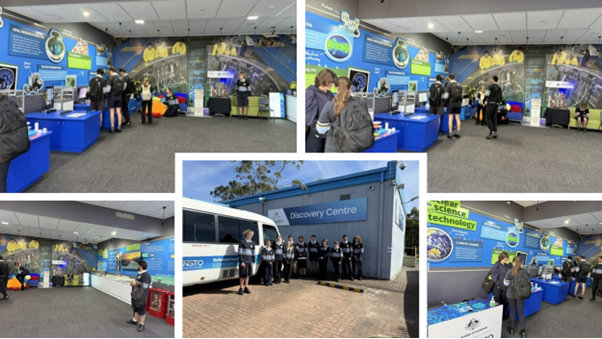
Our Year 12 Earth and Environmental Science students also recently visited ANSTO, where they saw how advanced scientific techniques are used to study climate change and Earth processes.
It has been a fantastic start to Term 2, with students across all year groups developing their scientific knowledge, practical skills and curiosity about the world around them.
ANSTO Year 12 Excursion
Our Year 12 Earth and Environmental Science students recently enjoyed an exciting and highly educational excursion to ANSTO - Australian Nuclear Science and Technology Organisation in Lucas Heights, Sydney.
The visit gave students a unique opportunity to see how cutting-edge science is used to investigate environmental issues, natural resources and Earth processes. During the day, students explored ANSTO’s world-class research facilities and learned how nuclear techniques are used to study climate change, groundwater movement, pollution, soil health and the age of rocks and fossils.
This excursion directly supported the NSW Stage 6 Earth and Environmental Science syllabus, which encourages students to apply scientific knowledge to real-world environmental challenges. Camden High School offers Earth and Environmental Science as part of its senior science curriculum, providing students with opportunities to engage in practical and inquiry-based learning experiences.
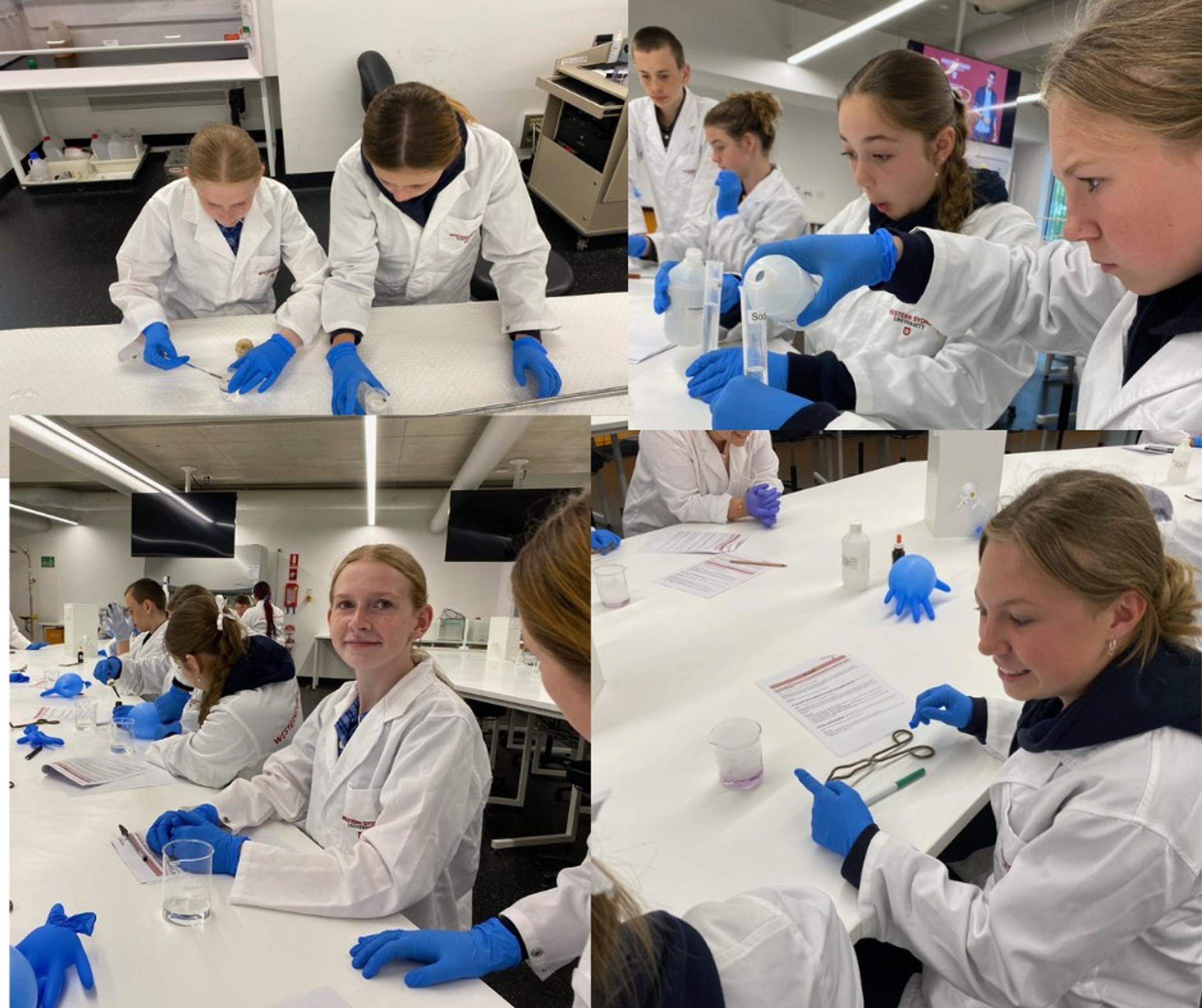
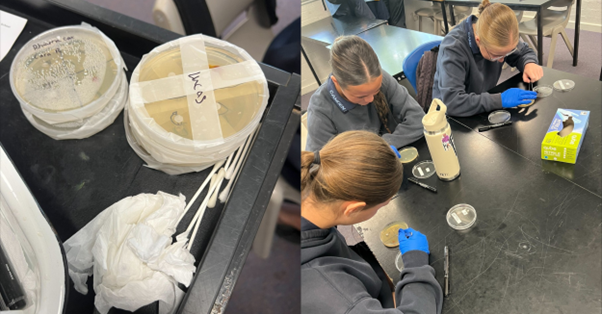
Our Year 9 Science students recently completed an engaging practical investigation as part of their assessment task on infectious diseases and the growth of microorganisms.
In this hands-on experiment, students inoculated nutrient agar plates with harmless bacteria and tested the effectiveness of various antiseptic and natural substances, including Betadine, iodine, essential oils and other disinfectants. By measuring the zones of inhibition around each substance, students were able to determine which treatments were most effective at preventing bacterial growth.
This investigation allowed students to apply the scientific method by developing hypotheses, controlling variables, collecting quantitative data and drawing evidence-based conclusions. Students also learned the importance of aseptic techniques and laboratory safety when working with microorganisms.
A fantastic example of inquiry-based learning, where students became real scientists investigating solutions to one of humanity’s ongoing challenges - preventing and treating disease.
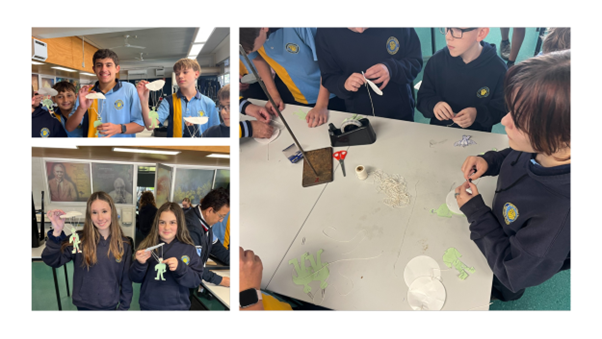
Our Year 8 Science students recently took part in an exciting and creative parachute design challenge as part of their unit on Forces.
Students were tasked with designing and constructing their own parachutes using a variety of materials. Their goal was to create a parachute that would fall as slowly as possible while safely carrying a small load. Once constructed, students tested their designs and measured the time taken for each parachute to reach the ground.
This engaging STEM activity helped students explore key concepts related to forces, including gravity, air resistance (drag), balanced and unbalanced forces, and acceleration. Students observed that as the parachute opened, air resistance increased and acted upward against the downward pull of gravity. When these forces became balanced, the parachute descended at a much slower and more controlled speed.