
Mathematics
Maths at Sacred Heart
Mathematics
Maths at Sacred Heart
This year at Sacred Heart, we have worked hard to deepen our understanding of best-practice teaching and learning in mathematics. We have focused on the small but impactful “one percenters” that strengthen student outcomes. This includes embedding daily fluency practice across the school to build automatic recall, introducing Rocket Maths as an extension program for Prep to Year 3, and trialling PR1ME Maths in Year 6 ahead of a broader rollout next year.
Mathematics has been an area of meaningful growth and positive change this year. Our focus has remained on implementing high-quality, evidence-based approaches that continue to evolve in response to research, ensuring we provide the very best support for all students.
This growth and shift in practice is clearly reflected in our student results. Nowhere is this more evident than in our Times Tables Rock Stars data, where every class has shown significant improvement. Students across the school are demonstrating increasing confidence, accuracy, and speed, highlighting the positive impact of our collective efforts.
| Class | End of year expectations | Term 1 average | Term 4 average | Average growth |
| Grade 2 | 8.00 seconds | 7.45 seconds | 6.44 seconds | 1.01 seconds |
| Grade 3M | 5.00 seconds | 7.32 seconds | 4.07 seconds | 3.25 seconds |
| Grade 4C | 3.00 seconds | 4.25 seconds | 3.00 seconds | 1.25 seconds |
| Grade 4P | 3.00 seconds | 3.85 seconds | 2.57 seconds | 1.28 seconds |
| Grade 5B | 2.80 seconds | 3.63 seconds | 2.56 seconds | 1.07 seconds |
| Grade 5T | 2.80 seconds | 3.82 seconds | 2.54 seconds | 1.28 seconds |
| Grade 6B | 2.70 seconds | 3.89 seconds | 2.40 seconds | 1.49 seconds |
| Grade 6N | 2.70 seconds | 3.87 seconds | 2.40 seconds | 1.47 seconds |
From this data, we can see that, on average, each year level is working at age-related expectations for multiplication and division skills. Every class has demonstrated significant growth, with improvements of over a second on average across the year. These results reflect performance across all times tables and questions, highlighting consistent progress for all students.
Year 3, in particular, has made remarkable progress, with the class improving by over 3 seconds on average. These results do not happen by chance, they are the product of consistent hard work, routine, and regular practice. In partnership with learning at home, we are extremely grateful for the strong connection with families, which has been crucial in supporting the development of students’ automatic recall skills.
This year, 117 students have reached Gone Green meaning they can answer every multiplication question in under 4 seconds, an outstanding achievement! We are excited to continue this momentum of world class teaching in mathematics in 2026.
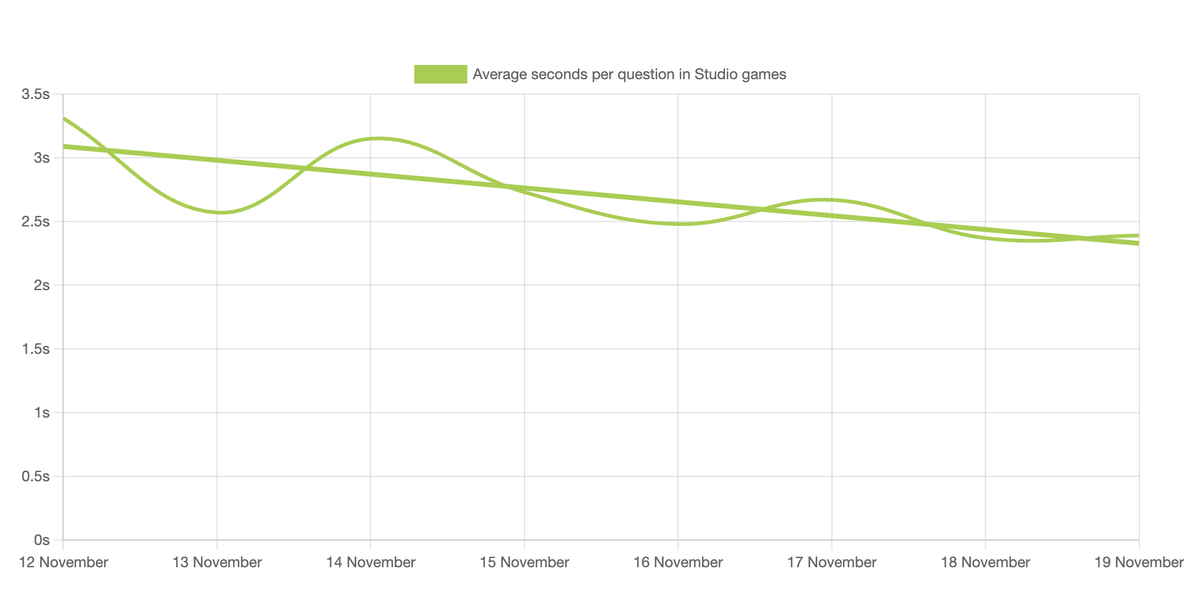
This graph from the week shows that average school time to answer each mulipication question has been decreasing each day on Times Table Rock Stars! What a wonderful achievement - well done Sacred Heart.
Students are encouraged to continue strengthening their number skills at home. Alongside Times Tables Rock Stars and NumBots, there are plenty of fun, hands-on ways to reinforce key maths concepts and build confidence in problem-solving. Regular practice at home helps consolidate the skills learned at school and supports ongoing growth.
Here are some additional ideas to make maths practice engaging:
These activities make practising maths fun and interactive, while helping students apply their skills in everyday situations.
“Excellence is built through small, consistent efforts repeated day after day.”
In mathematics, developing strong skills isn’t just about understanding concepts it’s about practising them regularly. Daily routines at home, whether working on times tables, number facts, or quick mental calculations, helps your child make these skills automatic.
Consistent effort and repetition strengthen confidence, accuracy, and problem-solving ability. Over time, these small, regular actions lead to big improvements, laying a solid foundation for future success in maths.
Mak Bulte
Maths Leader