
Leadership Report
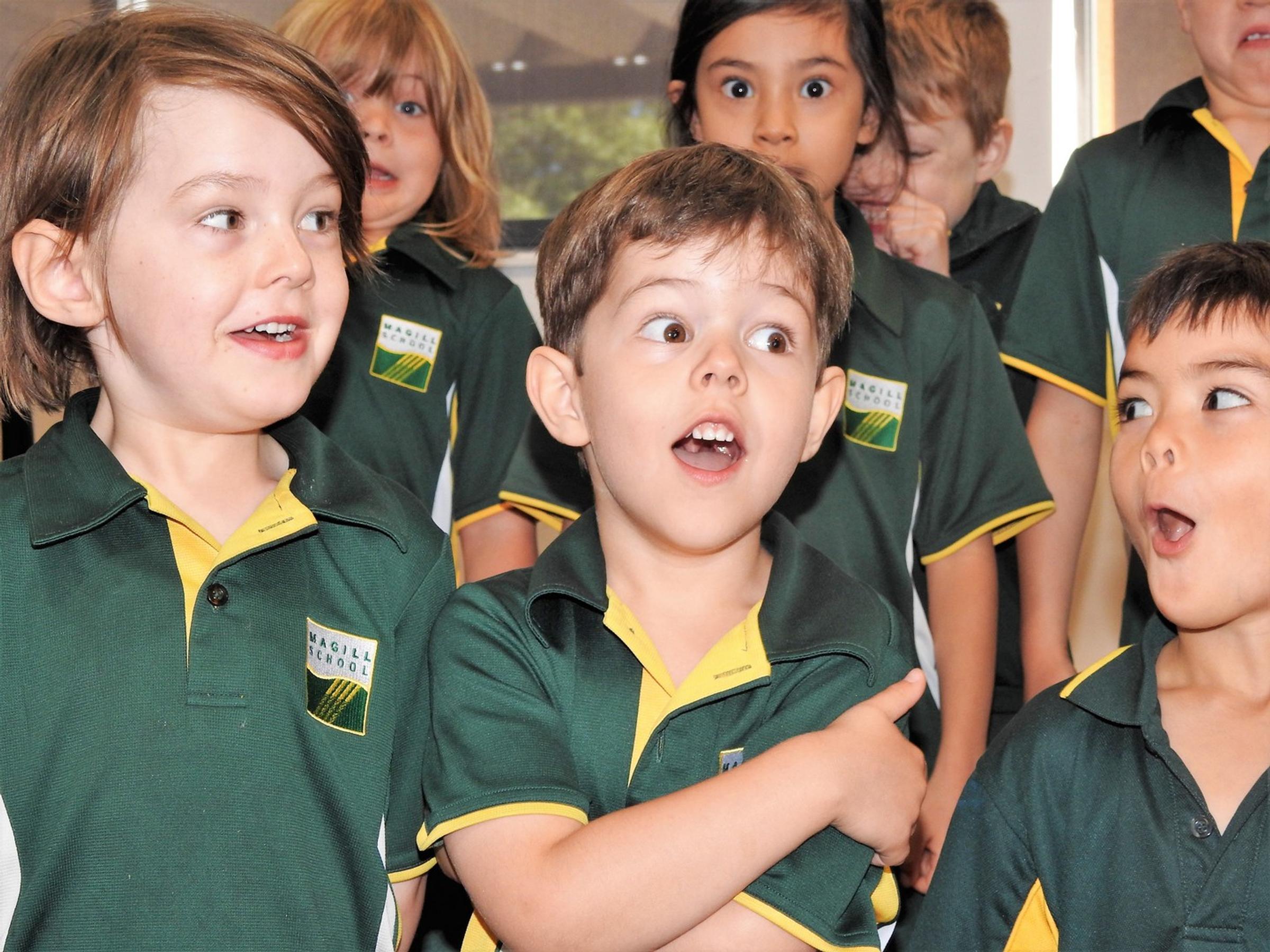

As we head toward the end of Term 2, with often wet and rainy days, it’s still great to see the smiles, learning and achievements happening around our school every day.
One of the highlights this week was our first Reception Transition, which welcomed over 50 new four- and five-year-old children to the Magill School community. They arrived with equal amounts of tears and smiles and some unique theories about how school works. Some were reluctant and some appeared ready to take over the place. Let’s just say it was great to meet and speak with some of our newest students as they begin their Magill School journey. It was especially good to see our current reception children welcoming the new students into their classroom. Showing the new students around, playing games with them and showing their Magill School values to help them have a positive first impression. A big thanks to our student leaders and all the staff who helped make the first transition visit a positive experience. We are also thankful that the previously mentioned rain mostly held off for the morning.
While most of our students enjoyed an extra day of rest on Monday this week, our staff were here at school undertaking professional learning. The focus of the day was my favourite topic, and if you are a regular reader of this newsletter, you will know that means Maths. As a school, we are looking closely at the way we teach maths and how we can build on the already great teaching and learning in maths for our students. One of the areas teachers from Reception to Year 6 are currently working on is Maths Fluency. Maths fluency involves students being able to quickly recall addition, subtraction, multiplication and division facts. For our youngest students in Reception and Year 1, this also includes counting, writing numbers and subitising (saying how many in a small group without needing to count). Maths fluency is an important part of maths learning. When students start working on more complex word problems, knowing your maths facts saves brain space for the other tricky parts of the problem.
If you have read this far, you will not be surprised that I am finishing with some more maths.
I have the pleasure of working with over 80 students from Years 3–6 who participate in the Maths Olympiad Competition. Earlier this term, our National Team achieved a milestone for our school by scoring above the national average on all five competition questions. With the second competition paper taking place next week, our Maths Olympiad teams have been busy learning strategies and practising questions that twist, stretch and challenge their mathematical thinking.
Problem solving in maths connects with the focus on maths fluency that I mentioned earlier, that’s because success in mathematics also requires understanding, reasoning, problem-solving and the ability to think carefully about what a question is really asking.
The following Maths Olympiad question is one example:
Vihaan’s netball team is doing a training exercise. The players are in a long line spaced 10 metres apart. The ball starts at one end and is thrown down the line from one player to the next until it reaches the end of the line.
If the ball travels 100 meters, then how many players are there doing the training exercise?
Many students with strong fluency skills quickly calculate that there are 10 gaps of 10 metres and confidently answer "10". The challenge is recognising that the question asks for the number of players, not the number of gaps between them.
When students draw a diagram, they can see the missing piece:

As you can now see, there are 10 gaps of 10 metres, but 11 players. Drawing the problem helps students visualise the situation. The diagram also allows students to check that they have answered all the parts of the question correctly.
Developing these skills looks different at each year level. Just before this article went to publication today, I had the opportunity to visit our Year 1 classrooms and see students working on a mathematical problem. One of the best parts of working at Magill School is visiting classrooms and seeing children actively involved in mathematical thinking.
The problem they were working on was:
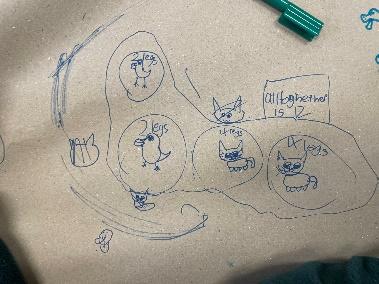
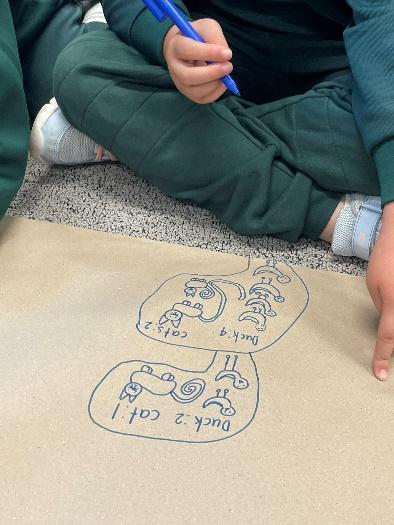
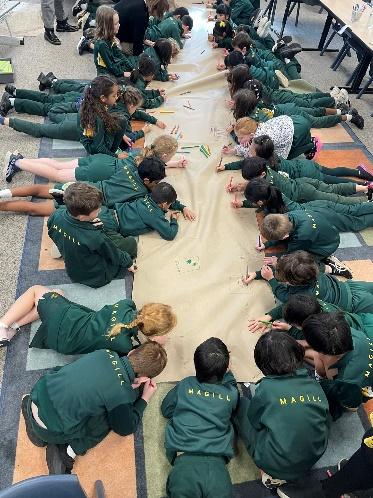
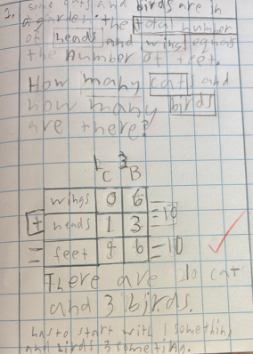
Some cats and birds are in a garden; the total number of heads and wings equals the number of feet. How many cats and how many birds are there?
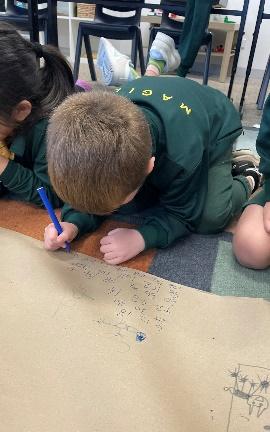
This type of open-ended question does not have a single answer. Problems like this encourage students to focus on how to approach a question, rather than rushing to reach a solution and move on. In these photos, you can see our Year 1 students in N1 and N2 working collaboratively. Drawing, discussing, testing ideas, and learning from each other as they develop their problem-solving skills.
To see how this learning progresses as students move up the grades, have a look at these responses to the same problem from Year 4 students F9. It was equally good to see these students using tables, and noticing patterns as they worked through this problem:
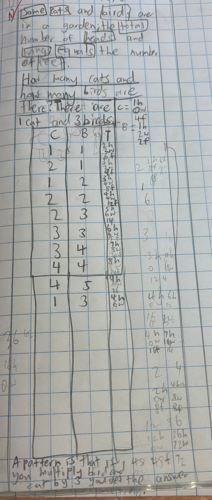
Questions like these remind us that while fluency is an important skill, students also need opportunities to reason, represent their thinking, communicate ideas and solve unfamiliar problems. It is the combination of these skills that helps students become confident and successful mathematicians.
Until next time, keep warm and keep working on your maths skills.
Sonia Magon
Assistant Principal