Principal's Update
Per Vias Rectas
Principal's Update
Per Vias Rectas
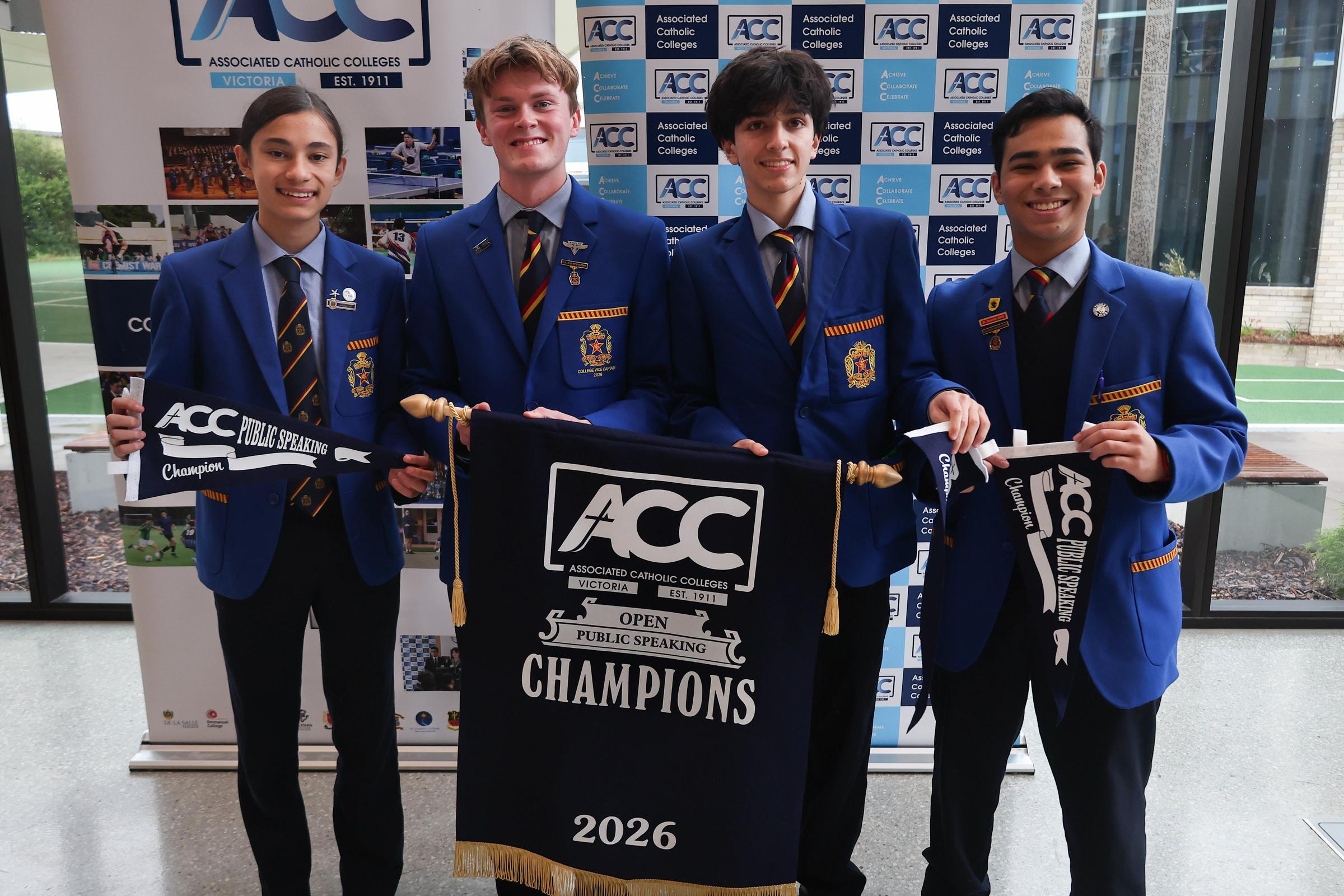
To our team who won the ACC Public Speaking premiership. Great work from Nick and Daniel (College Vice-Captains), Vinnie (Year 11) and Lucian (Year 8).
To our 32 students across Years 7 to 10 competing in the Da Vinci Decathlon problem-solving competitions - with the Year 8 team gaining a first place and the Year 9 team recording a second.
To the Old Collegians Association and Deputy Principal - ICT, David Cracknell, who make our reunions of past students happen. A recent reunion has seen the 30-year past students return and join Brother Quentin for a session of memories and laughs. We look forward to welcoming our 40-year alumni tomorrow evening.
A reminder that during the month of June, I will be taking leave to hike the Camino. In my absence, Mark Jones will take on the role of Acting Principal, with Chris Mills moving into the role of Deputy Principal – Wellbeing. I wish all members of our community a wonderful conclusion to Term 2 and look forward to seeing you again at the beginning of Term 3.
As a College Community, on 15 May we celebrated the life of our Founder, St John Baptist de la Salle. At a local level, we also recognised the many De La Salle Brothers, who since 1938, have set the tone for education at St Bede’s College. We do so with a sense of gratitude as we appreciate that John Baptist de La Salle began an education system in France that was to be adopted by many throughout the world as a way of inspiring young people.
St John Baptist de La Salle set up many schools after seeing a need to educate boys and young men who were the most vulnerable in their society. He understood that education was the path to freedom and responsibility. He was both a brilliant educator and a pragmatist, believing that the education of minds and hearts was essential for learning and life. From such beginnings a large network of Lasallian schools formed, now educating more than one million students worldwide. Of special note was the zeal in which St John Baptist undertook his work. It was not easy or passive; no worthwhile achievement in life ever is that way.
St Bede’s College is part of a wonderful enterprise with Lasallian schools in more than 80 countries around the world. We are proud of our Lasallian heritage. It gives our community a distinct and well-articulated view of education, allowing young men to feel connected, empowered and able to make a clear difference in the world.
Whilst expressing our gratitude to our founding De La Salle Brothers, it is also appropriate to acknowledge the recent Feast Day of St Bede on 25 May. When our first College Principal, Brother Benignus, chose St Bede as the name for this new boys’ college, he clearly had in mind that the Brothers were establishing a community where learning would be loved, sought and appreciated.
Bede (673–735), a Benedictine monk and historian was also an author, a poet, musician, a theologian and scientist, a gifted linguist and a fine teacher. Acknowledged as probably the most learned man in Europe of his day, he remains one of northern England’s greatest sons. During his lifetime and throughout the Middle Ages, Bede’s reputation was based mainly on his scriptural commentaries, copies of which found their way into many of the monastic libraries of western Europe. Bede’s works fall into three groups: grammatical and “scientific” scriptural commentary, historical and biographical.
On 1 June, our Year 11 students have their mid-year examinations and our Years 9 and 10 students follow with examinations on 9 June. I wish them every success in the weeks ahead. This can often be a demanding and challenging period; however, I encourage our students to approach this time with confidence, balance and belief in their own abilities. At St Bede’s College, our philosophy is to give students increased opportunities to sit formal examinations as they move into the higher levels. With practice, students learn to better prepare for such formal assessments and develop techniques for reducing the anxieties that can sometimes be associated with them. While ‘practice’ (study and revision) may not necessarily ‘make perfect’, practice certainly increases the likelihood of improved outcomes. We all know that rewards tend to follow hard work and commitment.
The results achieved on this set of examinations are important and they will influence a student’s overall performance and grade in each subject. Students should then use their examination results as a catalyst to improve their standing for Semester Two. Results, supplemented with our rubric for assessing Student Learning Habits, will certainly help students and families in academic goal setting. The Student Learning Habits rubric provides a general picture of how well a student is engaging in their schoolwork, behaving in class, contributing to the learning process, relating positively to peers and staff, managing their own learning and striving for personal excellence. With the right attitude, a determined approach and consistent application to home studies, considerable improvement can be achieved in the coming semester.
We look to our students to set themselves high expectations and constantly seek for that “personal best.” As home and College, we are partners in this learning process, and I encourage parents to ensure there is time and space, rituals and routines, to ensure their sons complete homework, review and prepare for classes, and read.
Striving for a “personal best” requires our students to be preparing for these examinations – they are not a 3/4-day event; pre-training and preparation are required! Year 11 should have been in preparation for some weeks now; Years 9 and 10 have another week of preparation. Establish an exam study plan and post it where all the family can help keep the schedule (including the weekend). Assign time to each subject on a systematic basis. Don’t use a “hit or miss” approach.
In reading the many writings of students, it is interesting to gain an insight into what they claim to be their vision or a dream—the visions range from the sporting to types of employment, assisting others, conduct of a business, etc. We always encourage our students and graduates to “follow their vision or dream,” and to not be put off by setbacks.
H. G. Wells wrote a novel called The Country of the Blind. In it he describes the experiences of a traveler with sight who finds himself in a land where all the inhabitants are blind. It is hard to grasp what must be the feeling of people who are blind and cannot see the world around them.
Helen Keller said, however, that it is a greater tragedy to have sight but not real vision. (Helen Adams Keller (June 27, 1880 – June 1, 1968) was an American author, political activist and lecturer. She was the first deaf-blind person to earn a Bachelor of Arts degree. The story of how Keller’s teacher, Anne Sullivan, broke through the isolation imposed by a near complete lack of language, allowing the girl to blossom as she learned to communicate, has become widely known through the dramatic depictions of the play and film The Miracle Worker. A prolific author, Keller was well travelled and was outspoken in her anti-war convictions.
Do we look around to see the needs of others or do we suffer from selfish disinterest and unconcern for what can be done to help others? If we do not see the needs of others, we have still a lot to learn. Of course, we can see need and think the problem is too big for us to do anything. It is true we cannot solve the great problems of the world on our own, but we can unite our efforts to those of others. We cannot do everything at once, but we can do something at once.
We need to have clear vision—or at least to dream dreams of want we want to achieve. If we lose our vision for the future, if we lose hope of achieving a goal, then life loses much of its meaning. When we cease to be fired up with hopes and dreams, we are entering the valley of the blind.
There is a short story, called “A Vision for the Future”.
The old Indian chief was dying. His face was lined with a life lived, his eyes filled with peace and patient waiting. Summoning his three sons, he spoke of his final wish.
“When I die, one of you must succeed me as the leader of our tribe. I want each of you to climb our holy mountain and bring back something of beauty. The one whose gift is the most outstanding will succeed me.”
The sons departed following the path deep into the forest, travelling with the height of tall trees, and finally climbing the mountain, old and stone solid. After some days, they returned from their travels. The first brought his father a flower from the summit, rare, beautiful and delicate, with a preciousness that called for great care. The second son brought a stone, colourful, smooth and round, polished by rain and sandy winds. The third son’s hand was empty.
He said, “Father, I have brought nothing back to show you. As I stood at the peak of our holy mountain, I saw on the other side through the cleft and out into the sunlight, a beautiful land filled with green pastures and a crystal lake. I breathed the mist and caught in my eyes the glistening sun. And I had a vision of where our tribe could go for a better life. I was so overwhelmed by what I saw and by what I was thinking that I returned with nothing.”
And the father replied, “You shall be our tribe’s new leader, for you have brought back the most precious gift of all—the gift of vision for a better future for our people.”
Last week was National Volunteer Week, Australia’s largest celebration of volunteering and the contribution of volunteers. I applaud all the parents, students and staff in our College who support their communities or special groups by giving freely of their time and talents as volunteers.
I would also like to say “thank you” to those whose volunteering supports the St Bede’s College community. To our Board Members who take on the task of protecting the governance and future directions of the College, to the Committee of the Parents & Friends Association who are behind all of our community events and provide funds for equipment, to the committee of the Old Collegians’ Association who work to keep our graduates connected to the College and to the many parents who provide encouragement and support for the many co-curricular activities in which our students are involved.
Your work and support ensure that the College is not merely an institution, but a very live community. Thank you!
Recognised since 1996, the dates for National Reconciliation Week remain the same each year; 27 May to 3 June. These dates commemorate two significant milestones in the reconciliation journey – the successful 1967 referendum and the High Court Mabo decision. National Reconciliation Week (NRW) is a time for all Australians to learn about our shared histories, cultures, and achievements, and to explore how each of us can contribute to achieving reconciliation in Australia.
The theme for National Reconciliation Week 2026 is All In, a call for all Australians to commit wholeheartedly to reconciliation every single day. All In makes clear that reconciliation is not a spectator sport and that all of us must step away from the sidelines and take action to make change.
The theme also reminds us that reconciliation and advancing Aboriginal and Torres Strait Islander peoples’ rights is not a passive activity, and it is not solely the responsibility of First Nations people, who have carried the weight of championing, explaining and acting. Reconciliation will not happen by itself, and it will not happen without all of us.
Per Vias Rectas
Deb Frizza
Principal