Faith, Mission
& Identity
"The ultimate test of your greatness is the way you treat every human being."
- Saint John Paul II
Faith, Mission
& Identity
"The ultimate test of your greatness is the way you treat every human being."
- Saint John Paul II
Project Compassion
Our Lenten Appeal, Caritas Australia’s Project Compassion, began on Ash Wednesday. Project Compassion brings thousands of Australian schools, parishes and supporters together to raise funds for people living in some of the most vulnerable communities across the world.
We are currently accepting online donations through the Caritas website to achieve our school goal of $6,000. Students, as well as staff and parents, are able to make donations on our school's page.
As part of our fundraising efforts, different activities are held each Wednesday and Friday at lunch until the end of Term 1. Activities thus far include:
How your donations help:
Every dollar raised by our school community in support of Project Compassion this Lent will help empower people across the world to build stronger, more resilient futures for themselves and their families.
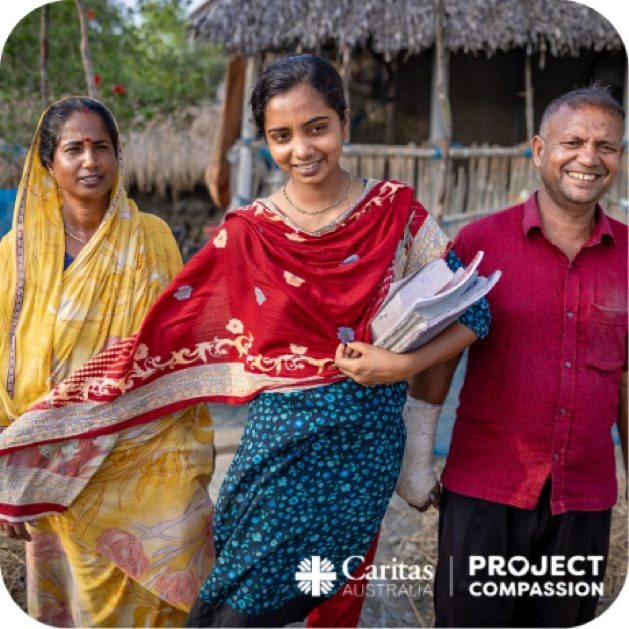
People just like Monoranjon. Monoranjon lives in a coastal village in southwest Bangladesh, one of the regions most affected by climate change. He and his family face extreme heat, cyclones and water scarcities, which often destroy his crops and threaten his livelihood. Things began to change when Monoranjon joined the Community Managed Sustainable Livelihoods and Resilience Program run by Caritas Bangladesh, with the support of Caritas Australia. Through the program, he learnt climate-resilient farming techniques including organic vegetable cultivation and livestock vaccination, meaning he is now able to grow salt-tolerant vegetables and raise livestock.
Today, Monoranjon’s income has improved, allowing him to send his children to school and protect their futures from poverty. He also now teaches others in his village, inspiring further change and opportunity across the community.
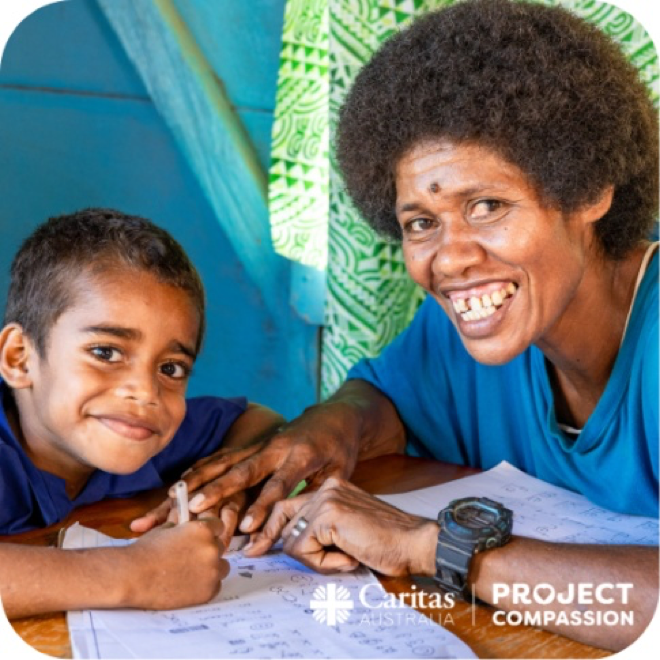
Manaini is a mother of six and a grandmother of two living in rural Fiji. Life has always been a struggle -
“The thing I worry about the most is my children’s education. The requirements that need to be met are hard for me to try and achieve with my daily income.”
Thanks to the generosity of schools like ours, Manaini joined training offered by Caritas Australia’s local partner, FRIEND. Through the program, she learnt food processing skills to transform leftovers from crops into flour, improving her family’s nutrition and increasing her weekly income to support her children’s education.
“The project totally changed the life of my family and even the community”
Watch Manaini’s story HERE to see how the actions of our school community today can create a lasting legacy of impact and change that will be felt for generations to come.
Where is she now? Sr Faye Kenny CSB
"I was born in Randwick, and as my mother was an ex-student for the Brigidines, she took me as a baby to the convent to visit the nuns. Mother Phillipa, as was her custom, took us into the Chapel and put me on Our Lady’s Altar, consecrating me to her, so my connection to the Brigidines began very early in my life. One day, when I was 5, my mother, knowing my love of animals, asked me would I like a baby brother or a horse. I was excited about the baby brother, but when he was brought home, and cried like most babies, I asked my mother to send him back and get me the horse. By then we had moved to Cronulla where my father had bought a pharmacy, and I had begun school at the Convent of Mercy. I spent my high school years as a boarder at Brigidine Randwick, and have the happiest of memories of that time and of the friends I made there. On leaving school I worked for my father, and then in 1953 I entered the Novitiate at Randwick to begin my three years of training as a Brigidine.
In 1956 I joined Mother Camillus (Carmel) to open St Margaret Mary’s School at Randwick North. We began with 11 pupils each with desks borrowed from the Brothers’ school and very little else. I have many amusing memories of Mother Camillus who was what we might call, "quite a character” (she referred to me as “Staff”). The school numbers grew rapidly and soon two lovely young teachers, Robyn Davey and Anne Cordingly joined us. We travelled to school each morning by taxi, and one of our drivers was Clive Churchill, the famous Souths player.
In 1965 I was appointed to Lindfield as Bursar and taught Year 2. My duties included seeing the children safely across the Pacific Highway in the afternoons. With no marked crossing I had to act as traffic warden when the policemen didn't come. They were happy years with a great staff and wonderful parent support. From Linfield I moved to Maroubra, where I enjoyed being involved in the Sacramental and swimming programs. Pam Purdon and I had the satisfaction of teaching numerous children to lose their fear of the water and to swim confidently.
After three years at Scarborough and another three at Lindfield, I was offered the chance to be part of an exchange programme with the Irish Province. I leapt at the chance, and soon found myself teaching at the primary school in Windsor, UK. The nuns and staff were most welcoming to the newcomer and patiently showed me the ropes. I soon felt very much at home there and made good friends I still keep in touch with. During those years I was able to travel in the holidays, and visited Europe, the Holy Land and many parts of the UK and Ireland.
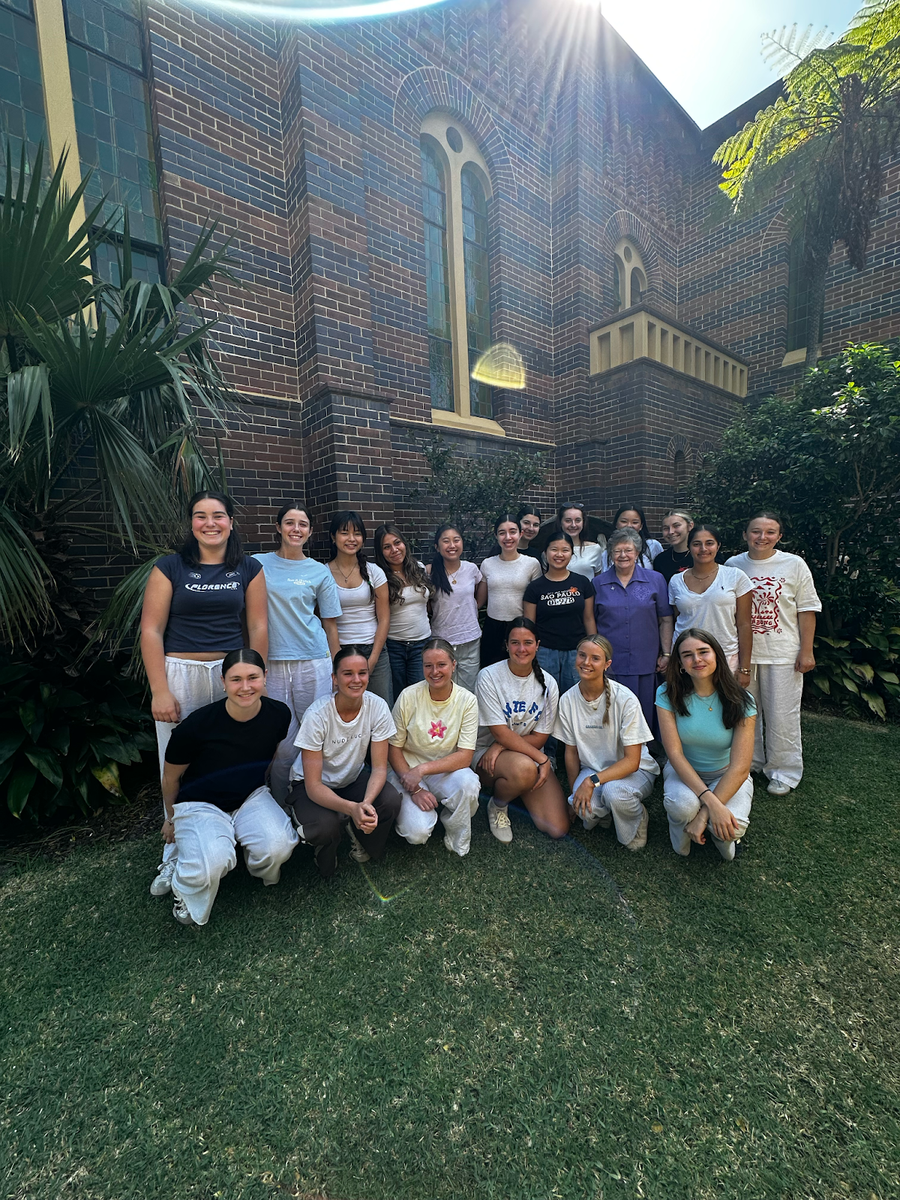
When it was time to return to Australia after six years (the original arrangement was for two), I made excuse after excuse; but eventually returned, to my brother Tony's great relief, and took up the position of Bursar at Randwick. Here Sister Pat Whitby and I joined an Ecumenical group who gave retreats to women in Western Sydney gaols and supported them when they returned to the community. Our team prayed together as we planned and worked in preparation for the retreats, and I met some truly admirable people who enriched my life. I regard that work as one of the great blessings of my life. These days I live very happily at Brigidine House, Randwick. I can really say I have had a wonderful life, and I thank God for all his blessings."
Sr Faye Kenny CSB
Brigidine Celebrates 125 Years
In 1883, six Brigidine Sisters arrived in Australia from Mountrath in Ireland, to set up a convent and school in Coonamble, at the request of the Maitland bishop who was concerned for his most distant parish. During the 1890’s, with more young Sisters and Novices arriving, the Leader, Mother John Synan, was anxious for a convent and school in Sydney, where there were more opportunities for the education of the Sisters. Finally, in August 1901, with the Loreto Sisters moving from Randwick to Kirribilli, there was an opening for a High School in Randwick. The Sisters rented a terrace house (three storeys and ten rooms - "Strathallen" at 152 Avoca St); and the school, with 8 pupils, opened two days after they took possession on 23rd September. Sisters Brigid Foley and Columbiere Kenny were the only teachers until Mother Alacoque Miller arrived in October to become the Superior and Novice Mistress. Sisters Gabriel Noone and Brendan O’Gorman arrived soon after to join the community. By November the numbers had increased to 28 students; with Religion, English, Senior Maths, Music, Painting and Drawing on the curriculum.
The Sisters were greatly attracted by the possibilities of the nearby Daintry Estate with the 1859 convict-built sandstone house called "Aeolia" on it. The house was sturdy enough for another storey and seemed ideal for the ten Sisters who were by now at "Strathallen" in very cramped conditions, and for classrooms for the High School. The house had once been a beautiful home surrounded by extensive grounds, and had been the scene of many social functions including hunting; Edwin Daintry apparently cut a dashing figure on a horse!
After many difficulties and delays, the house was acquired in 1902. Where did the money come from? The Irish Brigidines gave three hundred pounds, and Cardinal Moran gave them a modest loan, and the rest came from fundraising. At the first fete, the main attraction was a ride in a motor car, which was seen as very special since cars were not allowed in the Borough until 1902! The words of Bishop Byrne of Bathurst were certainly correct, "Mother John is a good financier." How else could she have accomplished so much?
Before the school closed at the end of 1902, Mother Alacoque invited all the pupils, about 50, to an afternoon tea in the grounds of their future school. "All were able to look through the beautifully built old stone house with its cedar doors, skirtings, staircase, marble fireplace and flagged verandahs" (Annals 1902).
On the night of 17 December, three nuns slept at Daintry so as to have everything ready for the first Mass celebrated there in the new chapel (the old Daintry kitchen, which had been "trimmed and glorified"). School opened in February 1903 with 50+ day pupils and 7 boarders.
As the school grew, buildings were added gradually to meet the needs of the growing numbers in the school and community, and boarding facilities were extended. By 1930, the buildings had taken on a U shape with a grassed area known as a quadrangle between the wings. In 1959, the old laundry (the Daintry stables) was demolished to make room for the Infants School; and in 1967, a new regional block was built where the Business College (the former Fisher's house) had stood.
By 1988, the convent had been completely refurbished as a hostel to cater for the needs of older Sisters; the school was a High School only with about 880 students; and the boarding school had been phased out.
As we celebrate 125 Years of Brigidine College, we look back with gratitude on the faith, the dedication, hard work and most of all the vision of those early Sister Pioneers, who were not afraid to take risks and to trust in Divine Providence that the enterprise would succeed! We have much to be thankful for.
Source: ‘Stone Upon Stone’ by Sister Patricia Whitby CSB
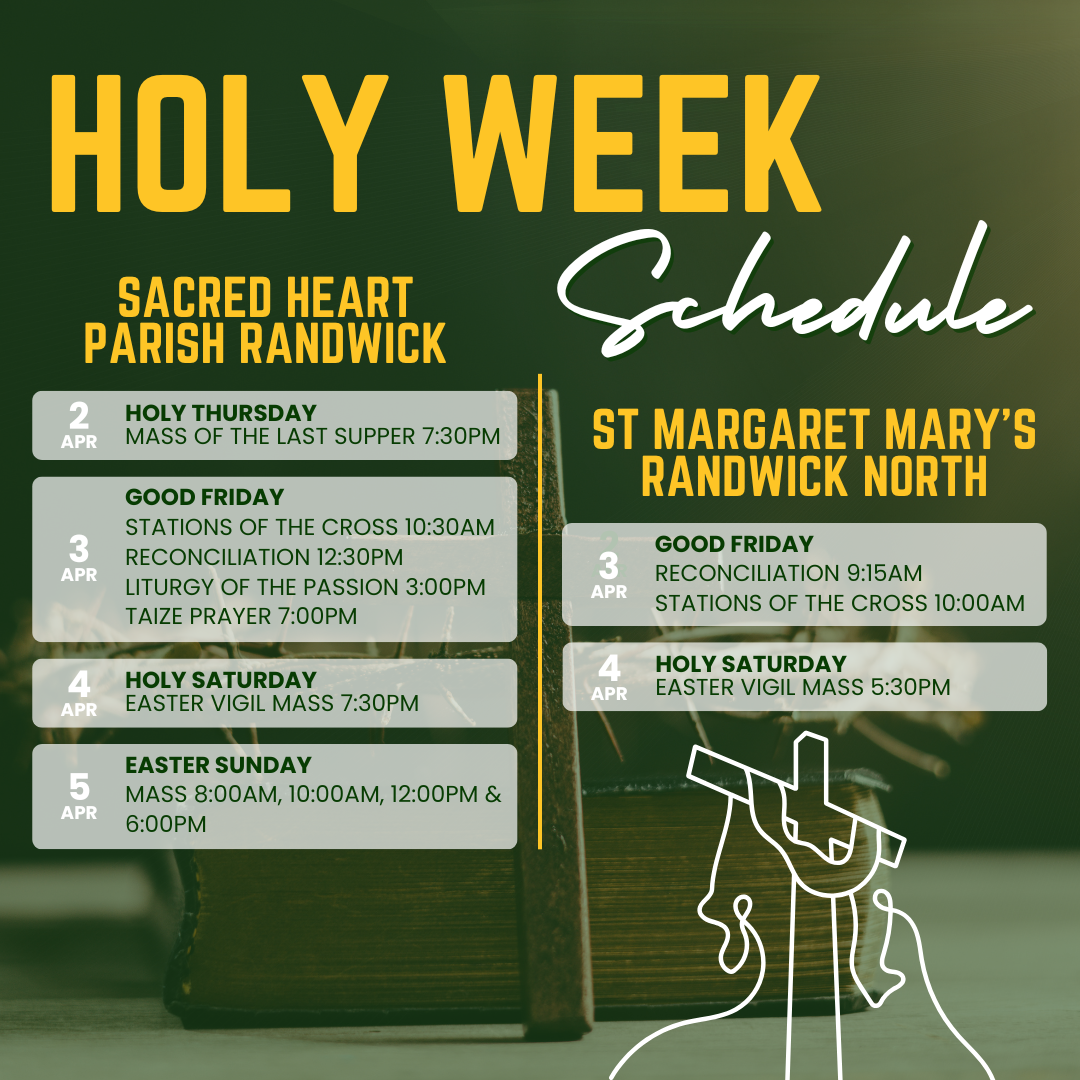
Our Lady of the Sacred Heart & St Margaret Mary's Holy Week Schedule
Monica Ribeiro
Director of Religious Education & Mission