
Teaching and Learning

Student Voice Representatives Update
I met with all the Student Voice Reps this week, and all the students were excited to get started in their roles. Our next meeting will be in Week 10 of this term. In Thursday's meeting we talked about being a voice for their class and that their role would be to ask their classmates for feedback then report it back to the next SVR meeting.
The actions for students to complete from the meeting are:
- Let all students know that we will be asking for suggestions/ ideas about naming our school houses. Suggested names should come with good reasons that are somehow related to the identity of our school.
- Give classmates a few days to think of ideas for house names then the SVR can write the suggestions down to bring back to the next SVR meeting.
- Senior Campus SVRs will be required to help out with the Grandparents' Morning Tea next Thursday 18 March. More info to come about their role in the morning tea but just a heads up that they will be required.
If you have any questions feel free to ask your SVR or you can email me for clarifiaction.
Kim
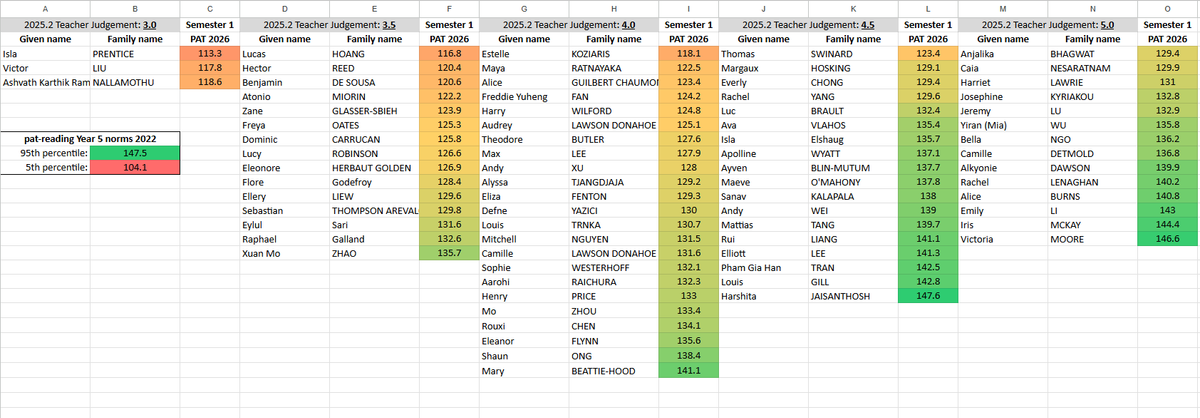
Teacher Judgement Data Walls
Please see your 2025 Teacher Judgement aligned to 2026 PAT data
Years 1 to 6 for both Reading and Maths are all available.
Teaching New Routines
At CPS we have focused on our classroom routines. Here is an excellent outline from the Foundational Classroom Management Resources Handbook - AERO 2024 which provides an excellent overview.
What?
Routines are sequences of recurring tasks or actions, for example, entering the classroom, designed and taught by the teacher and practised by students to become automatic (Lemov, 2021).
Why?
Routines give students certainty about what is expected in the classroom by providing consistency, predictability and structure (AERO, 2021).
Well-established routines enable students to independently follow them with little involvement from the teacher, reducing interruptions and increasing teaching time (Archer & Hughes, 2011).
It’s easier for students to decide how to behave when they are given clear sequences of the expected modelled behaviour (Bennett, 2020).
Explicitly teaching and modelling the expected behaviours of routines helps to free up students’ working memory to focus on learning.
To support students, a teacher should establish routines for specific tasks or times of the school day, such as entering the classroom, answering questions or transitioning between activities. Students who have learned the behaviours and routines expected of them, and had sufficient opportunities to practise to the point they become automatic, won’t have to think about these things while focused on learning (Chaffee et al., 2017; Simonsen et al., 2008).
How?
- Introduce the routine and briefly detail the expectations (why and what).
- Model and describe the routine by demonstrating the expected behaviours in small steps (I do). Provide visual supports such as schedules, photos of examples and non-examples and social stories for those requiring additional support.
- Provide an opportunity for students to practise the routine with teacher support (we do). Practise the routine until everyone can do it the best they can, acknowledging students who are getting it and supporting those who are not.
- Students complete the routine independently (you do), removing scaffolding from the teacher, as appropriate, and transferring ownership to students.
- Reinforce and maintain the routine consistently through acknowledgement, tokens, praise and practice.
Here are some expectations developed in another bilingual school:
Teaching New Routines Checklist
Routines explicitly taught in small steps
Visual supports are displayed and clear (schedules, examples/non-examples)
Students can explain the what and why of the routine
Students can complete the routine independently
Teacher monitors regularly with positive reinforcement and constructive feedback
Line Up and Entering Classroom Routine Checklist
Hear the music and line up
Walk inside together respectfully in line - active supervision
Put bag away
Lunch box away
Reader process
Bottle in tub
In classroom within 2 minutes of bell
Morning Classroom Routine Checklist
Acknowledgement of Country
Mark the roll
Visual Timetable Day and Date
Positive welcome, primer, hook, greeting
Within 5 minutes of being in the classroom
Is this similar in our school? Do we have the same consistency from class to class and year level to year level?
Janet
English DIBELS Data
Thank you to all English teachers who have started/completed uploading their DIBELS data into the 2026 DIBELS Tracker. Can you please make sure data is entered by Tuesday Week 9 so we can start analysing the data and using the planning tools at our meeting Wed Week 9. If you need any more time or support, please let me know.
Nicole
French ACADIENCE Data
Thank you to all the teams who shared some of their NCT time with me to go through the assessment. I just haven't been able to see Year 4 yet as I am not available during your NCT time so I will try and catch you some time on Monday.
It is wonderful to see everyone keen to give it a go. Please remember to read information on the Acadience PL and watch the videos linked if you are unsure of anything.
I have finished making the Acadience data Tracker. A big thanks to Simeon for his help!
You can start putting your data into the spreadsheet when you're ready. The F-2 tabs have colours and composite scores. The 3-6 ones do not have this as we need to first analyse the data and decide on our school benchmarks as this is a CPS addition.
Whatever data you have, can you please input it by Tues Week 9 as we will be looking at how to analyse the data and use planning tools to help us with next steps.
Nicole