Grade 6 News
Dear Parents and Guardians,
Upcoming Dates
- 27th April-1st May: Camberra Camp
- Thursday 7th May: Mother's Day Stall
Friday 8th May: Rowville District Cross Country (selected students only)
Friday 22nd May: Winter Round Robin Day 1
Friday 29th May: Winter Round Robin Day 2
Reminders
Icy poles will be sold on Monday and Tuesday at the Senior School during lunch.
Camp reminders
- Students are to arrive at school on Monday the 27th of April at 6.30am
Please ensure all students have a hat their snack, lunch, and water bottle for Monday.
Celebrating Learning
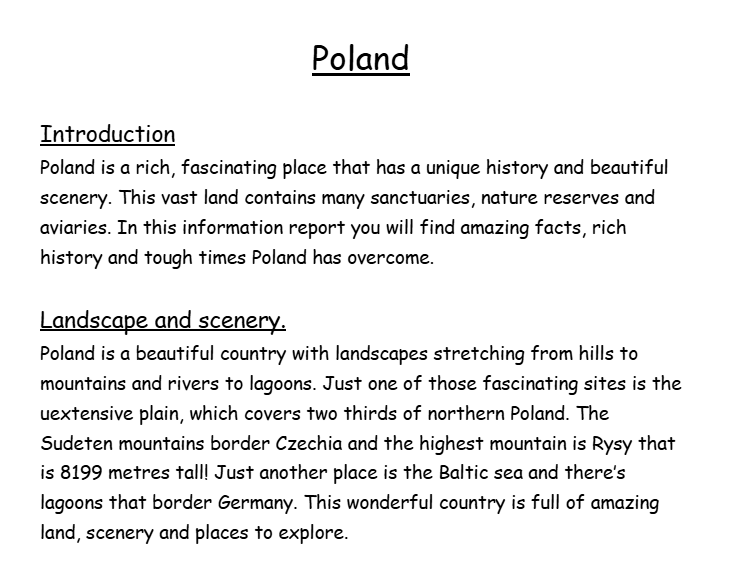
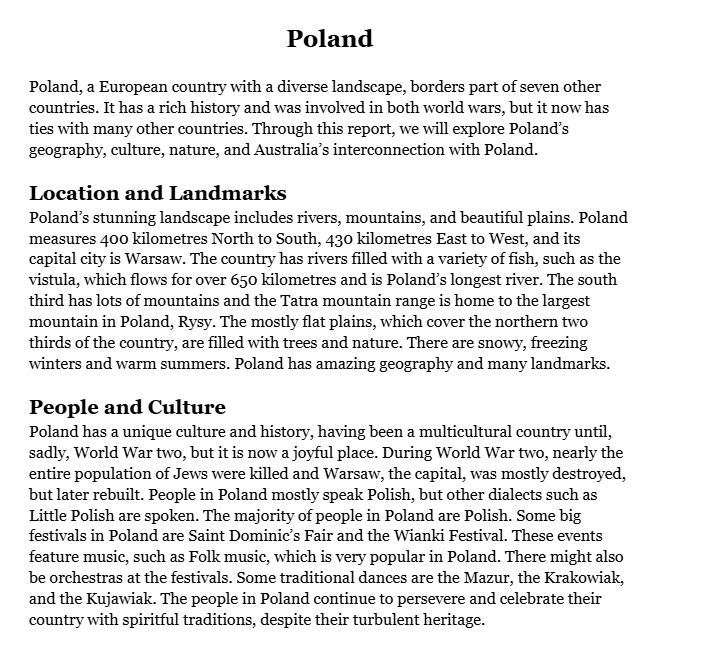
Last term, students published an information report on Poland. See below for some fantastic student work by Jesse L (6M) and Elizabeth R (6IM).
Learning in Action
Reading focus:
This term, students will be reading 'Can you see me?' By Libby Scott and Rebecca Westcott. Can You See Me? is a powerful and insightful novel that follows the story of Tally, an 11-year-old girl navigating her first year of high school while also living with autism. The book provides a unique perspective, as it is co-written with Libby Scott, a young autistic author, giving readers an authentic understanding of Tally’s thoughts, feelings, and challenges. Throughout the story, themes of friendship, belonging, and self-acceptance are explored, helping students build empathy and awareness of neurodiversity. We hope this engaging and heartfelt novel will spark thoughtful discussions in class and encourage students to reflect on the importance of kindness, inclusion, and understanding others.
Writing focus:
This term, students will be developing their writing skills at both a sentence and text level through persuasive writing. At a sentence level, they will be learning to expand and refine their ideas using strategies such as because, but, so, subordinating conjunctions, clauses, and a range of connectives. At a text level, students will learn to apply these skills to plan and write a persuasive letter about introducing a therapy dog at school, focusing on clear structure, strong arguments, and effective communication.
Maths:
This term, students will build on their understanding of fractions, including equivalent fractions and comparing fractions using number lines and common denominators. Over eight lessons, students will learn how to compare and order fractions more confidently by using strategies such as common denominators, highest common factors, and lowest common multiples. This will also prepare them for future learning about adding and subtracting fractions. Students will use hands-on resources like fraction walls, number lines, and fraction models to support their understanding. Key vocabulary for the unit includes numerator, denominator, equivalent fraction, mixed numeral, improper fraction, and integer.
After fractions, students will also look at 3D objects, decimals, probability, and patterns over the term.
Knowledge Rich: Immigration and International Interaction
This term we will be focusing on immigration in our Knowledge Rich unit. Students will explore how people and countries around the world are connected, including Australia’s neighbouring countries, major Asian countries, and countries linked to Indigenous peoples. They will compare populations and investigate key cultural, geographical, and economic features of different countries.
Students will also learn about Australia’s migration history by using maps, timelines, and census data to understand how our population has changed over time. They will interpret data, create graphs, and explore real stories of migrants and refugees to better understand their experiences. Throughout the unit, students will also examine how Australia’s national identity has been represented in different songs and time periods.
Wellbeing
This term in Wellbeing, students are focusing on help-seeking as an important skill for managing challenges and working through problems. They are learning to identify situations where it is appropriate to ask for help and to recognise a range of trusted people they can turn to, both at school and at home. A key focus is on normalising and destigmatising help-seeking, helping students understand that asking for support is a positive and responsible action. Through these lessons, students will also develop their ability to contribute effectively in groups and teams, practising how to communicate, collaborate, and support others when working together.
Kind regards,
The Grade 6 Team
Melissa Adams, Caillin Ibbotson, Craig McKenzie, Lisa Dealy & Chloe McElroy