Wellbeing

Wellbeing Leader - Mr Nick Flavel
PBL at St Bernards
Shine Bright, Do What’s Right!
As mentioned in the last newsletter, we are excited to introduce a new behaviour acknowledgement system at St Bernards. It has been thoughtfully designed based on valuable feedback from our students, parents, and staff, ensuring it reflects the needs and values of our whole school community. Students have been busy earning ‘gotchas’ over the past fortnight in recognition of following our school values - Respect, Safety and Responsibility. These tokens can then be exchanged for a variety of rewards which have been voted on by our SRC who have consulted with their classmates for input (see poster below).
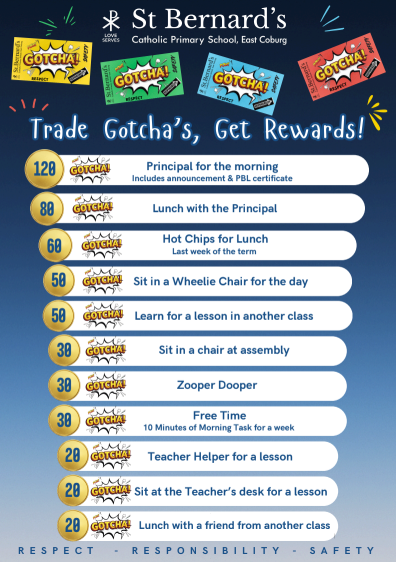
In addition, tokens earned will also contribute to students’ house teams which will be tallied at the end of this term to further reward certain students.
There’s a lot of research around the use of acknowledgements or rewards. Dr Shiralee Poed is a Senior Lecturer at the Melbourne Graduate School of Education within the University of Melbourne. All staff watched a video at our recent PBL school closure day on her research about the misconceptions around bribing children vs rewards. She states:
“Bribes are an enticement that you give someone to do something illegal, they are enticing you to do something that is wrong. This is completely different to a reward, which is given after the event for doing something right. They are a way of providing feedback to the student to say you are on the right track. We want to say that is the behaviour or the learning that we want from you and here is an acknowledgment that this is good work. Every time a kid writes a paragraph, we give them feedback and might put a star on it. We might write a piece of advice to them about that piece of work that is sandwiched with good things in between the things that aren't so positive. So we'll always say things like, I really like the way you capitalise the first letter of every sentence. You could work more on… but it was great that you did this, etc. PBL has that embedded for behaviour as well. And we treat behaviour in exactly the same way that we treat any other learning. So we look for ways to tell kids that behaviour you're doing right now is going to help you be successful in class. It's going to give you the most time to learn. So it's a really critical component of PBL. It's about helping kids shape what they're meant to do.”
What kids tell us more than ever about what they want is attention. Most kids want attention in the form of time with an adult. They want to be noticed. They want just the acknowledgment alone, the feedback alone most kids tell us is enough.
The effect size of giving feedback is in the top ten practises that teachers can do. So it’s important to acknowledge kids and give them feedback. It’s important to create climates of appreciation. That's what PBL communities are striving towards, is having this climate of appreciation where kids know what's expected, teachers know what's expected and they deliver on those things.