
Maths Matters
with Mrs Trend

Maths Matters
with Mrs Trend
Last night’s Information Night had a bit of a buzz about it — and for good reason. Thank you to the families who were able to come along and hear about our Maths glow up. Your partnership matters more than you know. When school and home are on the same page, our students absolutely thrive.
Over the next few newsletters, I’ll be unpacking our new-look instructional model in more detail — what it means, what it looks like in classrooms from Foundation to Year 6, and how you can support your child at home (without turning dinner into a maths test!).
At Ringwood North Primary School, Numeracy is taught through a structured, evidence-informed approach that aligns directly with the Victorian Curriculum 2.0.
Teachers use the curriculum to carefully map out the essential skills and knowledge students need across the year. This ensures a logical progression of concepts from Foundation right through to Year 6. Learning is consistent, intentional and developmentally appropriate — and importantly, key ideas are revisited and strengthened over time rather than taught once and left behind.
In simple terms: we know exactly what we’re teaching, why we’re teaching it, and how it builds from year to year.
An instructional model is the structure teachers use to design and deliver lessons. Think of it as the “game plan” for learning. It outlines the sequence of a lesson — how new content is introduced, practised, checked for understanding and applied independently.
Rather than leaving learning to chance, an instructional model ensures every lesson follows a clear, predictable structure that supports all learners.
So, without further ado, I present to you the new RNPS Mathematics Instructional Model:
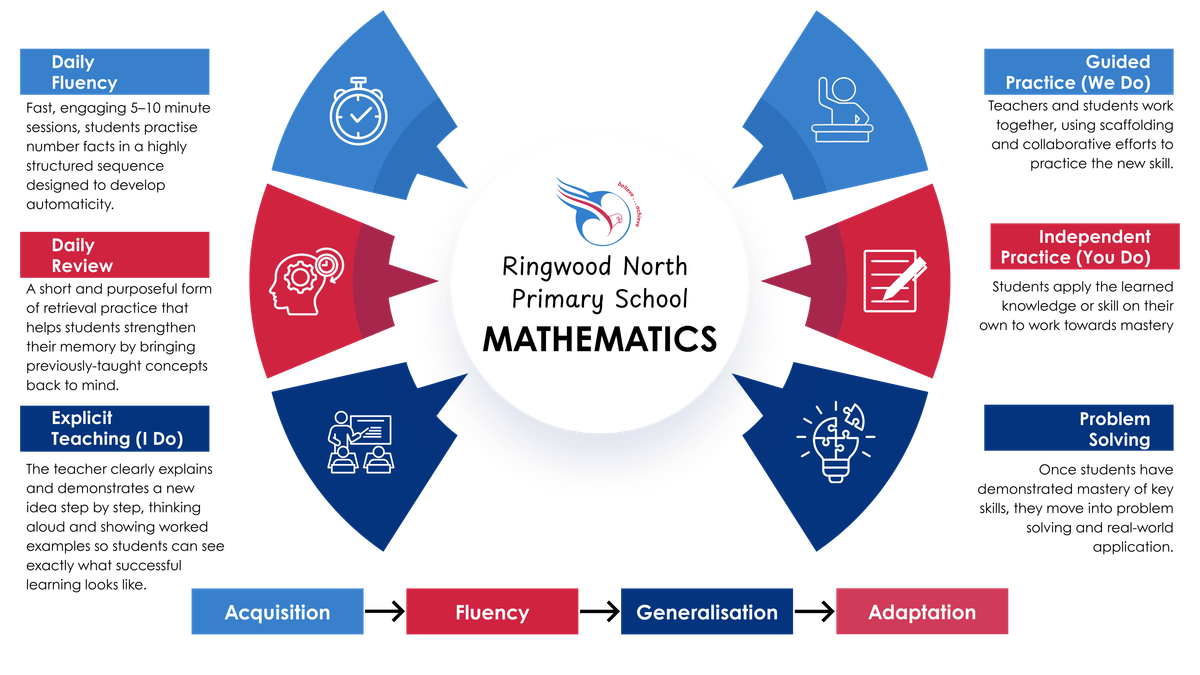
Our new instructional model is designed to:
Embed Daily Fluency practice, using programs such as Facts on Fire, so students develop automatic recall of essential number facts
Include Daily Review (retrieval practice) to strengthen memory pathways and ensure previously taught concepts are retained over time
Break new concepts into carefully sequenced, manageable steps to reduce cognitive overload
Provide structured guided practice before independent work, so students are well-supported before being asked to apply learning on their own
Use regular checks for understanding to adjust instruction in real time
Follow the Instructional Hierarchy (acquisition → fluency → generalisation → adaptation), ensuring students build accuracy first before moving to speed, flexibility and application (we’ll unpack this more in a future newsletter)
Ensure all students experience success while still being challenged
This consistency across classrooms helps students feel confident and secure. They know what to expect. They know what they’re working towards. And they get plenty of supported practice before being asked to do it on their own.
It’s structured. It’s explicit. It’s responsive.
We’re excited about this next chapter and grateful to have you on the journey with us.
Chantelle Trend
School Improvement Leader / Numeracy Learning Specialist