
Parent Partnerships
Don’t Burn the Chicken
ISSUE 4| TERM 2 | 2026
By Dr Justin Coulson
Hands up who wants their kids to fulfil their potential?
If you’re not putting up your hand, there’s a good chance someone might call Social Services or Child Protection. We’re all supposed to want to see our kids succeed, do their best, and fulfil their potential, right?
I have a provocation: research shows that the parents who get the best long-term outcomes from their kids are often the ones who learn to push a little less. This doesn’t mean they don’t care. Nor does it mean they have zero expectations.
There’s a central element that makes this work – and that variable is trust.
This is counterintuitive. But stay with me for a moment.
A friend recently shared an image that showed two roast chickens. One cooked at 900°F (480°C)for an hour – black, shrivelled, ruined. The other cooked at 300°F (150°C) for three hours – golden, perfect, exactly what a good meal should look like. (Although I’d think two hours would probably be enough.)
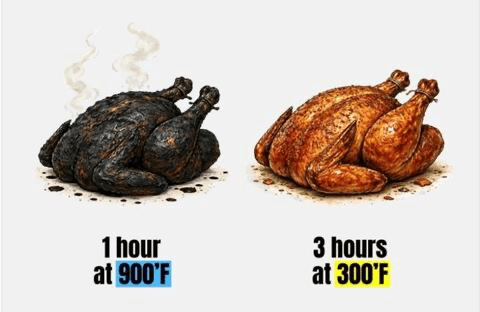
Same bird. Entirely different outcome. The only thing different was the temperature.
It’s a confronting metaphor for parenting because, if we’re honest, many of us are running our households – and our children – pretty hot.
There’s so much anxiety about whether they’re keeping up, falling behind, measuring up. I speak to parents daily, all convinced that if they push hard enough, early enough – and if they just ‘raise the bar’ – they’ll get better results in their children’s lives. They’ll make their lives ‘better’.
But what if we’re not accelerating our children’s development at all? What if we’re just burning them out?
Researcher Renee Landry conducted a series of four studies showing that if we just ‘trust’ that our kids are designed to develop healthily – and they actually want to develop healthily, we’ll be less controlling and less likely to ‘cook’ the kids. Instead we’ll be more relaxed, they’ll be more relaxed, and -according to the data – they will learn more deeply, persist longer in the face of difficulty, and develop the kind of intrinsic motivation that sustains them well beyond any single result or report card.
The mechanism is straightforward. When children sense that the adults around them genuinely trust in their capacity to grow – not just perform – they internalise that belief. They begin to trust themselves. And children who trust themselves take risks, attempt hard things, recover from failure, and keep going. They’re resilient.
Children who feel constantly evaluated do something different. They learn to protect themselves. They play it safe, avoid challenge, and optimise for approval rather than genuine learning. Carol Dweck’s research on mindset captures this precisely: pressure tied to performance teaches children to manage their image rather than develop their ability. Over time, we don’t produce stronger learners. We produce kids who either perform for the audience or stop showing up entirely.
High heat. Burned chicken.
I’m not arguing for low expectations. Trusting your child’s development is not the same as being indifferent to it. The research is clear that warm, high-expectation environments – where children are genuinely believed in, appropriately challenged, and supported rather than drilled – produce stronger outcomes than pressure-driven ones. You can want remarkable things for your child and still turn down the heat. In fact, the evidence suggests that to get those remarkable things, you probably have to.
So what does low-and-slow look like on a Tuesday afternoon?
It looks like an unhurried conversation after school that isn’t about homework or results. It looks like letting your child struggle with something for a few minutes before you jump in because you believe they can find their way through. It looks like protecting some unstructured time in the week, not as a reward for productivity but as a condition for it. It looks like saying, more often than feels natural, I’m not worried about you. I think you’ve got this.
Children are exquisitely sensitive to what we actually believe about them. When we hover, intervene, and push, the unspoken message – however loving the intention – is: I’m not sure you can do this without me. When we step back with confidence, the message changes. And so does the child.
The best meals take time. You cannot rush them without ruining them. Turn down the heat. Trust the process.
The outcome will be magnificent.
Hat tip to Adam Voigt, whose image and insight in his Real Schools newsletter sparked this piece.
