
From the Assistant Principal

What's the Big Idea?
Quick. What’s 7 × 9?
What’s 8 × 7… 11 × 11… 9 × 6?
If you were able to quickly recall these number facts, you might also remember how it felt learning them. For some, it was a point of pride. For others… a source of pressure. (For the record, 8 × 9 still makes me hesitate!)
Speed used to be the name of the game. I often tell students about the time, back in Grade 5, when I challenged the class times tables champion to a best-of-three showdown - and won, I might add, before being unceremoniously dumped from the leaderboard the following week with a woeful display of mathematical fluency.
But while quick recall still has its place, our understanding of how children learn mathematics has grown significantly since then.
These days, our focus is on helping students understand the big ideas in Mathematics - concepts that underpin everything they do.
In the early years (Foundation), students develop number sense, learning to trust the count and make sense of quantity. In Years 1 and 2, the focus shifts to place value and additive thinking - understanding how numbers are built and how they can be combined and separated.
By Years 3 and 4, students explore multiplicative thinking, which goes far beyond memorising times tables and into recognising patterns, groups, and relationships. In Years 5 and 6, the emphasis moves to fractional thinking, where students learn to work flexibly with parts, proportions, and more complex number relationships.
Across all year levels, we support students to move from concrete to abstract. This means starting with hands-on materials and visual models, then gradually building towards mental strategies and symbolic understanding. It’s not just about getting the right answer - it’s about knowing why it works.
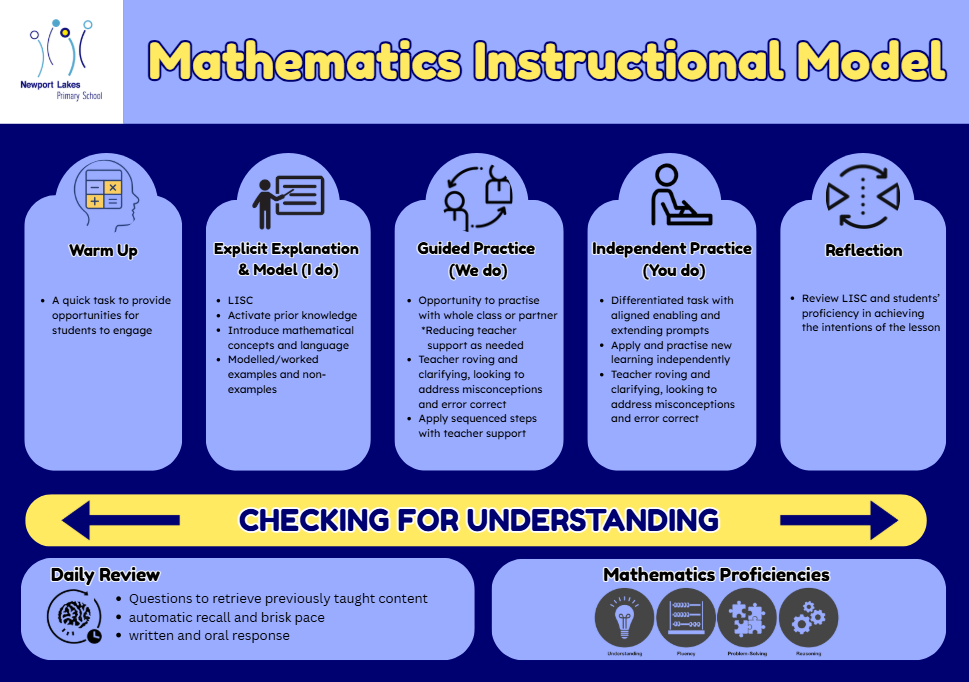
So what does this actually look like in the classroom? Our Instructional Model - the way teachers structure their lessons - follows a clear sequence: warm-up, explicit teaching and modelling (I do), guided practice (we do), independent practice (you do), and reflection. At every stage, teachers are checking for understanding and adjusting their teaching in response to student needs. This allows us to be responsive - adapting in the moment rather than pushing ahead when students aren’t ready.
But learning doesn’t stop once students leave the classroom - so where do families fit into this?
One of the most powerful things you can do at home is talk about maths in everyday life (with a smile and a positive attitude!). Cooking, shopping, sharing food, and telling the time are all rich opportunities to build mathematical thinking. Encouraging your child to explain their thinking (even if they don’t get it quite right) helps build both confidence and understanding.
And yes - knowing number facts still matters. But rather than racing the clock, we aim to build fluency through understanding, practice, and connection.
Because in today’s maths classroom, it’s not just about how fast you can answer… it’s about how well you understand the big idea.
Mat Williamson
Assistant Principal