
Numeracy Update
Linking Home and School in Maths
Dr Ange Rogers wrote this and I loved it, so I'm sharing it:
For most parents the only experience they have with Primary Schools maths is when they attended school 20+ years ago. I can attest to the fact that maths teaching has changed a great deal since ‘back then’. Many of us want to help our children, but we have no idea how maths is being taught- there are new words, strategies and materials being used. It was not until I had other parents messaging me saying “what does [insert some maths term] mean?” I realised the disconnect between schools and home in maths.
We all want the best for our children and whether you are a librarian, social media influencer, fashion designer, plumber or an aeronautical engineer, everyone uses maths every day- we know it is important!
In this blog I wanted to share some hacks and advice that I have refined over the years to help my children develop confidence and a genuine interest in maths.
My first piece of advice is to leave the teaching to the schools. As I mentioned, things have changed, so to avoid confusion it is best to work on fluency at home.
In Literacy, the purpose of the nightly ‘home reader’ is to work on reading fluency. The books are not meant to be difficult. This is the same in maths. But the beauty of maths fluency practice is you can do it ‘on the run’!
I work on Maths fluency in the car. Firstly, our passengers are literally a captive audience, and for the most part they have not much else to do in the car, so generally they are quite happy to be involved!
I run ‘Car Quizzes’. I am the ‘Quizmaster’ and I ask them 3-5 rapid fire questions as I drive. It takes a total of about 2 minutes and then they get to ask me questions (which is secretly getting them to do more maths!)
Below is an example of questions I have asked my children as they have moved through the different Year levels.
Foundation: One More or One Less (numbers 1-10)
For example: “What is one more than 3?” or “What is one less than 6?”
Year 1: Doubles (numbers 1- 10)
For example, “What is double 3?” (This is important for learning the 2x multiplication facts in Year 2)
Year 2: Double, Double (numbers 1-10)
For example, “What is double, double 2? (This means double 2 is 4, and then double 4 is 8- this is important for learning 4x multiplication facts in Year 3)
Year 3: Halving (numbers to 100)
For example, “What is half of 8?” or “What is half of 60?”. This is important for learning the 5x multiplication facts in Year 3)
Year 4: Multiplication Facts
For example, “What are 3 fours?” (This means what are 3 rows of 4. By the end of Year 4 the Australian Curriculum Version 9.0 standard requires students to be fluent with all multiplication facts up to 10x 10)
Year 5: Factors
For example, “What are the factors of 12?” (This means what are the numbers that multiply together to make 12. The answer is 1,12,6,2,3,4.)
Year 6: Simple Percentage Discounts
For example, “What is 10% off $50” (10% of $50 is $5, so $50 take $5 is $45)
The key is the questions need to be easy! We are wanting to build confidence and enjoyment of Maths. Coming up with content for the car quiz is as simple as asking your child what they are learning at school, and then including that in the car quiz.
My final piece of advice is to play board and card games as often as you can with your children. Once a fortnight we schedule a family ‘games night’. We play Uno or Cluedo or Trouble or Checkers or Spoons or anything together as a family. Maths is involved in every single game, and some of my favourite memories have been on these games nights.
I hope that this has given you some simple ways to help support your child on their maths journey.
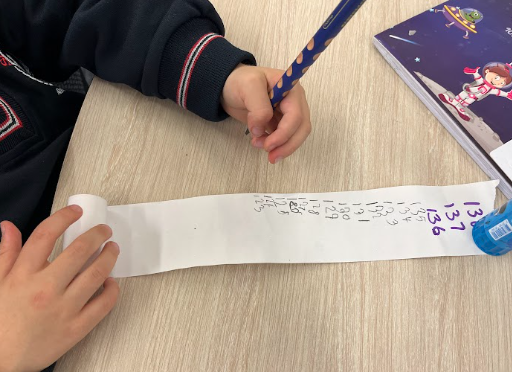
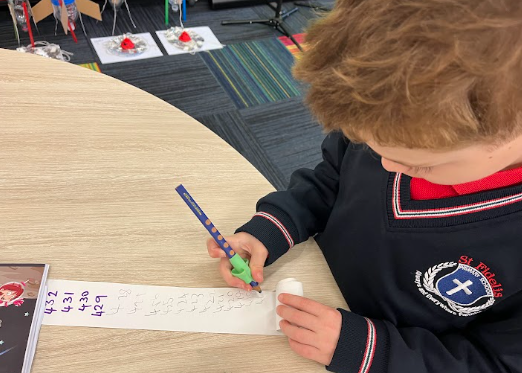
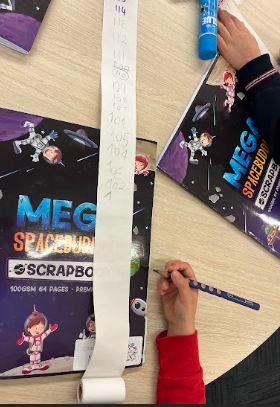
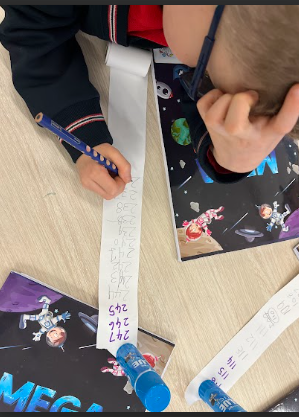
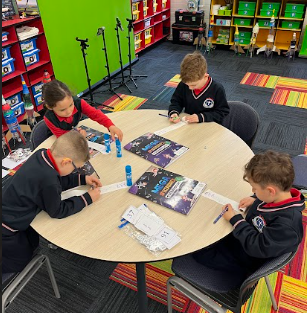
Our Foundation students have been working hard on counting backwards from a range of numbers. They have also been learning to order two-digit numbers and identify and record the tens and ones in each number. The students showed great enthusiasm and persistence while completing their tasks, and we are very proud of their efforts and achievements.
Learning our Times Tables
I worked with some of the Year 3 students on developing their times table knowledge and recall. We explored strategies to help them learn the 4 times tables, focusing on the “double and double” strategy. For example, if students know their 2 times tables, they can simply double the answer to find the 4 times table fact. Regular practice at home will help build their fluency and confidence with recalling these facts.
We also worked on the 3 times tables using the “double and one more group” strategy.
When students know a 2 times table fact, they can add one more group of the same number to find the answer. For example, for 3 × 6, students can think: double 6 is 12, then add another 6 to make 18. This strategy helps students make connections between multiplication facts and develop efficient mental calculation skills.
Dates to remember - Week 8 APSMO 2nd Olympiad test
Colleen Monaghan | Numeracy Leader