Term 1 Learning Summary

English
During the term, Year 5 students will be introduced to a new approach to the teaching and learning of English, following the introduction of the Ochre English program across the senior school. The program is aligned with the Victorian Curriculum 2.0 at Level 5 and incorporates teaching elements informed by the Science of Learning. Learning experiences including explicit instruction, frequent feedback, and spaced practice, to ensure all students are supported to make consistent progress in English.
In Reading, students will engage in a rich novel study of War Horse. Through guided reading and discussion, they will develop their ability to comprehend texts, identify key themes, and explore character development. Students will practise making predictions, inferring, and responding thoughtfully to the text, building deeper understanding and enjoyment of rich reading.
In Writing, students will strengthen their skills across grammar, literature, and literacy, while also developing handwriting and typing skills. Lessons will focus on sentence structure, punctuation, and vocabulary, as well as how authors use language techniques to engage readers. Students will practise fluent, Victorian-Cursive handwriting and build confidence in typing accurately and efficiently, applying these skills to a range of writing tasks in the upcoming NAPLAN test as well.
In Speaking and Listening, students will participate in reading aloud, group discussions, and oral presentations to build confidence and fluency. They will be encouraged through opportunities where they explain their thinking, respond to others’ ideas, and articulate their opinions clearly and respectfully.
Key vocabulary to support learning areas
English |
Character Theme Inference Prediction Perspective Evidence Sentence Paragraph Punctuation Morphology grammar Structure Author Narrator Descriptive Imagery Figurative language |
To support your child’s learning at home, you could:
Encourage regular reading and talk about the book, characters, and key events.
Support writing development by encouraging your child to keep a journal, write short stories, or respond to books they are reading, with a focus on clear sentences, correct punctuation, and neat handwriting.
Practise typing by letting your child type up texts on a computer.
Encourage your child to read each night, both aloud and to themselves.
Ask your child what they have learnt about their spelling words from their spelling inquiry during the week.
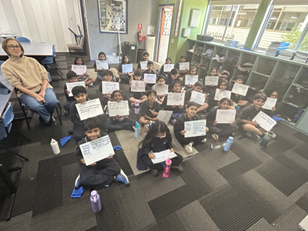
5B
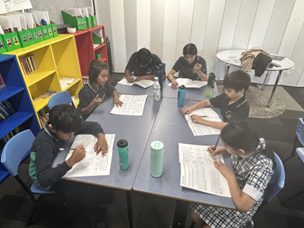
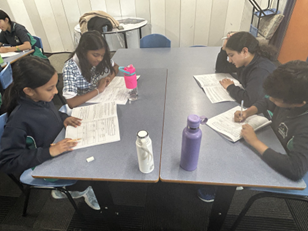
5E
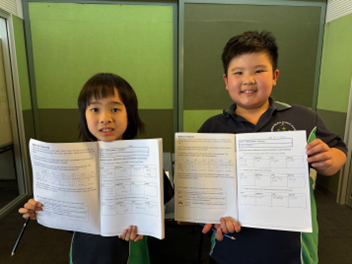
Mathematics
This year our school is continuing the implementation of our whole school approach to teaching and learning Mathematics with explicit teaching and Science of Learning at its core. The Maths lesson will predominantly be an interactive whole class instruction following the I do/We do/You do instructional cycle. Students will be taught skills and concepts explicitly and will receive immediate feedback from their teacher. The topics (with their objectives) that will be covered in Term One are as follows:
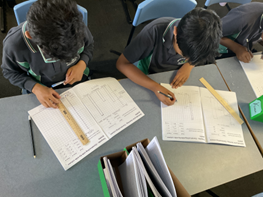
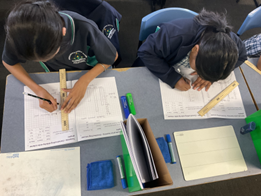
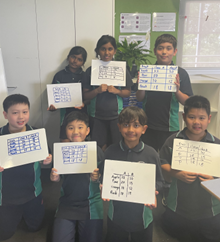
Data Representation: Data can be represented in different ways to help enhance meaning.
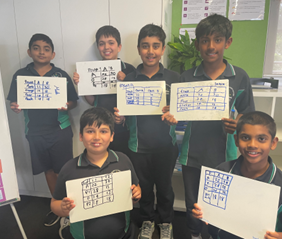
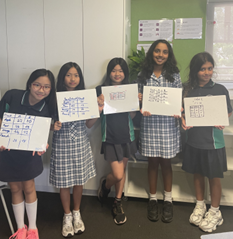
Prime, composite, square and triangular numbers: Properties of numbers can be used to identify and group them.
Operations (Part 1): Different mathematical situations require different methods to solve them.
Time: Time is used to quantify, measure, or compare the duration of events or the intervals between them.
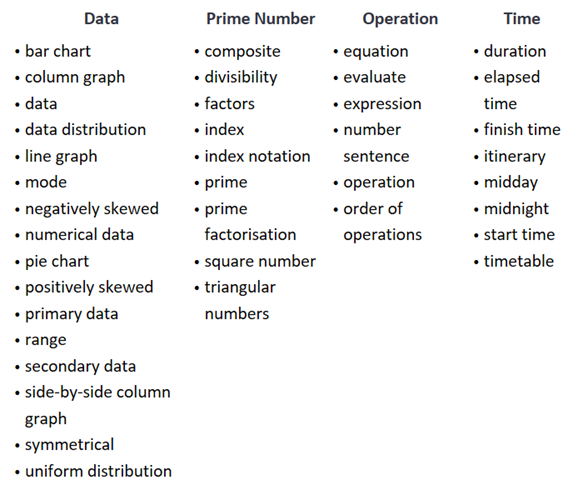
Key Vocabulary:
To support your child’s learning at home, you could:
Practise telling time using both digital and analogue clock.
Practise working out time duration, such as, how long till… and how long did … took.
Encourage your child to explain their thinking and reasoning behind their calculations.
Discuss the meaning and example of key vocabulary
5A
5F
Inquiry
Question: “What might history teach us about building resilient communities?”
Global Goal: Reduce Inequalities
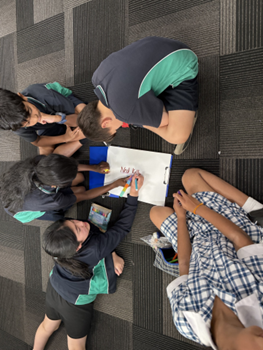
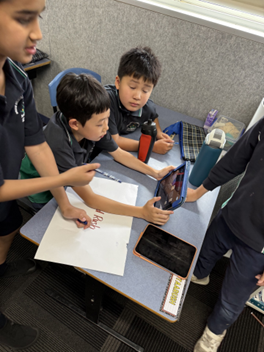
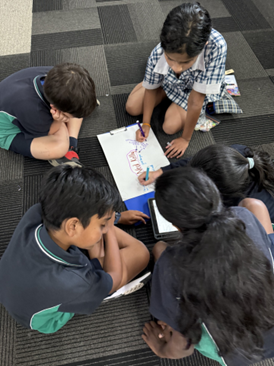
In Term One Inquiry, our learners will be exploring the question “What might history teach us about building resilient communities?” Students will build their understanding of Australian history through the perspectives of multiple people and cultures, particularly those formed in the era of the Gold Rush. They will compare experiences of groups and individuals who lived through a very different time in our history, considering the roles that police, bushrangers, migrants and Indigenous Australians played in forming communities, and comparing that to what we experience today and working towards our global goal of ‘reduced inequalities.’
Students will have the opportunity to go deeper into their learning and immerse themselves in the historical town of Beechworth on our camp at the Old Priory. The Beechworth camp allows learners to make connections between their classroom research and the areas in which many of the events occurred. Students will have the chance to engage with the story of Ned Kelly and developed a nuanced view of his place in the lore of Australia.
Key Vocabulary:
Resilience
Community
Inequality
Gold Rush
Eureka Stockade
Uprising
Beechworth
Immigration
Migrants
History
Indigenous
Bushranger
To support your child’s learning at home, you could:
Have an open conversation about Australia’s history and the different perspectives of all who have inhabited it.
Do some research and discovery together on the location, features and history of Beechworth.
Explore the history of your family tree together to identify when your family immigrated to Australia, what the circumstances were and what issues may have been faced for migrants in that era of Australia’s history.
5C
5D
Wellbeing
The Resilience Project and CyberSafety
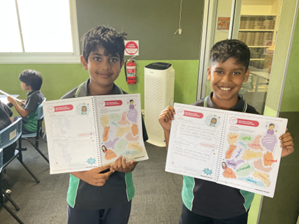
The Resilience Project is an exciting initiative at Glen Waverley Primary School which was introduced in 2024 to support student wellbeing. Our school philosophy states that students are at the centre of everything we do and that everything we do is based on research and a whole school approach. To complement our ongoing commitment to student, staff, and community wellbeing we have the privilege of participating in The Resilience Project’s Education Program, an evidence-based program with proven benefits to the positive mental health of our school community.
The Resilience Project has successfully delivered wellbeing programs to over 1,500 schools and early learning centres across Australia, and we are grateful to be a part of this initiative. It is committed to teaching positive mental health strategies to prevent mental ill-health and build young people’s capacity to deal with adversity. Teachers and students will engage in weekly lessons and activities around the key principles of Gratitude, Empathy, Mindfulness (GEM), and Emotional Literacy to build resilience.
Working on gratitude helps us to be thankful and appreciate what we have in our lives, rather than focusing on what we do not have or what we want. Working on empathy helps us to identify, understand, and feel what another person is feeling. Working on mindfulness gives us opportunities to develop our ability to pay attention to the present moment and our thoughts. One of the standout features of The Resilience Project’s approach is the emphasis on Emotional Literacy as a foundational skill. By honing emotional literacy, individuals gain the ability to navigate and understand their emotions, providing a solid foundation for the effective practice of gratitude, empathy, and mindfulness.
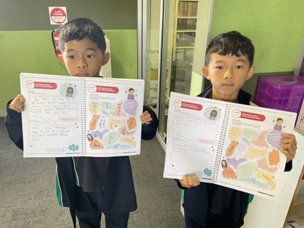
This year we will embed The Resilience Project into our school’s daily practice through GEM chats. These consist of 2–5-minute activities that students can do individually or as a whole group, at different points throughout the day. They are a great way to get students thinking about GEM outside of the set lesson time and, importantly, regularly practise the strategies to improve their mental health. Students will use their journals weekly to reflect on their learnings of the GEM principles.
You can explore The Resilience Project at Home Hub here.
CyberSafety will also be explicitly taught as part of our wellbeing and learning programs. Students will develop an understanding of how to be safe, respectful, and responsible when using digital technologies. Learning will focus on positive online behaviours, understanding digital footprints, and recognising when and how to seek support. This learning complements The Resilience Project by supporting students to make thoughtful, informed choices both offline and online.
We encourage all families to discuss the GEM principles and CyberSafety messages at home throughout the year as these initiatives become a major part of our whole-school approach to wellbeing.
Key vocabulary:
Wellbeing |
Gratitude Empathy Mindfulness Resilience Mental Health Emotional Literacy Habits Self-Esteem Goal Setting |
5A
5B