
Student Wellbeing
SAFER INTERNET DAY - Tuesday 10th Feb.
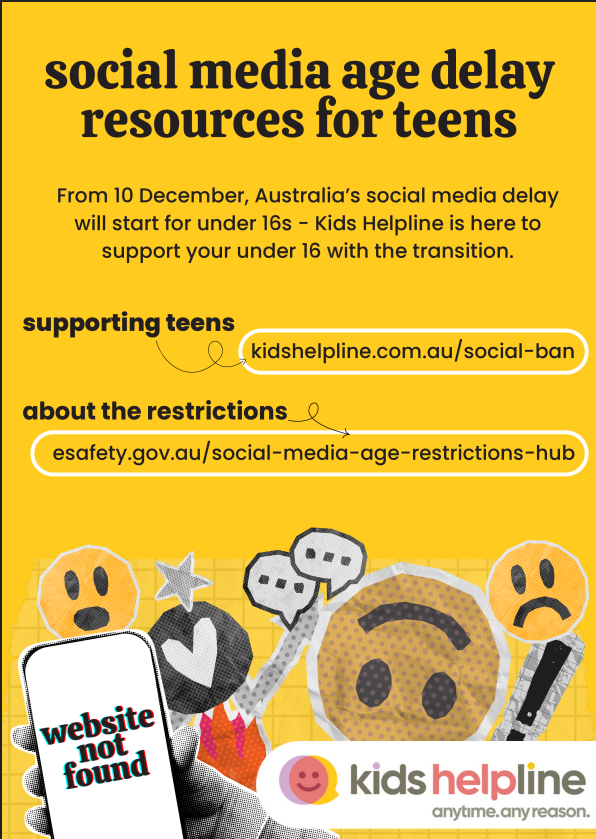
This Tuesday, all classes at St Joseph's School will explore various age-appropriate resources to start the year strongly with a focus on online safety. This is the day to get people talking about how we can make online spaces safer and more positive for everyone. Safer Internet Day is a global day of action bringing communities, schools, organisations and families from 180 countries together to raise awareness of online safety issues and work towards a safer internet. eSafety leads the day in Australia.
With the Social Media Ban newly in place, I felt it could be useful to take a look at a recent Parentline article that aims to offer support to parents navigating these new laws with their children.
Under 16s social media ban: a guide for parents
The government passed a new law called the Online Safety Amendment (Social Media Minimum Age) Bill 2024. It’s hoped that delaying the age teens can access social media to 16 years of age will help protect them from some of the known harms of social media.
This article explains what social media can mean for young people - the good and the tricky - and how you can talk with your child about it.
Now...Why has the law changed?
Our society has minimum age limits on things to protect young people.
This includes being 15 to get a job (in most states and territories), being 16 to get a driving learner’s permit, and being 18 to drink alcohol.
Throughout recent history, technology has often advanced faster than science and laws can keep up. Science sometimes shows something can be harmful years or decades after people have been doing it (e.g. asbestos, or smoking cigarettes). Laws are normally introduced after people are harmed by something, like when Australia’s gun laws changed after the Port Arthur incident. Social media is an example of technology moving quickly, with science and laws struggling to keep up with the pace of change. After all, Facebook only opened to the general public in 2006 (and it’s changed a lot since then!)
Watch this youtube video to gain a further understanding of the reasons for this change.
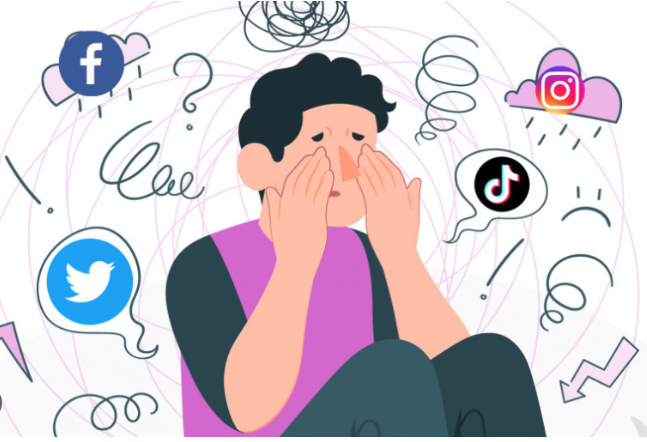
Social media and the teen brain
Have you ever thought to yourself, “I’m glad social media wasn’t around when I was a teen?”
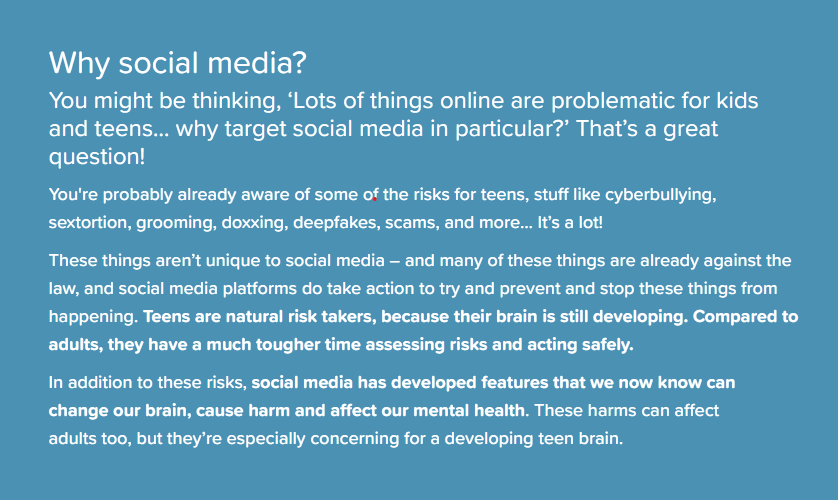
Social media does have some good aspects to it of course, but let’s explore how the latest features may hijack a teen brain and make them feel bad.
Introducing the endless scroll
Do you remember the days when you’d see everything in order – and if you scrolled, you’d eventually reach ‘the end’ of the timeline? Now, you can scroll and scroll and scroll and you’ll never reach the end.
For each piece of content we see, our brain releases a feel-good neurotransmitter (brain chemical messenger) called dopamine. Short form content, like reels, release a lot of dopamine. The ‘endless scroll’ changes how our brain processes dopamine, because there’s never an ‘end point’. And dopamine loves an end point. It’s released in anticipation of a reward (‘oh, let’s see what’s happening on insta right now’), and also once we’re done (‘I’ve reached the end of the feed. Yay. Time to put away my phone and do something else.’).
Our brain gets used to being flooded with dopamine. We need more and more of it to feel good, which is one thing that can make social media so addictive. That’s why people might feel like they’re going through ‘withdrawal’ if they delete their socials, or become distressed if they lose their phone. Check out our article on supporting your teen through the ban.
The algorithm
Did you know that general, everyday social media users are posting less and less? Back in the day, posting was a social activity. It might seem cringe now, but we were almost all just average people, photo dumping untouched images of nights out, sharing our status, and posting about our general, everyday life (like our favourite song, or a delicious meal we ate). The algorithm used to prioritise content by people you know and follow. Influencers used to be people just like us posting about their lives, which is why we trusted them.
How the algorithm prioritises content has changed drastically. It prioritises content that makes us more likely to stay online and engaged. Our attention is worth money to social media sites. It prioritises paid content.
The algorithm can prioritise content that causes distress, anger or outrage (including fake news) - because doomscrolling is a thing, and people are more likely to engage with ‘rage-bait’ than something wholesome.
Influencers have changed too, in an attempt to ‘hack’ the algorithm. Some of them now post more and more extreme, divisive and problematic content for views and virality. What they post often doesn’t reflect real life anymore, because real life doesn’t get enough clicks. This is one reason why social media has gotten worse for mental health.
Social media = negative impacts on mental health?
Research has shown that these social media features (and others) can negatively impact mental health. Social media can have negative impacts on mood, be addictive, fuel impulsive behaviour, feed poor self-worth and body image issues, makes it harder for us to learn, concentrate and sleep, and much more.
These impacts affect adults, as well as young people. But the effect on the teen brain is particularly concerning as it may be more harmful, and more likely to be permanent.
Let’s get real – it’s not like your teen will turn 16 and magically be mature enough to handle social media. The government hopes the age delay on social media will protect vulnerable younger teens from harm, give the teen brain more time to develop, and give adults more time to educate, help and support older teens to meaningfully minimise the risks and harms of social media. It’s also hoped that it will encourage social media to be more accountable and better protect its users.
What is really happening in kids/tween brains?
Is the under 16s social media ban really going to work?
It’s been a frustrating time trying to understand what’s banned, how age verifications will happen, what this means for teens who already have accounts, and so on.
The under 16 social media delay is new and something no one has done before – so there are honestly a lot of unknowns about it. It won’t be perfect, and we’ll all learn about it together.
Plus, it’s understandable a lot of parents have mixed feelings about it. Some parents think it’s great and will be good for their teen, some parents think it’s an over-reaction, and some parents think it will be difficult to enforce.
No matter your personal feelings, parents can’t technically give their under 16-year-olds “permission” to be on social media. It’s a blanket law that applies to everyone aged 16 and under. However, parents and teens won’t get in trouble if teens are on social media despite being under 16. This isn’t about punishing kids or parents – it's about empowering parents to more easily protect their children online and holding social media responsible for young people’s safety and wellbeing on their platforms.
I think my kids found a way around the ban... what do I do?
Let your kids know that they WILL NOT BE IN TROUBLE if they get around the rules/ban.
Parents/carers won’t get in trouble either. If your child is under 16 and on social media and something bad happens, like cyberbullying or sextortion, you and they will not get in trouble – please report these incidents (to the platform it happens on, and to ACCCE or eSafety if needed) and seek help. Kids deserve to be safe online, and no one wants to punish them for being a victim of online abuse or cyberbullying. Their safety is everyone’s top priority!
Parentline is here for parents if you need guidance or support. And Kids Helpline is a free, confidential service for teens who need help.
I hope you found some useful strategies from this article for supporting your child through the social media ban, effective from 10th Dec 2025.
Here is a link to some additional webinars for assisting parents with keeping their children safe online.
Please reach out if there is anyway we can further support you with this and keep the discussions open and happening frequently with your children about their online and social media use. It's the safest way forward in navigating this tricky online world.
Kind regards,
Jenny Todd
(Student Wellbeing Leader)