Vale Fr Michael Tate AO
06.07.1945 – 05.06.2026 (SVC 1958-62)
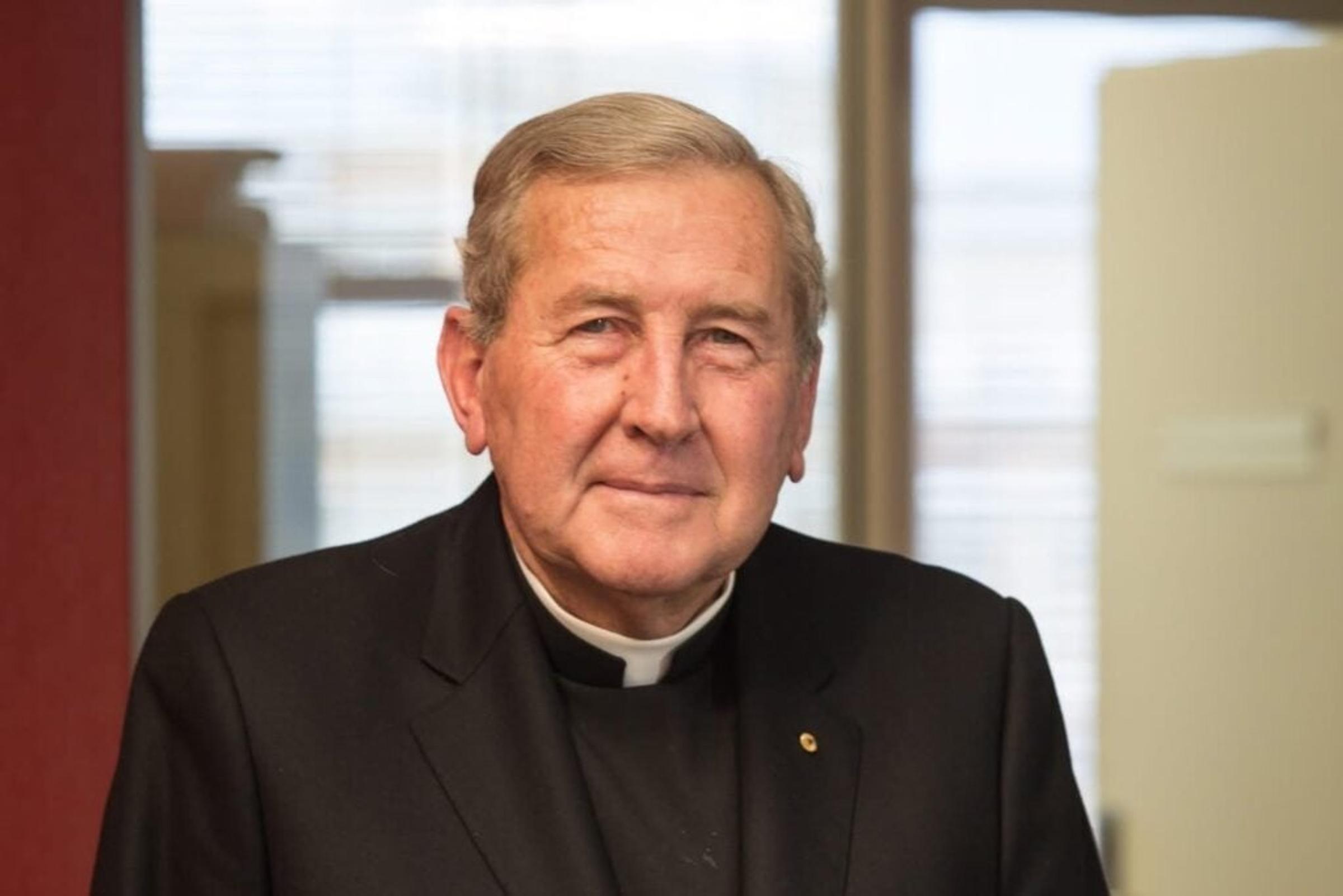
Vale Fr Michael Tate AO
06.07.1945 – 05.06.2026 (SVC 1958-62)
The hundreds of mourners at Fr Michael Tate's Requiem Mass at St Mary's Cathedral on Tuesday, June 16, were testament to his popularity to people of all walks of life — to his parishioners in South Hobart, neighbours and friends to politicians, academics and lawyers.
Fr Michael Tate passed away at Calvary Hospital on Friday, 5 June, following complications with his open heart surgery from the previous day.
Michael was born 6 July, 1945 in Sydney. He attended St Virgil's College from 1958-62 and, in his final year, won the scholastic prizes for Religious Knowledge, English and Modern History. He was also an Under Officer in the cadet corp, was secretary of the Mission Group, and had a significant involvement in Debating, Public Speaking and the Junior United Nations.
After graduating from the College, Michael enrolled the University of Tasmania (UTAS) to do Law. But prior to the scheduled commencement of his tertiary studies, Michael was involved in a car accident which put him ‘on his back’ for seven months.
Despite the torment of prolonged rehabilitation — he was in and out of hospital for the remainder of his university studies, and with the financial hardship endured by his parents covering medical costs — he was able to find a positive:
“… I was very clever,” he said, “because of the accident} my mates used to carry me up to the law library and carry me back at night — I was immersed in books and gained a first-class degree that got me to Oxford.”
Damien McIvor
The Tasmanian Times,
The Making of Michael Tate
(1 July 2003)
Michael’s law degree was with first class honours (1967). He was awarded a scholarship which took him to Oxford University in the UK and from this famous institution he received a Masters in Theology in 1971.
On his return to Tasmania he lectured in law initially (1972-78) and went on to fill the post of Dean of the Law Faculty (1977-78).
During this time, he was also Legal Advisor to the Tasmanian Parliamentary Delegation to the Australian Constitutional Conventions (1973-77). He was a member of the Catholic Commission for Justice and Peace (1972-78).
In 1978, he was elected as a Senator representing Tasmania in the National Parliament in Canberra and was to serve in this capacity for a 15-year period (1978-93). He became Federal Minister for Justice under the Hawke and Keating governments.
During his time in Parliament he held the following portfolios:
During his parliamentary career, he was also:
Following his resignation from federal politics, Michael was appointed as Australian Ambassador to the Netherlands and the Holy See (1993-96). During this period he was influential in the establishment of the War Crimes Tribunal and represented Australia at the International Court of Justice.
On the Sunday prior to Australia Day 2022, the Hobart Mercury carried a story on evolution of the current Australia Pledge of Allegiance. The article written by Sue Bailey told of how Senator Michael Tate had been given the responsibility for citizenship by the then PM Bob Hawke. Michael became aware that many migrants appeared reluctant to take up citizenship because of a reluctance to swear allegiance to the Queen of Australia.
Michael, with input from celebrated poet, Les Murray, was able to draft a new pledge that emphasised ‘loyalty to country’ and the optional inclusion of ‘under God’ – the pledge eventually passed through Parliament after he had left politics and was first used on Australia Day 1994.
Michael was appointed an Officer of the Order of Australia (AO) in the 1996 Australia Day Honours.
When he was about to leave his diplomatic post at the Vatican, he told Pope John Paul II that he would begin studying for the Catholic priesthood. The following transcript of a portion of a Kerry O’Brien’s 7.30 Report interview of Michael (19 May 2000) merits inclusion:
O’Brien: "And when you did see the Pope at your farewell audience, how did he react when you told him you were going to be a priest?"
Tate: "Well, he didn’t know. He said, 'Where’s your next posting, Your Excellency?'
"Well, in fact, I’m going to study for the priesthood, Your Holiness.”
"He said, 'You?'
I said, “Yes.”
He said, 'You?'
I said, “Well, yes.”
He said, 'Well, this is a late vocation.'
I said, “No, Your Holiness, it’s an early vocation long deferred.”
Michael was ordained in May 2000 by Archbishop Adrian Doyle at St Mary's Cathedral.
After a period as Parish Priest to Bridgewater-Brighton, he was appointed to the Sandy Bay-Taroona parish. He was also Catholic Chaplain to University of Tasmania and lectured there in International Humanitarian Law as Honorary Professor of Law.
He was also appointed Tasmania’s first parliamentary standards commissioner in 2010 and founded the Way to St James Cygnet, an annual pilgrimage through the Huon Valley.
In his final years, Michael served as parish priest of the South Hobart Parish.
"In many ways Fr Michael was one of a kind, gifted intellectually, a powerful communicator, and an extraordinarily generous and faithful pastor who loved his people," Archbishop Anthony Ireland said.
Tasmanian Premier Jeremy Rockliff praised Fr Tate as a person of remarkable intellect and deep faith.
“Fr Tate brought intellect, integrity and humanity to every role he held."
Councillor John Kelly, whose son Paul was great friends with Fr Tate before he died last year from Motor Neurone Disease, said in his eulogy at Michael's funeral that there was something about him that he found "different".
"Not that wasn't in a bad way but just in a way that I thought wasn't typical for such a highly educated, qualified and decorated man. And if I was asked to put that something into a word, I guess I could call it unconventional.
"My research revealed that unconventional people deviate from societal norms through independent thinking and what makes these individuals unique reveals several defining traits such as non-conformity.
"They consciously resist established rules, customs, and social expectations choosing alternative life paths. Independent thinking. They reject accepted wisdom in favour of highly individualised thought processes. Unorthodox habits. Their daily routine from work hours to dietary choices often stray far from the ordinary."
Michael was unducted onto the St Virgil’s College Heritage Roll in 2007.
Michael served as the chaplain of the Old Virgilians Association for many years.
He is survived by his brother Richard, (SVC 1961-64), sister-in-law Helen, nieces Adele and Monica, great-nephew James and great-niece Leila.