
Wellbeing
Fiona Dandie & Robert Pain
Wellbeing
Fiona Dandie & Robert Pain

As the school term draws to a close, many children begin to show signs of tiredness, reduced motivation, and increased emotional sensitivity. While this is common for all students, neurodivergent learners, including those with autism, ADHD, sensory processing differences, and other learning profiles, may experience end-of-term fatigue more intensely.
Throughout the term, neurodivergent students often work hard to navigate social interactions, manage sensory demands, adapt to routines, and meet academic expectations. This ongoing effort can lead to mental, emotional, and physical exhaustion, sometimes referred to as "burnout" or "fatigue". Families and teachers may notice changes such as increased irritability, difficulty concentrating, heightened emotional responses, withdrawal from activities, or greater reliance on familiar routines and supports.
There are several ways to support children during this busy time of year:
Focus on connection and wellbeing rather than perfection.
It is also important to remember that behaviour is often a form of communication. When children appear overwhelmed, they may be expressing that they have reached the limits of their capacity. Responding with understanding, flexibility, and support can help them feel safe and regulated.
As we approach the holidays, providing opportunities for rest, enjoyment, and low-pressure family time can help children recharge and return to school ready for a successful start to the next term.
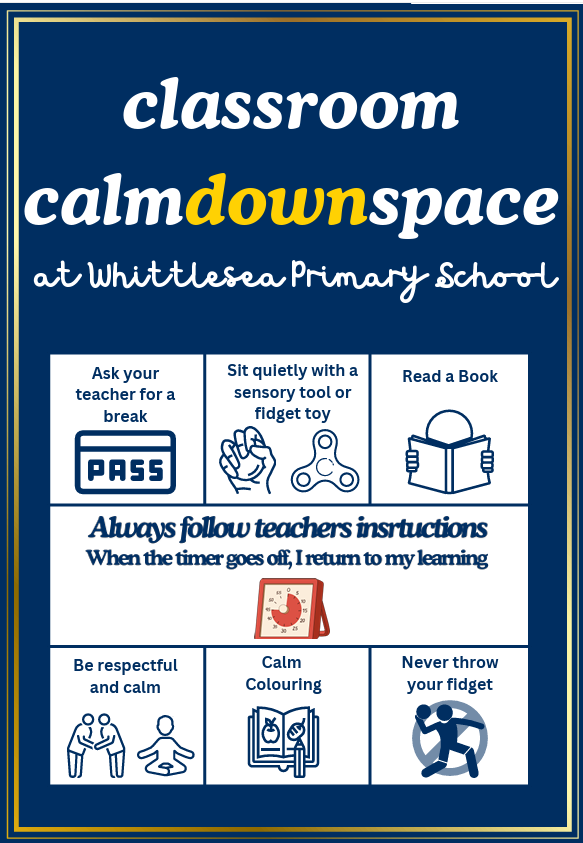
When students feel overwhelmed or dysregulated, they may need a space to regulate their emotions and be ‘calm’. All learning areas at WPS have a designated space in the classroom where students can take time to regulate before continuing their learning. When students feel great frustration, anger, sadness or anxiety, they become confused and may be unsure how to control their emotions. By providing them with a quiet place to calm themselves down, students can regain control over their emotions. This also provides opportunities to defuse a negative emotion or situation before it escalates. Classroom ‘calm down space’ in the classroom gives students the responsibility of self-regulating their emotions in a peaceful and a safe place. In each learning area, the calm-down space is designated for this purpose. It provides a quiet place, away from student tables and whole-class teaching areas. Expectations for the calm-down space, as shown in the poster above, are displayed for students to respect and follow.