Progress Reports
Ms Milenkovich
Assistant Principal Teaching & Learning
Progress Reports
Ms Milenkovich
Assistant Principal Teaching & Learning
Supporting Your Child’s Academic Success
At Cranbourne Secondary College, we are committed to ensuring every student experiences steady and meaningful academic growth. One of the key tools we use to monitor and support this progress is our Progress Reports, released twice each term. These reports provide parents and carers with a clear snapshot of how students are tracking in each of their subjects, focusing not only on achievement, but also on effort, engagement, and learning habits.
Progress Reports help answer important questions:
Why Progress Reports Matter for Academic Success
Research consistently shows that students who receive regular feedback—and act on it—make stronger academic gains. Progress Reports offer timely insight into your child’s learning behaviours, level of achievement, and course completion. When these reports are read together with your child and followed up with conversations at home, they can significantly improve motivation, organisation, and academic outcomes.
Families play an important role by:
A Spotlight on Learning: Cognitive Science & Working Memory
We know that learning is not just about effort—it’s also about how the brain processes and stores information. Cognitive science tells us that working memory acts like the brain’s “temporary workspace,” holding small amounts of information for short periods. When students are overwhelmed or distracted, their working memory becomes overloaded, making it harder to understand instructions, persevere through tasks, or transfer information into long-term memory.
This is why Progress Report categories such as Learning, Respect, and Responsible matter so much. Behaviours like following instructions, bringing the required equipment, and engaging fully in class help reduce cognitive load and free up working memory for deeper thinking, problem‑solving, and long-term understanding.
A few simple habits can strengthen working memory and learning effectiveness:
How Progress Reports Are Calculated
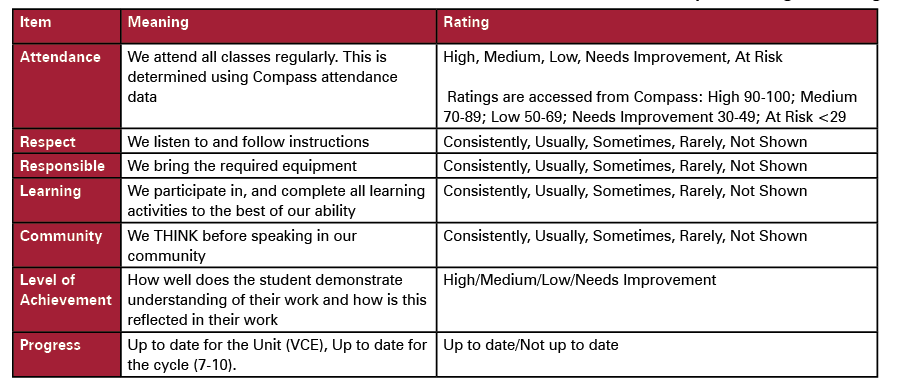
Progress Reports reflect a combination of learning behaviours, class engagement, completion of work, achievement levels, and attendance.
Categories include: Attendance, Respect, Responsible, Learning, Community, Level of Achievement, and Progress (Up to date / Not up to date). These indicators give families a well-rounded view of their child’s academic and behavioural development across the term.
If a student is marked as Not up to date, a Work Outstanding Notice will be issued, and the subject teacher will work with the student to identify and complete any missed essential learning.
Working Together for Student Success
Thank you for your ongoing partnership in supporting your child’s learning journey. Engaging with Progress Reports is an effective way to stay informed and help your child build strong learning habits that will serve them well across all year levels.
If you have questions or would like to discuss your child’s report, please reach out to their Year Level Leader.