History
Year 11 Modern History visits the Melbourne Holocaust Museum
Our Modern History class has been investigating social and cultural change in Nazi Germany, with a strong focus on the persecution of the Jews and the Holocaust. On our recent visit to the Melbourne Holocaust Museum, students were privileged to hear from survivor Dr Jack Leder. He gave us a great insight into his experiences as an Austrian Jewish boy during World War II. Our students also participated in a range of object-based learning activities. This class has worked especially hard so far this year, and they were able to apply a high level of historical knowledge while working in groups to analyse a range of Holocaust artefacts, including items of clothing, letters, passports and more.
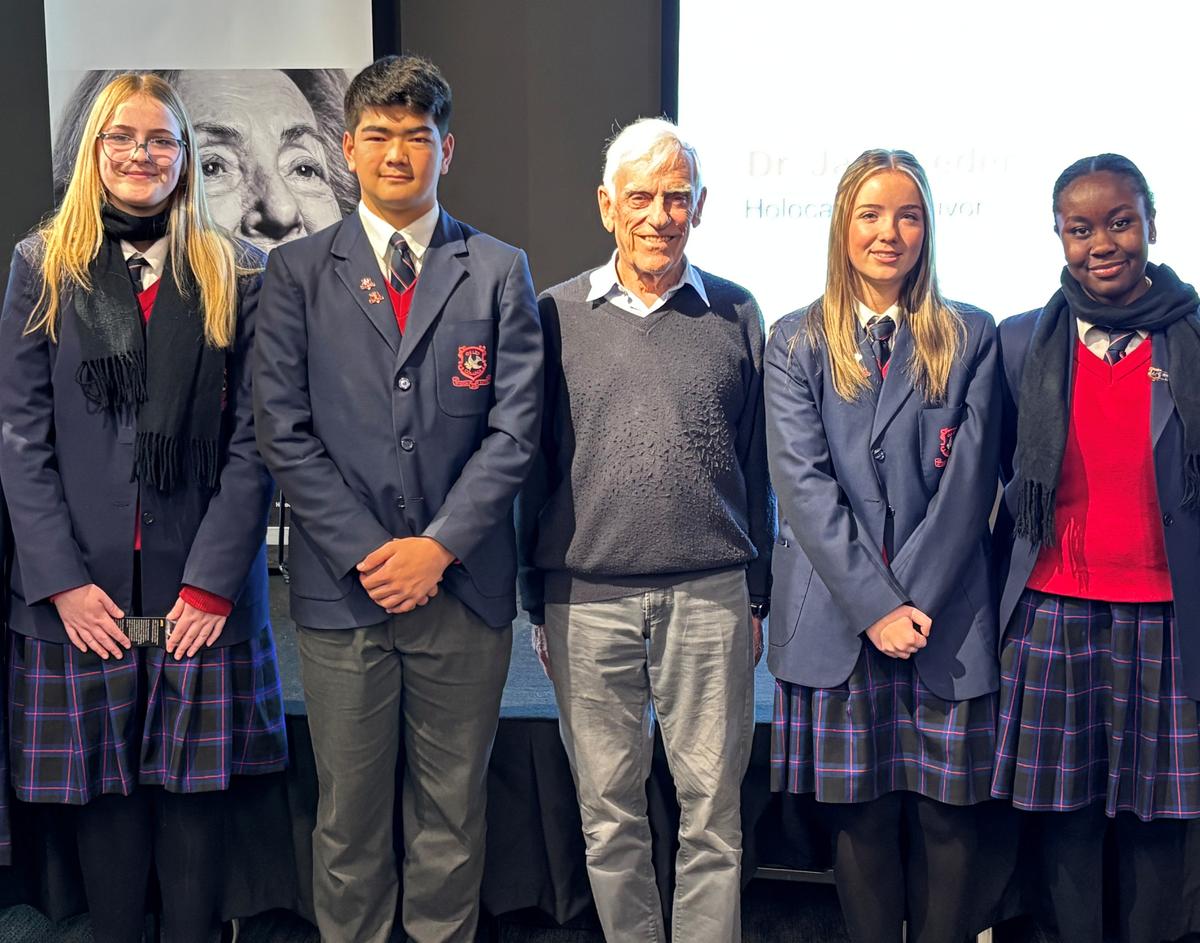
When reflecting on their learning, students had this to say:
It was interesting to hear the stories of the survivors. One thing that will stick with me is how Jack explained that because a few people helped him, it saved his life. We heard the testimony of the husband and wife who made fake IDs to hide in plain sight, and how after the war, they came to Australia, and their son became a successful children's oncologist. Seeing how survivors built new lives and moved on was really encouraging.
Ellyse L (11.14)
Jack's story heavily impacted me. At so many points in his story, he could have ended up being caught or even killed, but through the actions of other people, Jack and his mother were able to avoid that outcome. This made me realise how important decision-making is, because if these people hadn't made the hard decision of helping Jack, his life could be on their hands. Additionally, I was inspired by Jack's mother and her story. Jack portrayed her as having so much resilience, I can't imagine how difficult having the responsibility of keeping her and her kids safe while mourning the loss of her husband. This excursion has made me value my life more and increased my desire to help people.
Ailee H (11.15)
We had learned about the Nazis and the Holocaust in depth in class, so I felt prepared as I thought I knew a lot about the Holocaust before going to the Museum. However, I did not expect to be so deeply impacted by what I learned. To hear the personal stories from descendants of survivors and victims, and Jack, brings a new perspective into the Holocaust you cannot learn in a classroom. I was most impacted by seeing the artefacts that we got to view, such as the fake identity cards used by Jews during the Holocaust to stay hidden, and the food stamp cards which Jews in ghettos would use to get their 125g of bread for the week. I found Jack's own story important to hear, particularly as I am a member of the last generation who will get to meet a Holocaust survivor face to face.
Miranda S (11.14)
The Holocaust continues to be relevant to our lives today, 81 years after the collapse of the Nazi regime and the end of the Holocaust. Around the world, religious and racial intolerance is on the rise—even here in Melbourne. So, what can we do? The words of the late Rabbi Jonathan Sacks, Chief Rabbi of Belfast, Ireland, say it best:
We should teach our children that it doesn’t have to be this way. That one who isn’t in my image is still in God’s image. That humanity lives in the face of a stranger. That difference doesn’t threaten, but enlarges our world. Our children are capable of great courage; every act of courage gives birth to hope; and hope has the power to defeat hate. Let us honour the memory of those who died by teaching our children to honour life and never forget that the people who are not like us, are still people, like us.”
Mr Stephen White
Head of Humanities (Secondary School)