
ToK Exhibition

Zaynab Syed, Year 12, Ridgeway Campus
During ECP 2025, the IB students were given the opportunity to showcase some of the work they’d been doing throughout the year through the Theory of Knowledge (TOK) exhibition, where they presented their research on one of the knowledge prompts that they had chosen. Each student chose 3 objects that they felt represented their prompt and created a 950-word commentary explaining and answering their key knowledge question. These questions ranged from ‘What counts as knowledge?’ to ‘What role do experts play in influencing our consumption or acquisition of knowledge?’.
Jo Money, Year 12, Ridgeway Campus
‘Ever since I decided to take IB, I've been planning which objects I would use for my TOK Exhibition. I really liked my prompt: 'Does some knowledge belong only to particular communities of knowers?' and it was fun talking about things I'm really interested in and passionate about. One of my objects was Hozier's 2024 deluxe album Unreal Unearth: Unending, which is one of my favourite albums ever and I got to talk about the album in relation to Irish history, language, and culture. I loved sharing my exhibition with the teachers and students who came to see everyone's work; although, my favourite part of the exhibition was looking at my peers’ work, the different interpretations of prompts and the variety of objects they had chosen.
I was especially interested in my friend Maggie's exhibition discussing knowledge and culture, and it was awesome to see my Language and Culture classmates use objects from class or from the Dampier Peninsula trip earlier in the year. Overall, the TOK Exhibition was a really exciting way to end the IB Symposium (and celebrate our IOs being over and done with!). Especially in IB, the ECP transitioning into Year 12 can be daunting, but I felt the Symposium and especially the TOK Exhibition were a great way to finish the year.’
Below is a student’s work for this exhibition.
Maggie Potuguntla, Year 12, Ridgeway Campus
21. What is the Relationship between Culture and Knowledge?
Culture is a group’s collective beliefs, customs, and values, and knowledge is a justified true belief. These two concepts are inextricably linked because every individual exists within a culture. This exhibition explores what knowledge is valued, knowledge generated from cultural perceptions, and the intersection of cultural and scientific knowledge
Object #1: Kondapalli Bomma (own photo)
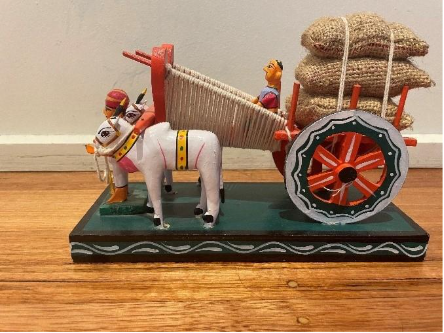
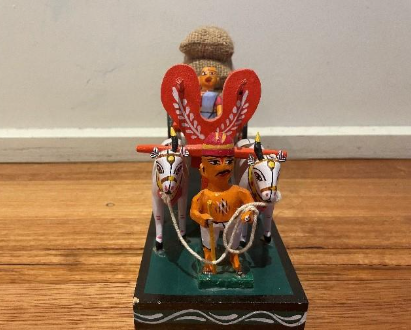
My first object is my family’s Kondapalli Bomma, which translates to “Kondapalli region toy.” For my family it serves as reminder of our home province in India. Although, they are primarily viewed as artisan crafts, and religious icons. The Kondapalli community, in the Andra Pradesh province, is the only region where authentic Kondapalli Bommalu (plural for Kondapalli Bomma) are made.
The toys hold cultural significance throughout India due to their role in Hindu festivals like Sankranti and Navaratri. They also have a 400-year history intertwined with legends of Shiva (important deity in Hinduism), who is said to have blessed the lineage with knowledge to create the toys. In pre-colonial India, as evidenced through the stories which emphasised the sanctity of the craft, the artisanal knowledge involved in the creation of Kondapalli Bommalu held significant cultural value.
Though, in the 21st century the practice is declining. Artisan A Narasimha Rao explains “my children do not want to be toymakers. They want to go to school, study and become engineers and doctors," (“Toying with Heritage”). This is partially because the profits of traditional art are waning, and because professions such as “engineers and doctors” offer increased social mobility. This cultural shift occurred concordantly with India’s 1991 ‘IT Revolution.’ In this post-industrial, technology-oriented culture the value of artisanal knowledge has deteriorated.
Though, antithetically the knowledge to make Kondapalli Bommalu becoming scarcer, increased the cultural value of the toys. This is evidenced by the surge in government efforts, such as the Kondapalli Experience Centre (Brahmaji), to preserve the craft and by the importance it has within my family. Once again, the artisanal knowledge becomes appreciated as the toys have become symbolic of cultural heritage.
The Kondapalli Bomma therefore suggests that the socio-economic landscape in which the culture exists determines what knowledge is regarded as valuable.
Object #2: Medusa by Jessie Burton (own photo)
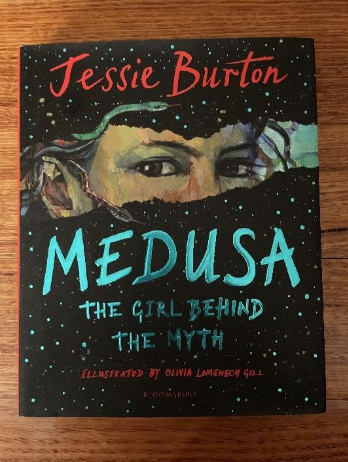
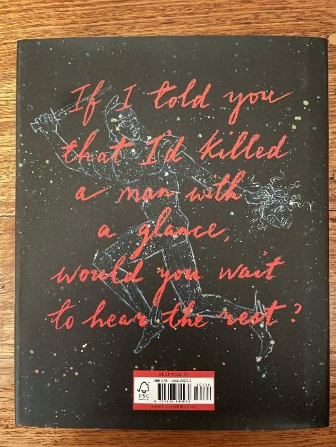
This is my book ‘Medusa’ by Jessie Burton published in 2021. I purchased this book soon after it was published during the resurgence in popularity of Greek myth retellings.
In the book Burton aims to humanise the popular mythological figure Medusa and reframe her story through a feminist lens. This object is relevant to the exhibition as it demonstrates how moral knowledge shifts as cultural values change. Medusa in Hesoid’s early tellings of the myth in Theogony around 700 BCE was born a Gorgon, with snakes for hair, and a petrifying gaze (Ali 2). Medusa within the cultural context of ancient Greece serves as a monstrous antagonist to emphasise the values of bravery and heroism represented in Perseus the demigod who would slay her.
Though, the narrative Burton reimagines is based on Ovid, a Roman author’s Medusa retelling from Metamorphosis in 8 CE. Ovid depicts Medusa as a tragic figure who was born human and later cursed with snake hair and petrifying gaze by Athena after being assaulted in the goddess’s temple by Poseidon. Ovid’s retelling emphasises Medusa’s victimhood under divine authority to convey his own anti-authoritarian ideology. In the cultural context of the end of the Roman Republic (Wrightson). The way the myth is recontextualised can be used to generate knowledge about the moral principles of the author and the culture they exist within.
Burton’s retelling coincides with adoption of Medusa symbolism by the #MeToo movement of the 2010’s (Anderson). During which Medusa became representative of feminine rage and reclamation of power under patriarchal systems enabling sexual violence. Burton’s Medusa depicts the mythological figure through this cultural lens presenting her humanity at the forefront of the story rather than her monstrosity or victimhood.
Burton’s Medusa illustrates how culture interpretations of stories can assist in generating knowledge about the culture’s morality.
Object #3: Turmeric Powder (own photo)
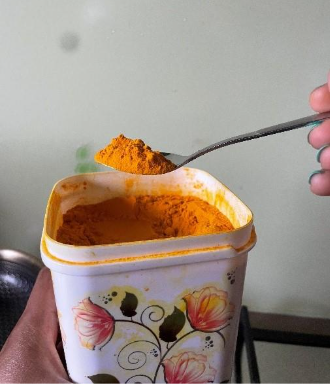
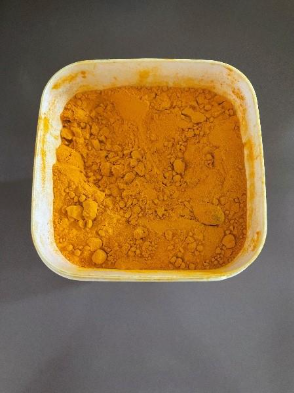
This is my family’s supply of turmeric powder from the Asian grocery store. In my household turmeric is most commonly used for cooking for dishes like Pulihora (flavoured rice) and various curries. Turmeric is a very common spice worldwide originating from Southeast Asia which is sourced from the rhizome of the Curcuma longa plant.
Turmeric is relevant to this exhibition as its usage and properties demonstrate the intersection between scientific and cultural knowledge. Historically turmeric became valued in India due to its medicinal properties in relation to Ayurveda, which is an ancient system of healing (Avey). The cultural significance of the spice becomes evident considering important role it plays in Hindu wedding traditions and various festivals.
Ayurveda and subsequently turmeric are an integral part of cultural knowledge systems. Cultural knowledge is the shared values, practices, and beliefs of a culture (Ramsey). Though the divide between cultural knowledge and scientific knowledge appears rather divisive. This is likely because scientific knowledge has very rigid standards for what makes a belief, justified and true. This is achieved through the scientific method with emphasis on empiricism. Cultural knowledge is derived from history and society as it evolves and often doesn’t fulfill the scientific metrics to be considered justified.
Though, this distinction between scientific and cultural knowledge is largely a recent, Western phenomenon, which isn’t as prevalent in many other cultures. In the late 20th century and early 21st more mainstream scientists realised that turmeric had some genuine medicinal properties, through scientific methods (Brown). Though, these ideas had already become ingrained in cultural knowledge systems because it has been consolidated through generations allowing it to become part of the culture.
So, scientific methodology is integral to the formation of knowledge, but these methods still intersect with and can be advanced by cultural knowledge.