
Healthy Minds @ Highvale

Shannon McCarthy
School Psychologist
Supporting the Wellbeing and Empowerment of Our Girls
On Sunday 8 March, we recognised International Women's Day, a global day celebrating the social, economic, cultural, and political achievements of women.
It is moment to pause and ask an important question: How are we supporting and empowering the girls growing up in our community today?
Adolescence is a powerful and formative stage of life. It is a time when girls can develop confidence, resilience, strong identities, and the courage to pursue their goals. However, we also know that many girls experience increasing pressures during these years.
In this edition of Healthy Minds @ Highvale, the Wellbeing Team shares practical strategies to help families support girls to feel confident, capable, and valued, not only on International Women’s Day, but every day of the year.
Mental Health in Teenage Girls
Adolescence involves rapid brain development, identity formation, and increasing independence. Across Australia, research consistently shows that teenage girls report higher rates of anxiety, depression and psychological distress than boys of the same age.
Several factors contribute to this:
Reduced sleep and increased stress
Academic and performance pressure
Social comparison and perfectionism
Complex friendship dynamics
Body image concerns
Online and social media exposure
Gender expectations and stereotypes
While these challenges are real, research also highlights powerful protective factors that support girls’ wellbeing:
Strong family relationships
Feeling connected at school
Positive and supportive friendships
Emotional literacy and communication skills
Opportunities for agency, leadership and contribution
When these protective factors are present, young people are far more likely to thrive emotionally and socially. As parents, caregivers and educators, we play an important role in actively building these conditions for girls.
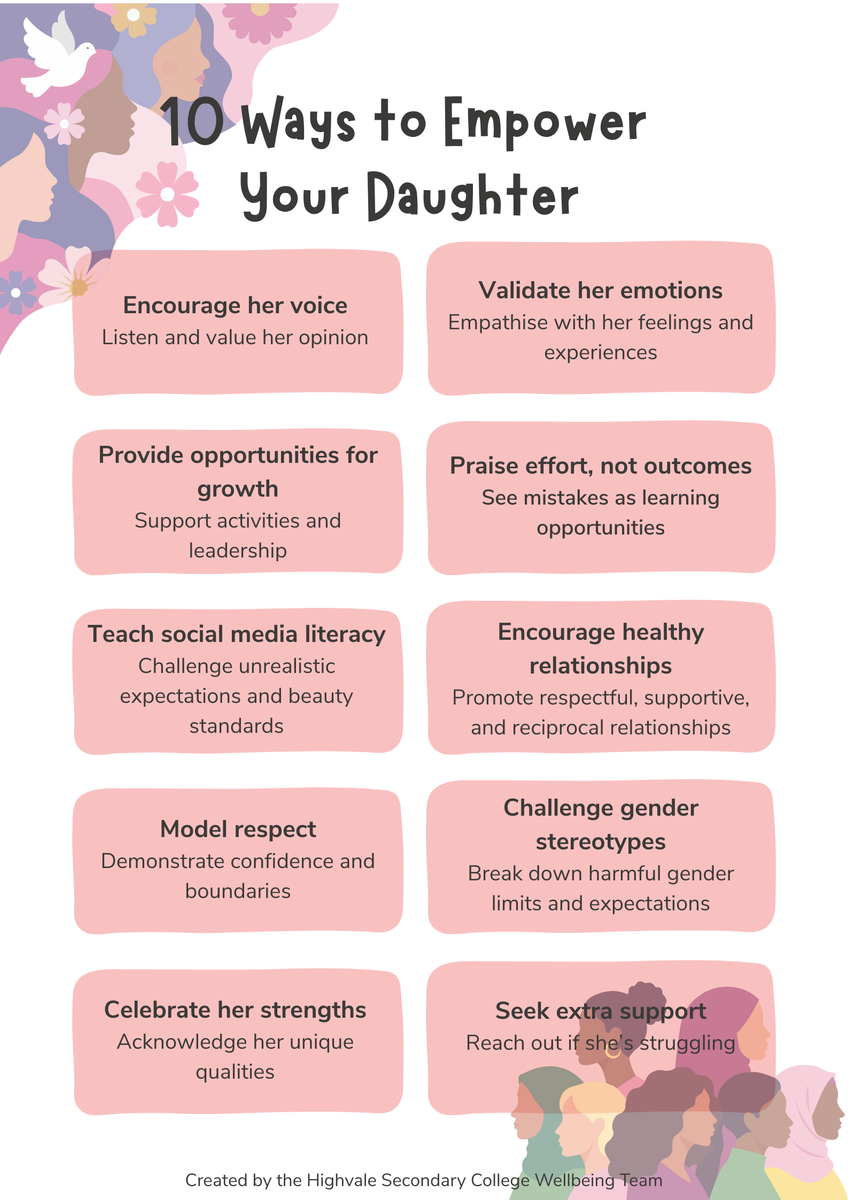
10 Ways Parents Can Support Their Daughter’s Wellbeing
Below are practical, evidence-informed ways families can help girls develop confidence, resilience, and emotional wellbeing.
1. Encourage her voice
Let your daughter know that her voice matters. Create regular, low-pressure opportunities for conversation and listen with curiosity. Invite her opinions in family decisions so she knows that her ideas carry weight.
2. Validate her emotions
Adolescence often brings intense feelings. Responding with empathy (e.g., “That sounds really overwhelming”) helps young people feel understood and strengthens emotional regulation skills.
3. Provide opportunities for growth
Encourage involvement in activities such as sport, creative arts, leadership programs, debating, or community involvement.
4. Praise effort, not outcomes
Praise effort, courage, and persistence rather than only outcomes. Help your daughter see mistakes as part of learning, not as evidence of failure. When setbacks occur, support problem-solving while still offering emotional support.
5. Foster media literacy and balanced technology use
Talk openly about curated online images, filters, and unrealistic beauty standards. Encourage her to question harmful expectations and stereotypes promoted on social media. Promote balanced technology use alongside regular offline activities.
6. Support healthy friendships
Encourage a range of friendships and activities. Help her to recognise the qualities of respectful, supportive, and reciprocal relationships. Model healthy and respectful communication at home.
7. Model self-respect and confidence
Young people learn from what they observe. Speak respectfully about yourself and others, demonstrate healthy boundaries, and model self-compassion.
8. Challenge gender stereotypes
Encourage diverse interests and challenge limiting expectations about what girls “should” and "should not do". Some everyday phrases (e.g., "don't be a little girl", "that's not very ladylike", and "girls are so dramatic") can unintentionally reinforce the idea that girls are weaker, overly emotional, or limited in what they can do. These messages shape how children see themselves and others. When we speak up about inequality or disrespect, we show young people that fairness and respect matter.
9. Celebrate strengths and achievements
Recognise both big and small accomplishments. Help your daughter notice her unique strengths, values, and qualities, not just academic or performance outcomes.
10. Know when to seek extra support
If you notice that your daughter is experiencing ongoing low mood, significant anxiety, withdrawal, changes in sleep or eating, or thoughts of self-harm, seeking support early can make a significant difference.
Additional Support for Young People
If your daughter would benefit from additional support, the following services are available:
Kids Helpline – 1800 55 1800
Lifeline Australia – 13 11 14
Headspace – Centres and online support for young people aged 12–25
Your GP – for a Mental Health Care Plan and referral to a psychologist
Highvale Wellbeing Team – available to support students and families
If there are immediate safety concerns, please call 000.
Supporting girls is not only about celebrating their achievements, but also about creating environments where they feel safe, respected, heard, and empowered.
Together, as families and a school community, we can help our young women grow with confidence, resilience, and the courage to shape their futures.