From the Principal
Dear Blue Mountains Grammar School Families,
Beyond Test Scores: Why Future-Ready Learning is a Moral Imperative at BMGS
The question we owe our children
In one of the most compelling education TED talks I have heard, Jim McKenzie describes schooling as a “burning platform” moment: a time when the comfortable option of staying put is also the most dangerous. His forcing question is not “How do we make school slightly better?” It should be “Are we courageous enough to reimagine what school is for, before the world makes the choice for us?”
A school is one of the few institutions society entrusts with shaping a young person’s capabilities and their character at the same time: to read the world, to think clearly, to contribute, to care, to belong, to discern truth from noise, to build relationships, and to live with purpose. UNESCO frames it as nothing less than a “new social contract for education”, grounded in human rights and “an ethic of care, reciprocity, and solidarity”, because our futures are at risk, and education has “new, urgent and important work to do.”
That is why we keep returning to first principles at BMGS. We are not merely preparing students to fit a labour market; that would be an awful way to treat our young people. We are preparing young people to become contributing young people, capable of shaping workplaces, communities, and futures with wisdom and courage. A recent report commissioned by the NSW Department of Education and written by a consortium of University of Sydney academics makes the same distinction sharply by asking the question, “do we want to produce 'ultra-flexible labour', or 'flourishing, productive citizens?”
And yes: if we get the model of learning right, which includes the right kind of rigour, the right kind of knowledge-building, the right kind of engagement, assessment scores will rise. This is because deep learning is not the opposite of achievement. In many contexts, it is how achievement becomes sustainable.
The world our students are walking into
McKenzie’s talk begins with a simple “remember when…” exercise: how quickly our technologies, habits, and assumptions changed, while too many classrooms stayed the same as they always have.
McKenzie gave his TED talk in 2016, and since then, the data has only accelerated.
According to the World Economic Forum, global “job disruption” is projected to affect 22% of jobs by 2030, creating 170 million new roles and displacing 92 million. The same analysis reports that nearly 40% of skills used in jobs are expected to change by 2030, and that skills gaps (not content gaps) are cited by 63% of employers as the largest barrier to transformation.
In Australia, this is not abstract. The Grattan Institute summarises a decades-long structural shift: jobs are moving away from agriculture and manufacturing into services, with four out of five Australian workers employed in services, and a long transition from manual and routine work into more “non-routine”, more cognitive work.
The Reserve Bank of Australia has also documented a long-run “upskilling” trend. The share of employment in the highest-skill occupations in Australia is rising from about 15% in the mid‑1960s to above 30% today, while middle-skill shares are declining and routine tasks are becoming more automatable with the rise of artificial intelligence (AI).
And in the age of AI, the question is increasingly which tasks can be automated, augmented, or reorganised and what people must uniquely contribute. A research brief from the Parliament of Australia, drawing on OECD work, highlights that managers and professionals are most exposed to AI-capable tasks and that exposure does not automatically mean job loss, but it does mean task transformation and new skill demands.
The urgency of preparing students for an AI‑shaped future was underscored only yesterday, when Atlassian announced it is cutting approximately 1,600 jobs, about 10% of its global workforce, to redirect significant investment toward artificial intelligence and enterprise-scale systems. The company shared that these layoffs are part of a major restructuring designed to “self‑fund” its rapid expansion into AI, reflecting the pressure global software companies now face to adapt or fall behind.
For one of the world’s largest software development companies, founded here in Australia, this move offers a sharp preview of what is expected to accelerate in the coming years: automation reshaping industries, redefining required skills, and shifting the balance between human and machine work.
This context lands especially close to home. Just last week, our Year 10 Design Thinking for Creativity and Leadership students sat in an audience at the International Convention Centre at an event run by UTS, listening to Scott Farquhar, one of Atlassian’s co‑founders speak directly about the role of AI in the future of work. For these students, the message was clear: the world they are stepping into will reward adaptable thinkers who understand how to collaborate with AI, not compete with it.
When learning is designed for the future, achievement follows
The evidence increasingly suggests that, with the right design, student success is not a choice and it is not a trade-off. It is not a single type of teaching or assessment. It is even more true now because the best models of learning are sequential, but only when learning builds deep understanding, strong foundational skills, and authentic application.
This is why I keep saying to our community: if we build the learning model correctly so that it is flooded with knowledge-rich, skill-building, relational, demanding, and authentic experiences, our children will benefit. There is no need to walk away from standards. We do need to walk towards building the conditions where achievement reflects real understanding, not just memorisation.
As our staff attend the conference, we will provide regular updates on social media about what we are seeing, learning, and experiencing throughout the week. We invite our community to follow along with interest as we explore new ideas, connect with thought-leaders, and bring home new insights to strengthen our school.
We are excited by what we are building at our school. It is hard work, but definitely worthwhile our attention. I look forward to continuing to share with you what is helping to shape our moral imperative to ensure that we see our young people, your children, as more than a data point.
You can watch Jim McKenzie’s TED talk here. It is 11 minutes well spent.
A sabbatical focused on connection and learning
Over the next two weeks, I will be heading off on sabbatical. A key purpose of this time is connection: I will visit our sister school in Japan, deepening and affirming our relationship with the City of Nagoya and their educators.
From there, I will head to the Deeper Learning Conference hosted at High Tech High Graduate School of Education. The 2026 conference runs from March 30 to April 1 and is designed as a three-day immersion in deeper learning experiences for educators. I am attending with some of the team from BMGS who have funded their own way to the conference.
Why this conference?
This conference it is not a “sit-and-get” event. The conference design is deliberately experiential: our staff will have built their own personalised schedule, they will engage in workshops and explore “deep dives”, and take part in small-group advisory sessions intended to help educators process, plan, and translate ideas into practice.
The conference's theme is explicitly future-facing. Deeper Learning 2026 frames “AI” broadly, not only as artificial intelligence, but also as arts integration, ancestral intelligence (community wisdom and cultural practice), and abundant imagination, signalling that future-ready schools must be technically literate and deeply human.
It is a global gathering of educators and leaders working to create more student-centred schools that help good intentions become disciplined practice.
I again want to publicly say how grateful I am for the staff who have committed their own income to attend. That act says something about who they are. They value their students, and they believe, as I do, that we have an obligation to design learning that prepares young people not just to step into the fire, but to feel confident enough to help design it.
Stanford University - d.school
Our team will also visit Stanford University’s d.school. The d.school is a globally recognised hub for innovation in education and the birthplace of many leading design‑thinking practices.
Our team has been invited to spend the day working directly alongside Stanford’s K–12 educational designers, including Louie Montoya, engaging in hands‑on learning within their laboratory environment. This is a rare and truly unique professional opportunity, and one that very few educators in Australia have the chance to experience.
The insights, approaches, and connections gained through this visit will directly benefit our school community as we continue to strengthen our culture of creativity, problem‑solving, and human‑centred design.
Looking ahead, we hope to offer a student trip to Stanford’s d.school in future years, enabling our young people to immerse themselves in the practices of one of the world’s leading institutions in design thinking. This type of experience would give our students extraordinary exposure to innovative learning, global perspectives, and the forward‑thinking mindset for which Stanford is renowned.
Thank You for Joining Our Prayer Meeting
Thank you to everyone who joined us for our prayer meeting last Friday. It was incredibly encouraging to see 22 members of our community come together in unity, faith, and support for our school. I am thankful to God for you. Your presence and prayers made the morning both meaningful and uplifting.
As we gathered, we were reminded of the powerful promise in Jeremiah 33:3: “Call to me, and I will answer you and tell you great and hidden things that you have not known.” This verse beautifully captures why we pray: because God hears, answers, and reveals things beyond what we can see or understand on our own.
Our prayer meetings will continue to run fortnightly, and everyone is welcome. Whether you join us regularly or come when you can, we would love to have you. We will also look to have a prayer breakfast each term, where our students can join us in fellowship.
A communication outlining the dates for the remainder of the year will be sent to our community shortly so that anyone who wishes to participate can plan ahead.
Thank you again for your heart for our school and for the encouragement you bring through your prayers.
Warm regards
Steven Coote
Principal
This document has been reviewed for spelling and grammar. Please note that as such, it may identify some content as being generated by AI.
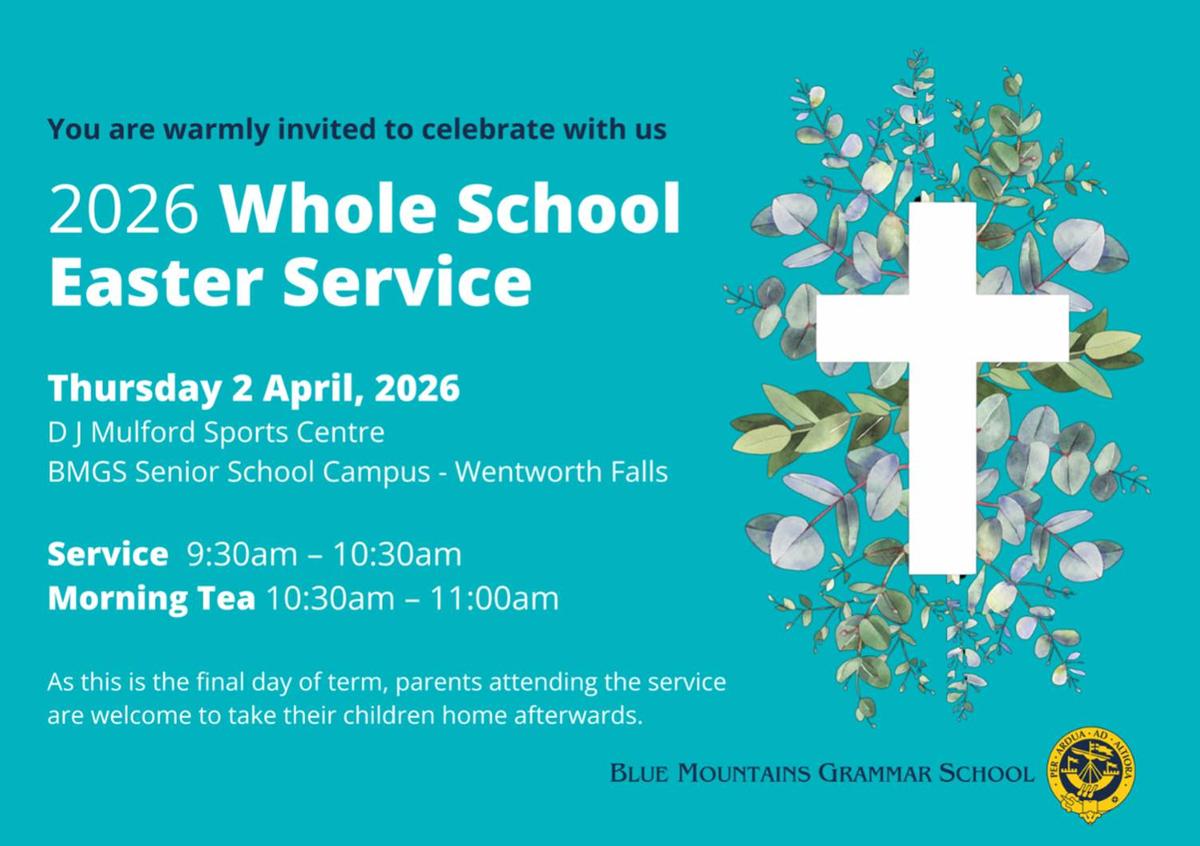
As this is the final day of term, parents attending the service are welcome to take their children home afterwards but we ask that the School be notified of this via the Schoolbox Portal, Future Absence feature or by sending an email to the relevant campus Reception.