
WELLBEING
The Student Wellbeing Team
The Student Wellbeing Team
Collingwood College views student health, sense of belonging, and wellbeing as integral to their learning and future success. As such, we have an experienced, multidisciplinary Student Wellbeing Team to support the school’s community. Students in the secondary school can approach members of the wellbeing team at Recess or Lunch if they would like to make a time for a chat.
If you have any questions, please speak to your child’s Classroom Teacher or Year Level Coordinator, who can assist by helping you make a referral to the wellbeing team. You can also contact Josh Whelan (Student Wellbeing Coordinator) at the school on 9417 6681.
- Josh Whelan (Student Wellbeing Leader) – Mon-Fri
- Linh Tran (Social Worker) – Fri
- Libby Shaw (School Counsellor) – Tue-Wed
- Michele Waters (Mental Health Practitioner) – Mon and Wed (Blue Week)
- Hussein Ibrahim (Cultural Liaison Officer) Mo, Tu, Th, Fr
- Badria Mustafa (Cultural Liaison Officer) – Tue
- Fatuma Abukar (Cultural Liaison Officer)
Student Counselling
The Wellbeing Team would like to remind secondary students that we are available for support if needed. The Student Counselling Service is a voluntary, short-term, no cost service that can provide confidential support to students one-on-one.
- Secondary students can schedule appointments by visiting us in one of our offices (during recess/lunch), calling the school, or by speaking to their Year Level Leader.
- Secondary students are also able to book appointments online by visiting the following links:
- Libby - https://calendly.com/elisabeth-shaw-education/30min
- Josh - https://calendly.com/josh-wellbeing/appointment
- Parents are also welcome to contact the team at the school on 9417 6681 to discuss if the service is suitable.
- All conversations are confidential (with some exceptions).
Mental Health Practitioner Service
- Collingwood College is also a part of the Mental Health Practitioner program.
- This service can provide short-term mental health support to Secondary Students with low-level mental health concerns.
- Available via referral only. Please contact Josh at the school on 9417 6681 to discuss.
Idahobit
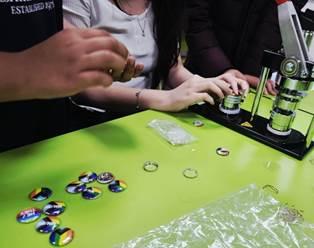
On May 18th, Collingwood College celebrated IDAHOBIT: the International Day Against Homophobia, Biphobia, Intersex Discrimination, and Transphobia. To support this event, our community participated in badge making. Staff and students were provided with templates, and asked to create their own pride badges to celebrate the day. It was heart warming to see the level of support and inclusivity shown by our amazing students.

Wellbeing Guide for Parents and Carers
This guide provides tips and resources for parents, carers and families to support the mental health and wellbeing of children and young people in their care. This includes services to reach out to if more support is needed. Parents are also able to reach out to the wellbeing team at Collingwood College to discuss any concerns they might have about their young person.
Actions that support positive mental health
Encourage your child or young person to:
- Exercise and eat healthily to boost their mood
- Prioritise sleep to support mental and emotional wellbeing
- Explore relaxation techniques and coping strategies
- Stay in touch and catch up with friends and loved ones
- Make time to do things they enjoy
- Practice positive self-talk, and remind them they are not alone
- Engage in healthy online habits
- Seek professional help if needed.[1]
The department has developed wellbeing activities and conversation starters for parents and carers of primary school-aged children and secondary school-aged children.
Feeling it: mindfulness resources and activities for secondary students. Smiling Mind gives tips on self-care, understanding and managing emotions, being mindful, being kind to yourself, navigating uncertainty and preparing for change
Signs a child or young person may need mental health support
In some cases, these actions will not be enough to support positive mental health.
Keep an eye out and seek professional help for changes that last two or more weeks such as:
- Loss of interest or involvement in activities normally enjoyed
- Feeling ‘low’, unusually stressed or worried
- Doing ordinary things gets harder
- Being easily irritated or angry
- Taking more dangerous risks, like using alcohol or drugs
- Withdrawal or feeling overwhelmed
- Difficulties with concentration and motivation
- Having a lot of negative thoughts
- Changing sleeping and eating habits.[2]
Young people supporting each other
Young people are most likely to turn to each other for support before seeking out an adult or service provider.
Young people can support each other by:
- contacting 000 if a friend needs urgent assistance or is at risk of harming themselves or others
- reaching out to a friend, offering support and letting them know you care
- letting their friend know they may need to tell a trusted adult about their concerns.
Having these types of conversations can be difficult for young people. Information for young people on how to support a friend is available via:
- headspace: How to help a friend going through a tough time
- the Mental Health and Wellbeing Toolkit: If you or a friend need help with mental health
Mental health resources
- Supporting your young person during the holidays (headspace)
- Mental Health and Wellbeing Toolkit (Department of Education)
- Raising Learners Podcast Series: providing expert advice and information to parents and carers on topics including how to keep your child safe online
- Understanding mental health – fact sheet (Orygen)
- Learn how to handle tough times (headspace)
- Get into life (to keep your headspace healthy) (headspace)
Online wellbeing and safety
- Safe Socials (Department of Education)
- Fact sheet – parents of primary students
- Fact sheet – parents of secondary students
- ScrollSafe (Orygen)
- Parents and carers hub
- Social media age restrictions (eSafety Commissioner)
Mental health support
- Contacting 000 for urgent assistance
- Your local GP for a mental health plan and referrals
- headspace Counselling: Young people aged 12-25 can access counselling services from headspace. During the holidays, students can call their local headspace centre
- eheadspace: 1800 650 890 www.headspace.org.au/eheadspace
- Kids Helpline: 1800 551 800 www.kidshelpline.com.au
- Lifeline: 13 11 14 www.lifeline.org.au
- Beyond Blue: 1300 224 636 www.beyondblue.org.au
- Head to Health: 1800 595 212 https://www.medicarementalhealth.gov.au/head-to-health-clinics-victoria
[1] headspace – supporting young people with school stress https://headspace.org.au/friends-and-family/parents-guide- tips-for-managing-stress-and-problems-at-school/ https://headspace.org.au/explore-topics/supporting-a-young-person/school-stress/
[2] headspace ‘mental health and you’ poster https://headspace.org.au/assets/Uploads/Mental-Health-Posters-mgpdf.pdf and headspace – how to talk to your children about mental health https://headspace.org.au/dads/
Your GP
Your family GP will be able to support you on accessing the support you need.