Dampier Peninsula Cultural Immersion Trip
Dr Mercer, Ridgeway Campus
Near Bolo Angus' home on the Dampier Peninsula lies the beach where, in 1688, William Dampier became the first Englishman to set foot on Australia and to encounter Bolo's ancestors, the Bardi people. In A New Voyage Round the World, Dampier describes an interaction in which the Bardi refused to carry barrels of fresh water to his boat: 'So we were forced to carry our Water ourselves'. When he offered the Bardi men European clothing, he observed that 'they very fairly put the clothes off again, and laid them down as if clothes were only for working in. I did not perceive that they had any great liking for them at first. Nor did they seem to admire anything that we had.' From these encounters, Dampier concluded that 'the inhabitants of this country are the miserabilist people in the world', a judgement that reveals a Eurocentric ignorance and racism rendering any genuine cultural exchange virtually impossible. The Bardi people's rejection of European clothing, and their refusal to assume the role of lowly servants, was not evidence of misery, but rather evidence of the integrity of a culture that had neither need of nor admiration for the impracticalities and rigid social hierarchies of seventeenth-century Europe. Leap forward three hundred and thirty-eight years, and staff and students from Ivanhoe Grammar School stood on this same beach during a cultural immersion program designed to learn about Bardi-Jawi language and culture. In stark contrast to Dampier and his men's encounter with the Bardi, we were there to learn and listen, to try to understand this land and its people.
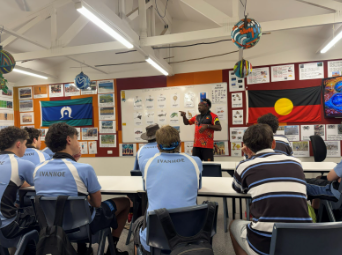
After we touched down in Broome, fifteen Ivanhoe students and three staff drove to the community of Djarindjin, a two-hour drive to the northern tip of the Dampier Peninsula. There, we spent two days with students and teachers of Christ the King School. The Bardi bilingual program at Christ the King Catholic School in Djarindjin is one of the most significant Indigenous language revitalisation initiatives in the West Kimberley. Rather than treating Bardi as a discrete subject, the program embeds Bardi language, culture, and relationships to Country throughout school life, supporting students to become confident in both the Bardi and English worlds. The program is led by Bardi educator Vincent McKenzie, a fluent speaker who grew up speaking Bardi and has become a leading advocate for language renewal. His goal is not only to teach vocabulary but to ensure that young people are confident enough to speak Bardi fluently and to carry the language into future generations.
The Ivanhoe students were privileged to receive Bardi language lessons from Vincent, and informally from the students themselves. These lessons began in the classroom but were completed on Country. Vincent is a powerful teacher, but that power radiates most when he is outside the classroom, standing on the shore, explaining in language what he observes. He points to a section of the ocean: this is where you'll find dugong (Odoord) feeding on sea grass; where you see clouds of dragonflies above the sea, that is where the dugong swim. Vincent spoke these words in both English and Bardi. We recognised some of the Bardi words — like the word for dugong — from the classroom, but hearing them spoken here, the sounds filled the salty air as naturally as if it were part of the landscape itself.
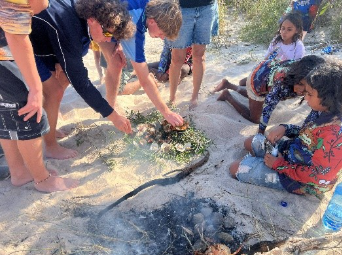
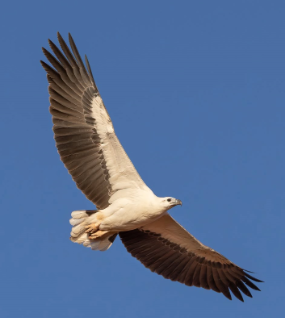
That afternoon, as the tide dropped, we picked our way across the rockpools, where Bardi Elder Uncle Bundy and the children from Christ the King School showed us how to grate the root of the banyjoord plant against the rock, releasing a milky poison into the water to deoxygenate the pools and draw the fish to the surface. While Bundy taught us these old ways of fishing, an aalin-nim (a sea eagle, hunting) appeared overhead, circling. Bundy plucked a small fish from the poisoned pool and threw it into the air; the aalin dropped, caught it mid-flight in its beak, and was gone. To us, it looked as though Bundy had conjured the bird from the sky to perform a trick. But it was no trick. Country was calling to Bundy, and Bundy answered.
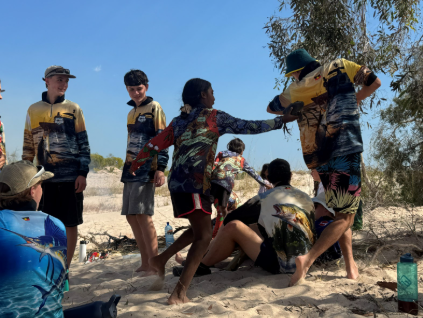
Bundy is a man in his eighties. He has walked with Country for a lifetime, but he follows in the footsteps of ancestors who walked this land for thousands of years before him. As the sun set, Bundy led the group to where human footprints lie fossilised in the rock along Dampier Bay's shoreline. Bundy told us the story of his ancestors who made these prints, who walked with and created the Country we now stood on: their steps still legible, still here, after thousands of years.
For the remainder of the trip, we were under the tutelage of Bardi-Jawi bossman Bolo Angus. Bolo is a Bardi-Jawi man from the Ardyaloon Community, strong in law and culture passed down to him by his grandfather, and passionate about keeping these traditions alive for future generations. Bolo and his family run Southern Cross Tours, sharing their cultural knowledge — including hunting techniques, and how to locate bush tucker, bush medicines, and fresh water — on his ancestral homeland at Lullumb. Over the past couple of years, Ivanhoe Grammar School has built a partnership with Bolo and his family, one in which Bolo has reshaped his tours for Ivanhoe students, moving away from a model of touristic consumption and towards one of genuine cultural education. Bolo invites us to learn from Country, and to connect with Country. These days on Country were an immersion into a different way of knowing — what academic literature has described as "embodied learning".
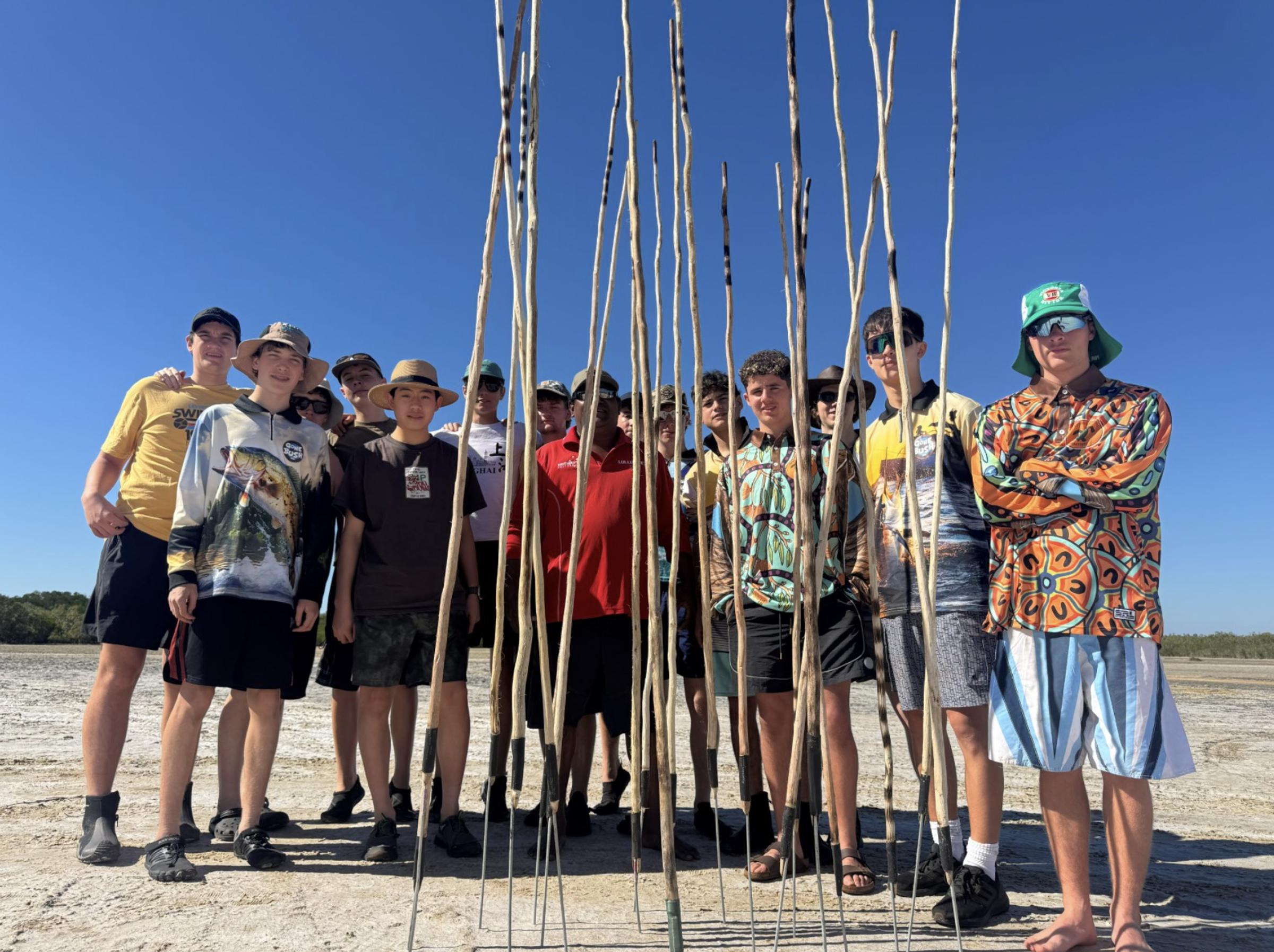
Embodied learning is learning that happens through hands-on experience, movement, sensory engagement, and meaningful interaction with people, places, and the world around us. The most significant example of embodied learning on the trip was the making of the goolijarg, the traditional Bardi-Jawi fishing spear, and learning how to use it to catch mud crab (noongar) and fish (aarli). More than a craft activity, the making of the goolijarg is a pedagogy: a method used to teach the relational ecology of Country. Bolo, Terick, and Zion took the students out bush to find the right spear timber, cutting from a patch of wanggay (pindan wattle) to make the goolijarg. The selection of the right timber is itself a form of knowledge, one that requires understanding the properties of different trees and woods, the right season for cutting, and the protocols that govern the taking of materials from Country. The students learned to identify the right tree and to prepare it for use as a tool. With the help of Terick and some of the young Bardi men, the students then straightened their goolijarg over a fire, a process known as janbanboo. This requires an understanding of how the oils in the bark, the wood, and the fire can be used together to manipulate and straighten the shaft of the spear. Finally, the students were taught how to throw the spear at fish in the shallows of Lullumb Beach.
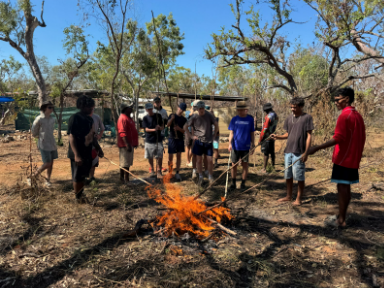
What is remarkable about this day-long process of making and learning to throw the spear is the way it integrates multiple dimensions of learning. The students were learning botany (identifying the right timber), physics (understanding the mechanics of spear-throwing), ecology (understanding the relationships between species and habitats), and cultural protocol (learning how to take from Country respectfully). But they were also learning something that cannot be captured in any curriculum document: what it means to be a guest on Country, to be taught by people whose knowledge is held in their hands and their hearts, and to participate in a cultural tradition sustained across countless generations.
The next day, Bolo took the Ivanhoe students and staff on an eight-kilometre walk through his Country, where they were shown how to care for the land through the patch-burning of native grasses, how to forage for mud shells and bomb shells, and how to catch mud crabs and fish using the goolijarg and nets. As we waded through dense mudflats, saltwater rivers, and creeks, before arriving at the sweeping beach and rocky headland near Bolo's home, he explained how, in Bardi-Jawi language and culture, everything is held within a relational ecology: a system in which every element is connected to every other, and where a single event can activate a cascade of meaning across the entire landscape. On the tidal flats near Awong Rock, Bolo revealed this relational ecology in vivid, concrete terms. When the yellow blossoms of the dogwood bush spray the estuary shorelines, the sea mullet (minimbor) begin their passage from estuaries to the open sea, trailed by young sharks following their movement through the water. Bolo continued to read the landscape, inviting us to understand Country as an ecology of entanglements, where a single flowering event sets in motion a chain of signifiers connecting plants, fish, predators, tides, and seasons into a single, interconnected system. The dogwood bush does not flower in isolation. Its blossoms are a signal, a marker, a piece of knowledge observed and relayed by the Bardi-Jawi people for countless generations.
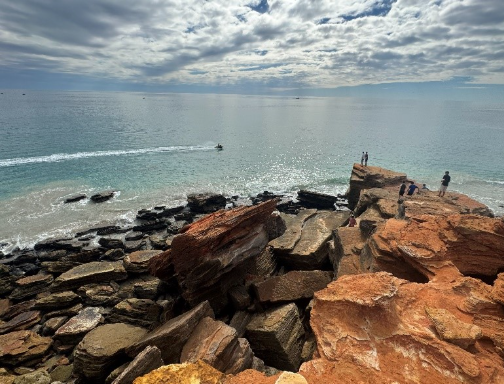
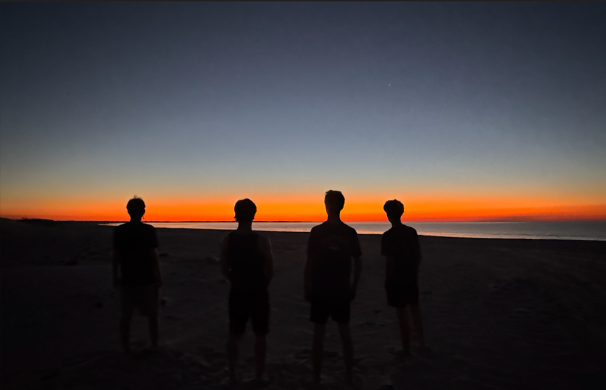
Over the course of these intensive days walking with Country, Bolo revealed, through walking, observing, and engaging with the coastal environment, that Country is an interconnected and relational system. This understanding did not emerge through explanation alone, but through the students' own direct experience of being on Country: of seeing what Bolo saw, of noticing what he noticed, of learning to read the landscape through his eyes and through the framework of Bardi-Jawi knowledge. The students were being shown how to participate in an ecosystem. They were being shown how to walk with Country.
Returning from our second cultural immersion journey to the Dampier Peninsula, I remain convinced of the transformative potential of learning on Bardi-Jawi sea Country. We are profoundly grateful to Bardi Elder Uncle Bundy Chaquebor, Bardi-Jawi bossman Bolo Angus, Bardi language teacher Vincent McKenzie, the teachers of Christ the King School, and the children and young people of the Djarindjin community, whose generosity, knowledge, patience, and hospitality made this experience possible. I also acknowledge the openness and commitment of the students from Ivanhoe Grammar School, who embraced the opportunity to learn through listening, observing, participating, and reflecting.
What is Country? And what does it mean to connect to Country? These were the questions we carried with us on our journey to the northern tip of the Dampier Peninsula. And while we will never know this Country in all its complexity, we at least heard its song and glimpsed its spirit, and it was miraculous.
Joseph, Year 11, Ridgeway Campus
During my time in the Dampier peninsula, I along with the group of 15, experienced so many new and once in a life opportunites. There were definitely some stand out experiences that everyone enjoyed and will never forget. The trip went for 9 days including many days of fishing, teaching and cultural immersion. On our first day we went to the Christ the King school and learned many Bardi words and ways of life along with helping to teach some of the students English words. Later that night one of the highlights of the trip was the basketball game with the students at the school and that was so much fun and helped build our relationships with the kids.
The next day we went out on country fishing and learning from Bundy (the elder of the area) and we learned some traditional hunting techniques, for example stunning fish by taking oxygen out of rock pools using a native tree root mixed in with sand to catch fish easier which has been used for tens of thousands of years. Another highlight of the trip was the day that we all got the opportunity to go out on country and make our own spears from trees that we hand-picked with Bolo. We then spent the rest of the day stripping and straightening the trees into the perfect spear shape before inserting the rod to make it complete.
In the following days we used the spears on country in the mangroves and on the flats catching 25+ mud crabs, a few flathead and queenfish using handlines. That was definitely the highlight of the trip: being able to use the spears we hand made to catch what would end up being our dinner.
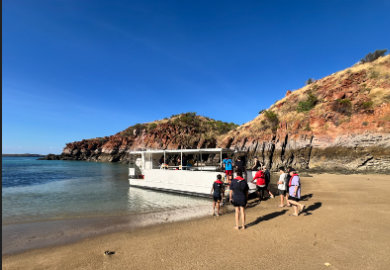
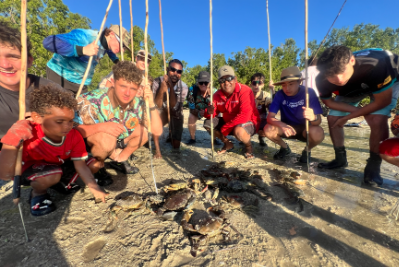
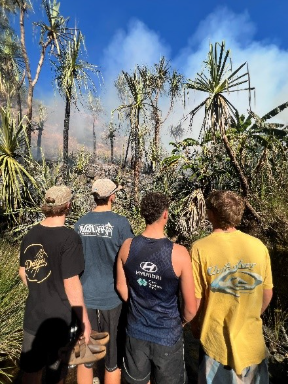
The next day we went on the tour of our lives departing from Cygnet Bay and touring all of the privately owned islands by different elders and families. We visited Bolos Island which was very sacred to him and his family because it is where lots of cultural teaching has occurred and we had the privilege to help him with the back burning of his island along with many other places throughout the trip. He taught us how to get fresh water when we were there and welcomed us onto his country. On the final night Bolos children and grandchildren performed a traditional dance and song for us which was a once in a lifetime experience and showed us their totems they used in the dance. They explained that all of their tribes cultural knowledge was passed down by singing and dancing and nothing is written down, it is all taught through songs which made us as a group feel really special that we were learning their culture the same way it is taught to everyone else. After that we enjoyed the biggest feed including all of the crabs we had caught, dugong, turtle, stingray and much, much more around the campfire.
The next day we stayed in Broome for a night before heading home the next morning. These were some of the highlights of the best trip of my life alongside the 30 degree days, morning runs & swims, beautiful sunsets, new friendships and endless cultural knowledge. I personally recommend this trip to anyone and everyone ready to step out of their comfort zone and connect with the land like they have never thought was possible. It is totally worth it!
All photos including the Dampier Pensiular children have been taken with the consent of the school on the behalf of the parents.