
Principal

International Women’s Day – Building Respectful Young Men
Last week, our school community marked International Women’s Day with an assembly focused not only on celebrating the achievements of women, but also on helping our students reflect on the role they play in creating respectful environments.
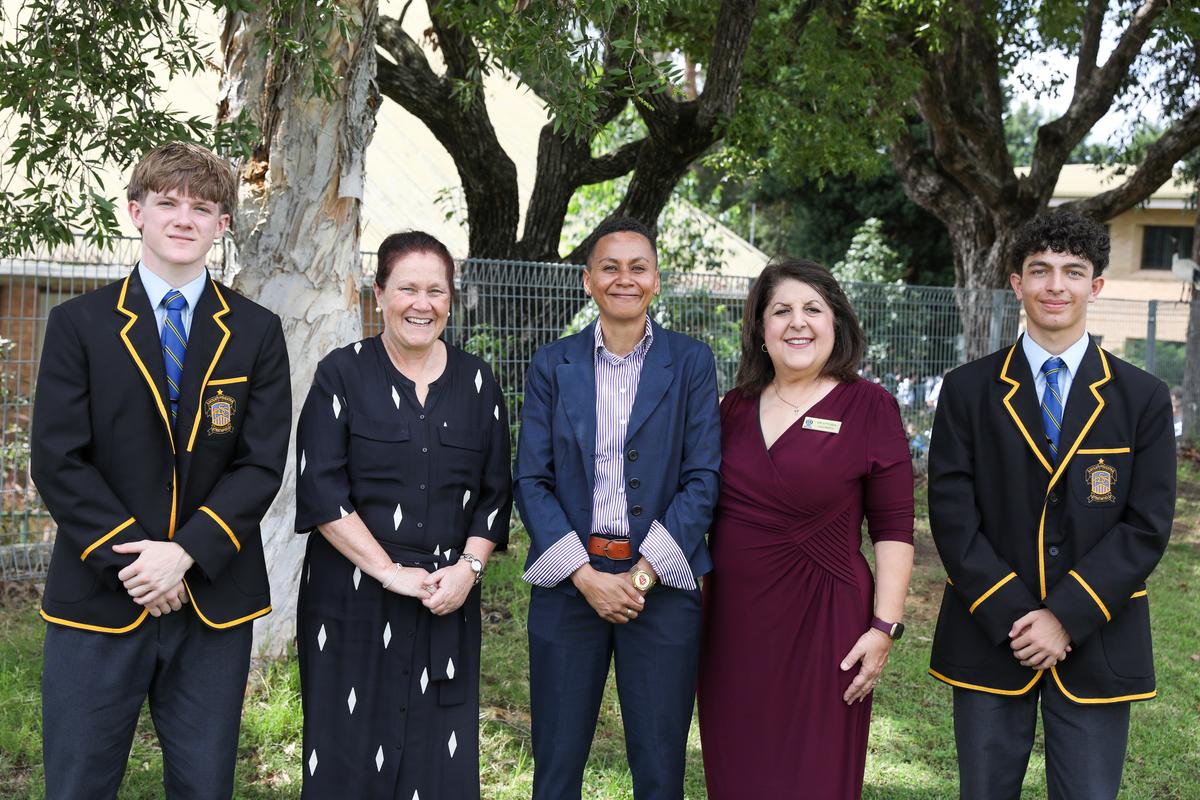
International Women’s Day is both a celebration and a moment for honest reflection. Australia has produced remarkable women across many fields — in leadership, science, sport and public life — whose contributions have shaped our national story. At the same time, it is important to recognise that many women still experience environments where their authority or expertise is questioned or undermined in subtle ways.
During the assembly, students were invited to consider what these experiences can look like in everyday settings. Often, they are not dramatic events, but small, repeated behaviours that can gradually shape how respected and welcome someone feels. In a school environment, these behaviours can include eye-rolling or exaggerated sighs when instructions are given, whispered commentary among peers, joking remarks about appearance, or testing authority in ways that would not occur with others.
I spoke openly with the boys about micro-aggressions — small, often unintentional behaviours that send subtle messages about respect and authority. These might include speaking over someone, dismissive body language, muttered remarks under breath, or groups of students dominating shared spaces rather than instinctively making room for others. While each moment may seem minor in isolation, repeated over time they can undermine a person’s sense of authority and belonging.
In particular, we encouraged students to be conscious of how these behaviours can affect female staff. Teachers and support staff come to school each day as qualified professionals committed to educating and supporting our students. They should not have to navigate eyerolling, whispered commentary, exaggerated reactions, or group posturing simply for doing their jobs. Developing the awareness to recognise these behaviours — and the maturity to avoid or challenge them — is an important step in becoming respectful young men.
A key part of the conversation also focused on the influence of group behaviour. Individually, many boys are thoughtful and respectful. However, when large groups of teenagers gather, dynamics can change. Volume rises, bravado increases and behaviour can shift as students respond to peer expectations. In these moments, actions that might seem humorous within a group can unintentionally undermine others.
Students were encouraged to reflect on how the small choices they make — making space for others, listening without commentary, responding respectfully to correction, and challenging disrespectful remarks among peers — contribute to the College’s culture. These habits matter because the behaviours young men practise now often become the behaviours they carry into universities, workplaces and relationships later in life.
Within our Christian context, we also reflected on Jesus' example and the way he treated women during his ministry. In the cultural context of first-century Judea, women were often marginalised socially and religiously. Yet the Gospels consistently show Jesus engaging with women in ways that were strikingly countercultural.
One example is his encounter with the Samaritan woman at the well (John 4). At a time when Jewish men rarely spoke publicly with women — and when Jews typically avoided Samaritans — Jesus not only initiated conversation with her but engaged her in a profound theological discussion. He listened to her, spoke openly about faith and identity, and entrusted her with sharing the message of what she had experienced.
Another example occurs when a crowd prepared to stone a woman accused of adultery (John 8). In that moment, Jesus confronted the hypocrisy of those seeking punishment, responding with the words, “Let the one among you who is without sin cast the first stone.” Rather than condemning her, he defended her dignity and challenged the crowd’s willingness to judge.
Women were also among Jesus’ closest followers. The Gospels describe figures such as Mary Magdalene, Joanna and Susanna who travelled with Jesus and supported his ministry (Luke 8). At the crucifixion, when many male disciples had fled in fear, women remained present at the foot of the cross. According to the Gospel accounts, women were also the first witnesses to the resurrection, entrusted with sharing news of one of the most significant moments in Christian belief.
In a society where women’s voices were often discounted, Jesus listened to them, affirmed them and included them in the life of his ministry. His actions demonstrated that dignity and respect are not optional values — they are central to Christian leadership.
Students were reminded that, in this understanding, strength is not about dominance or bravado. Rather, it is shown through self-control, humility and respect for others.
International Women’s Day provided an opportunity to ask our students an important question: Who are you when you are alone, and who are you when you are in a group?
Character is often revealed in those everyday moments — when we choose whether to follow the crowd or quietly set a different standard.
Our hope is that conversations like these help our students grow not only academically, but also in character, maturity and leadership. Respectful habits formed during school years become the foundation for how young men conduct themselves in the wider world.
International Women’s Day reminded us that building a respectful culture does not depend on grand gestures. It is shaped by small, consistent choices made every day.
Thank you, as always, for the role you play at home in reinforcing these values. Together, we continue to support the development of young men who are confident, considerate and respectful in every environment they enter.
NAPLAN Begins This Week: Why There’s No Need to Feel Anxious
NAPLAN testing began today (Wednesday) for students across Australia, and while it can sometimes cause concern for both parents, carers and students, education experts emphasise that there is no need to feel anxious. The National Assessment Program – Literacy and Numeracy (NAPLAN) is designed to measure key literacy and numeracy skills and provide useful information about how students are progressing in their learning. It is not a pass-or-fail exam, and the results are not used to grade individual students as they are with classroom assessments.
While NAPLAN focuses on student performance, it also plays an important role in helping schools evaluate and improve their teaching programs. The results provide valuable information that helps schools understand how well students are learning and where improvements may be needed.
One of the most important roles of NAPLAN is benchmarking student achievement. Because the test is the same across the country, it allows schools to compare their students’ results with national and state averages. This comparison helps educators understand whether their students are performing at expected levels. If results show that students are performing below the national average in areas such as writing or numeracy, schools can recognise that additional support or different teaching approaches may be needed. In this way, NAPLAN acts as a reference point for measuring student learning.
NAPLAN results also help schools inform teaching and curriculum decisions. Teachers and school leaders analyse the data to identify specific learning areas that may require improvement. For example, if many students struggle with persuasive writing, the school may introduce additional writing activities or targeted literacy programs. Similarly, if students find certain mathematical concepts challenging, teachers can adjust their lessons to provide more practice and support. By using NAPLAN data in this way, schools can make informed decisions that strengthen teaching strategies and classroom learning.
Another important benefit of NAPLAN is that it helps schools monitor their performance over time. Because the tests are conducted regularly, schools can track results from year to year and see whether students are improving. This allows educators to evaluate whether new programs or teaching approaches are effective. For example, if a school introduces a new literacy initiative, future NAPLAN results can help indicate whether students’ reading and writing skills are improving as a result.
NAPLAN also contributes to accountability and transparency in education. Results are published by the Australian Curriculum, Assessment and Reporting Authority on the My School website, where parents and the community can view general information about school performance. This allows families to see how schools compare with others that have similar student populations. For schools, this public reporting encourages ongoing improvement and helps maintain consistent educational standards across the country.
In addition, NAPLAN can help schools identify students who may need extra support. If results show that a student is having difficulty in areas such as reading comprehension or numeracy, teachers can provide targeted assistance through tutoring, small-group instruction, or specialised learning support. Identifying learning challenges early helps ensure students receive the help they need to succeed.
Finally, NAPLAN data can help inform education funding and policy decisions. Education authorities analyse the results to understand broader trends in student achievement across Australia. This information can guide where additional resources and support programs are directed, helping ensure schools that need extra assistance receive it.
Overall, while NAPLAN week can feel important, it should be viewed as just one part of a student’s learning journey. The assessment provides helpful information for schools and educators, but it does not define a student’s abilities or future success. Instead, it serves as a tool to support continued improvement in teaching and learning across Australia.
I would also like to thank Ms Carpenter, Mrs Tatola and Mrs Metua for overseeing the testing process for students in Years 5, 7 and 9. Their organisation and supervision helped ensure the assessments ran smoothly throughout the day and no doubt, the rest of the week. We also extend our thanks to Mr Sazdanovski and the IT Team for providing technical support and assisting students with the online testing platform.
Community News
Mr David Dunne has advised me of the wonderful news that he and his wife will be welcoming their second child in mid-May.
Mrs Amanda Metua, Head of Diverse Learning, has resigned her position at the College to take up a three-year contract with the Cook Islands Ministry of Education as Literacy Consultant and Facilitator. It will be an exciting new adventure for her, and we wish her well. She has made an enormous contribution to the learning needs of hundreds of our students, and she will be hard to replace. Her last day at SPC will be Monday, 30 March 2026.
We keep in our prayers Ms Taylor Cooper (PE Teacher) whose grandmother has been very unwell for some time.
Our condolences go to:
Mr Matthew Pasternasky whose grandfather passed away over the weekend.
the Gliddon Family - Will (Year 11), Lachlan (Year 9), Xavier (Year 6), Old Boys Stephen (’82), Ross (’84), Andrew (’88), Mark (’93) and Paul (’95) on the loss of their grandfather and father, Mr John Gliddon, last week.
Eternal rest grant unto them, O Lord, and let perpetual light shine upon them. May their souls and the souls of all the faithful departed, Through the mercy of God, rest in peace. Amen. |
|---|
Dr Vittoria Lavorato
Principal
SPC boys can do anything!
**except divide by zero