
ANAPHYLAXIS MANAGEMENT POLICY
Start creating your first online newsletter now

ANAPHYLAXIS MANAGEMENT POLICY
Start creating your first online newsletter now
ANAPHYLAXIS MANAGEMENT POLICY 2026-2027
Help for non-English speakers: If you need help to understand this policy, please contact Glenroy College on 9304 0400
Rationale:
To explain to Glenroy College parents, carers, staff and students the processes and procedures in place to support students diagnosed as being at risk of suffering from anaphylaxis. This policy also ensures that Glenroy College is compliant with Ministerial Order 706 and the Department’s guidelines for anaphylaxis management.
Scope:
This policy applies to:
all staff, including causal relief staff and volunteers
all students who have been diagnosed with anaphylaxis or who may require emergency treatment for an anaphylactic reaction and their parents and carers.
Policy:
School Statement
Glenroy College will fully comply with Ministerial Order 706 and the associated guidelines published by the Department of Education.
Anaphylaxis
Anaphylaxis is a severe allergic reaction that occurs after exposure to an allergen. The most common allergens for school-aged children are nuts, eggs, cow’s milk, fish, shellfish, wheat, soy, sesame, latex, certain insect stings and medication.
Symptoms
Signs and symptoms of a mild to moderate allergic reaction can include:
swelling of the lips, face and eyes
hives or welts
tingling in the mouth.
Signs and symptoms of anaphylaxis, a severe allergic reaction, can include:
difficult/noisy breathing
swelling of tongue
difficulty talking and/or hoarse voice
wheeze or persistent cough
persistent dizziness or collapse
student appears pale or floppy
abdominal pain and/or vomiting.
Symptoms usually develop within ten minutes and up to two hours after exposure to an allergen but can appear within a few minutes.
Treatment
Adrenaline given as an injection into the muscle of the outer mid-thigh is the first aid treatment for anaphylaxis.
Individuals diagnosed as being at risk of anaphylaxis are prescribed an adrenaline autoinjector for use in an emergency. These adrenaline autoinjectors are designed so that anyone can use them in an emergency.
Individual Anaphylaxis Management Plans
All students at Glenroy College who are diagnosed by a medical practitioner as being at risk of suffering from an anaphylactic reaction must have an Individual Anaphylaxis Management Plan. When notified of an anaphylaxis diagnosis, the Principal of Glenroy College is responsible for developing a plan in consultation with the student’s parents/carers.
Where necessary, an Individual Anaphylaxis Management Plan will be in place as soon as practicable after a student enrols at Glenroy College and where possible, before the student’s first day.
Parents and carers must:
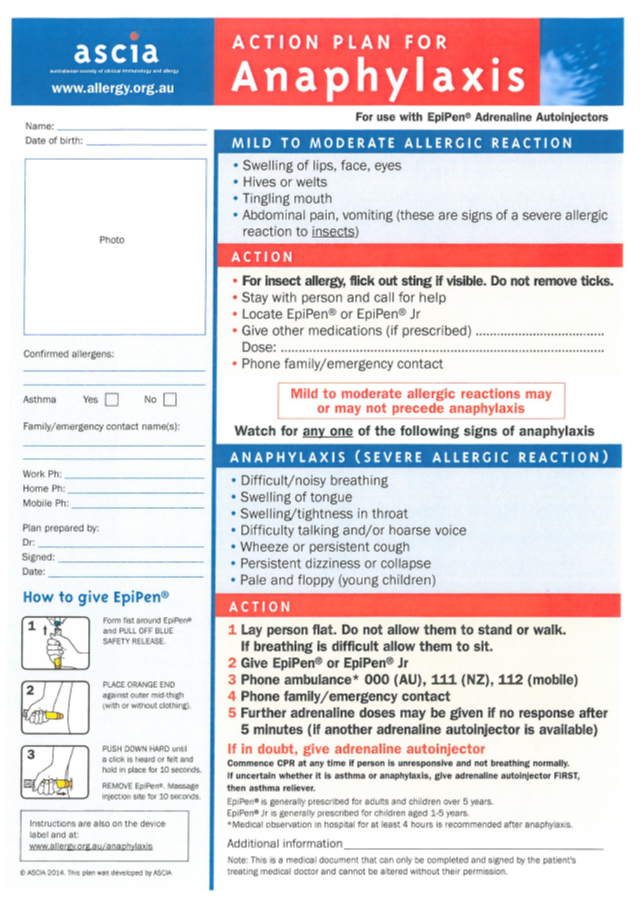
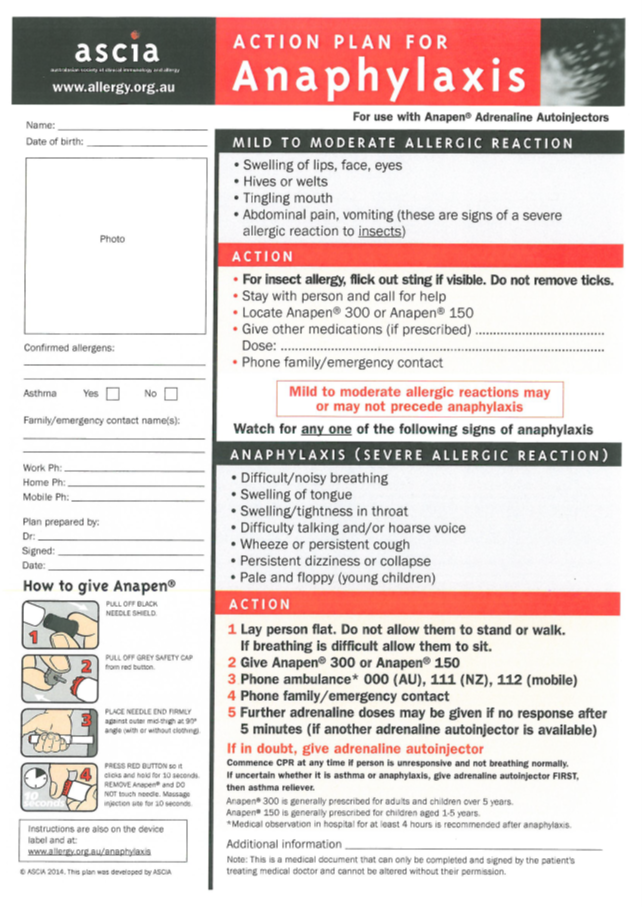
obtain an ASCIA Action Plan for Anaphylaxis from the student’s medical practitioner and provide a copy to the school as soon as practicable
immediately inform the school in writing if there is a relevant change in the student’s medical condition and obtain an updated ASCIA Action Plan for Anaphylaxis
provide an up-to-date photo of the student for the ASCIA Action Plan for Anaphylaxis when that Plan is provided to the school and each time it is reviewed
provide the school with a current adrenaline autoinjector for the student that has not expired;
participate in annual reviews of the student’s Plan.
Each student’s Individual Anaphylaxis Management Plan must include:
information about the student’s medical condition that relates to allergies and the potential for anaphylactic reaction, including the type of allergies the student has
information about the signs or symptoms the student might exhibit in the event of an allergic reaction based on a written diagnosis from a medical practitioner
strategies to minimise the risk of exposure to known allergens while the student is under the care or supervision of school staff, including in the school yard, at camps and excursions, or at special events conducted, organised or attended by the school
the name of the person(s) responsible for implementing the risk minimisation strategies, which have been identified in the Plan
information about where the student's medication will be stored
the student's emergency contact details
an up-to-date ASCIA Action Plan for Anaphylaxis completed by the student’s medical practitioner.
Review and updates to Individual Anaphylaxis Management Plans
A student’s Individual Anaphylaxis Management Plan will be reviewed and updated on an annual basis in consultation with the student’s parents/carers. The plan will also be reviewed and, where necessary, updated in the following circumstances:
as soon as practicable after the student has an anaphylactic reaction at school
if the student’s medical condition, insofar as it relates to allergy and the potential for anaphylactic reaction, changes
when the student is participating in an off-site activity, including camps and excursions, or at special events including fetes and concerts.
Our school may also consider updating a student’s Individual Anaphylaxis Management Plan if there is an identified and significant increase in the student’s potential risk of exposure to allergens at school.
Location of plans and adrenaline autoinjectors
A copy of each student’s Individual Anaphylaxis Management Plan will be stored with their ASCIA Action Plan for Anaphylaxis in sick bay and staff room, and plans will also be stored with the student’s adrenaline auto-injector in the general office. Adrenaline auto-injectors must be labelled with the student’s name
Risk Minimisation Strategies
To reduce the risk of a student suffering from an anaphylactic reaction at Glenroy College, we have put in place the following strategies:
staff and students are regularly reminded to wash their hands after eating
students are discouraged from sharing food
gloves must be worn when picking up papers or rubbish in the playground
a general use Epi-Pen will be stored at the College office for ease of access
Adrenaline autoinjectors for general use
Glenroy College will maintain a supply of adrenaline autoinjector(s) for general use, as a back-up to those provided by parents and carers for specific students, and also for students who may suffer from a first time reaction at school.
Adrenaline autoinjectors for general use will be stored at First Aid and labelled “general use”.
The Principal is responsible for arranging the purchase of adrenaline autoinjectors for general use, and will consider:
the number of students enrolled at Example School at risk of anaphylaxis
the accessibility of adrenaline autoinjectors supplied by parents
the availability of a sufficient supply of autoinjectors for general use in different locations at the school, as well as at camps, excursions and events
the limited life span of adrenaline autoinjectors, and the need for general use adrenaline autoinjectors to be replaced when used or prior to expiry
the weight of the students at risk of anaphylaxis to determine the correct dosage of adrenaline autoinjector/s to purchase.
Emergency Response
In the event of an anaphylactic reaction, the emergency response procedures in this policy must be followed, together with the school’s general first aid procedures, emergency response procedures and the student’s Individual Anaphylaxis Management Plan.
A complete and up-to-date list of students identified as being at risk of anaphylaxis is maintained by the First Aid Officer and stored at First Aid. For camps, excursions and special events, a designated staff member will be responsible for maintaining a list of students at risk of anaphylaxis attending the special event, together with their Individual Anaphylaxis Management Plans and adrenaline autoinjectors, where appropriate.
If a student experiences an anaphylactic reaction at school or during a school activity, school staff must:
Step | Action |
1. |
|
2. | Administer an EpiPen or EpiPen Jr
OR
Administer an Anapen® 500, Anapen® 300, or Anapen® Jr.
|
3. | Call an ambulance (000) |
4. | If there is no improvement or severe symptoms progress (as described in the ASCIA Action Plan for Anaphylaxis), further adrenaline doses may be administered every five minutes, if other adrenaline autoinjectors are available. |
5. | Contact the student’s emergency contacts. |
If a student appears to be having a severe allergic reaction but has not been previously diagnosed with an allergy or being at risk of anaphylaxis, school staff should follow steps 2 – 5 as above.
Schools can use either the EpiPen® and Anapen® on any student suspected to be experiencing an anaphylactic reaction, regardless of the device prescribed in their ASCIA Action Plan.
Where possible, schools should consider using the correct dose of adrenaline autoinjector depending on the weight of the student. However, in an emergency if there is no other option available, any device should be administered to the student.
Communication Plan
This policy will be available on the Glenroy College website so that parents and other members of the College community can easily access information about Glenroy College’s anaphylaxis management procedures. The parents and carers of students who are enrolled at Glenroy College and are identified as being at risk of anaphylaxis will also be provided with a copy of this policy.
The Principal and School Anaphylaxis Supervisor are responsible for ensuring that all relevant staff, including casual relief staff and volunteers are aware of this policy and Glenroy College procedures for anaphylaxis management. Casual relief staff and volunteers who are responsible for the care and/or supervision of students who are identified as being at risk of anaphylaxis will also receive a verbal briefing on this policy by the Daily Organiser.
The Principal is also responsible for ensuring relevant staff are trained and briefed in anaphylaxis management, consistent with the Department’s Anaphylaxis Guidelines.
Staff training
Staff at Glenroy College will receive appropriate training in anaphylaxis management, consistent with the Department’s Anaphylaxis Guidelines.
Staff who are responsible for conducting classes that students who are at risk of anaphylaxis attend, and any further staff that the Principal identifies, must have completed:
an approved face-to-face anaphylaxis management training course in the last three years, or
an approved online anaphylaxis management training course in the last two years.
Glenroy College uses the following training course [ASCIA eTraining].
Staff are also required to attend a briefing on anaphylaxis management and this Policy at least twice per year, facilitated by a staff member who has successfully completed an anaphylaxis management course within the last 12 months, including the Principal and School Anaphylaxis Supervisor. Each briefing will address:
this Policy
the causes, symptoms and treatment of anaphylaxis
the identities of students with a medical condition that relates to an allergy and the potential for anaphylactic reaction, and where their medication is located
how to use an adrenaline auto-injector, including hands on practice with a trainer adrenaline auto-injector
the College’s general first aid and emergency response procedures
the location of, and access to, adrenaline auto-injectors that have been provided by parents or purchased by the College for general use.
When a new student enrols at Glenroy College who is at risk of anaphylaxis, the Principal will develop an interim plan in consultation with the student’s parents/carers and ensure that appropriate staff are trained and briefed as soon as possible.
The Principal will ensure that while students at risk of anaphylaxis are under the care or supervision of the school outside of normal class activities, including in the school yard, at camps and excursions, or at special event days, there is a sufficient number of school staff present who have been trained in anaphylaxis management.
Further information and resources
The Department’s Policy and Advisory Library (PAL):
ASCIA Guidelines: Schooling and childcare
Royal Children’s Hospital: Allergy and immunology
POLICY REVIEW AND APPROVAL
| Policy last reviewed | April 2026 |
| Approved by | Principal |
| Next scheduled review date | April 2028 |
The Principal will complete the Department’s Annual Risk Management Checklist for anaphylaxis management to assist with the evaluation and review of this policy and the support provided to students at risk of anaphylaxis.
Individual Anaphylaxis Management Plan
This plan is to be completed by the Principal or nominee on the basis of information from the student's medical practitioner (ASCIA Action Plan for Anaphylaxis) provided by the Parent. It is the Parents' responsibility to provide the College with a copy of the student's ASCIA Action Plan for Anaphylaxis containing the emergency procedures plan (signed by the student's Medical Practitioner) and an up-to-date photo of the student - to be appended to this plan; and to inform the College if their child's medical condition changes. | |||||||
| School | Phone | ||||||
| Student | |||||||
| DOB | Year level | ||||||
Severely allergic to:
| |||||||
Other health conditions
| |||||||
Medication at school
| |||||||
EMERGENCY CONTACT DETAILS (PARENT) | |||||||
| Name | Name | ||||||
| Relationship | Relationship | ||||||
| Home phone | Home phone | ||||||
| Work phone | Work phone | ||||||
| Mobile | Mobile | ||||||
| Address |
| Address | |||||
EMERGENCY CONTACT DETAILS (ALTERNATE) | |||||||
| Name | Name | ||||||
| Relationship | Relationship | ||||||
| Home phone | Home phone | ||||||
| Work phone | Work phone | ||||||
| Mobile | Mobile | ||||||
| Address |
| Address | |||||
| Medical practitioner contact | Name | ||||||
| Phone | |||||||
| Emergency care to be provided at school |
| ||||||
| Storage for Adrenaline Autoinjector (device specific) (EpiPen®/ Anapen®) |
| ||||||
ENVIRONMENT | |||||||
| To be completed by Principal or nominee. Please consider each environment/area (on and off school site) the student will be in for the year, e.g. classroom, canteen, food tech room, sports oval, excursions and camps etc. | |||||||
| Name of environment/area: | |||||||
| Risk identified | Actions required to minimise the risk | Who is responsible? | Completion date? | ||||
| Name of environment/area: | |||||||
| Risk identified | Actions required to minimise the risk | Who is responsible? | Completion date? | ||||
| Name of environment/area: | |||||||
| Risk identified | Actions required to minimise the risk | Who is responsible? | Completion date? | ||||
| Name of environment/area: | |||||||
| Risk identified | Actions required to minimise the risk | Who is responsible? | Completion date? | ||||
| Name of environment/area: | |||||||
| Risk identified | Actions required to minimise the risk | Who is responsible? | Completion date? | ||||
This Individual Anaphylaxis Management Plan will be reviewed on any of the following occurrences (whichever happen earlier):
I have been consulted in the development of this Individual Anaphylaxis Management Plan. I consent to the risk minimisation strategies proposed. Risk minimisation strategies are available at Chapter 8 - Prevention Strategies of the Anaphylaxis Guidelines | |
| Signature of parent: |
|
| Date: | |
| I have consulted the Parents of the students and the relevant College Staff who will be involved in the implementation of this Individual Anaphylaxis Management Plan. | |
Signature of Principal (or nominee):
| |
| Date: | |
Anaphylaxis – Who Does What at the College
Documents:
DET check list:
Glenroy College Management Plan for students with Anaphylaxis - Camps and Excursions form
Event: ______________________________________________________
Event co-ordinator: ____________________________________________
Anaphylaxis prevention and risk management on camps and excursions | Strategy | Person responsible | Signature & Date |
| Lack of awareness of parent/carer about risks involved at camp/excursion | Phone or “in person” discussion between staff and parent about prevention, risks, and first aid management for anaphylaxis before the camp/event. | Event co-ordinator | |
| Remote and rural locations of events and travel to and from the event access to emergency medical care. | (please fill in, will be different, depending on location)
| Event co-ordinator | |
| Other risks in the environment-specify | Event co-ordinator | ||
Lack of awareness of prevention strategies by staff in attendance
| All staff attending to know names of students with anaphylaxis and what is in their school management plan for prevention (kept in first aid room).
Co-ordinator to disseminate information about prevention strategies with all staff members and the student prior to event. | Event co-ordinator
Event co-ordinator & Student
| |
Lack of awareness of anaphylaxis first aid management
| At least 50% of staff member attending to have current anaphylaxis first aid training.
All staff to be aware of their role in first aid emergencies at the event and the location of the student’s Epi-Pen and action plan. | Event co-ordinator
All staff on camp/at event |
Risk Minimisation Strategies Discussion Guide – Staff/Camp Co-ordinators
Ideas on Risk Minimisation Strategies in the College and/or Childcare Environment – this provides ideas for staff/coordinators about what to put in the risk management prevention boxes. It cannot be prefilled in as each camp /allergy /student will be different
Copyright © Anaphylaxis Australia Inc 2011 Permission granted for use by DET from July 1 2011 to July 1 2014,ACN 159 809 051
Risk Minimisation Strategies in School and/or Childcare
All staff members should know who the child/student at risk of anaphylaxis is by sight. They are not to be left
alone when complaining of feeling unwell, even in sickbay. Their complaint should always be taken seriously.
The many areas of risk and the strategies one might implement to reduce the risk of an allergic reaction vary greatly according to a number of factors including:
The following list of strategies is meant to be used as a guide or as a tool to prompt thought on achievable risk minimisation procedures in an environment where there is an individual who is at risk of a potentially life
threatening allergic reaction. It is not an exhaustive list of all strategies that could be implemented in any given environment.
School and Children’s Services staff are encouraged to work with the parents of the child at risk in the production of an individualised School/Children’s Services management plan which could include some of the strategies listed in this discussion paper as well as others specific to the child’s needs.
* Information on strategies to help prevent insect sting reactions is included at the end of this long list of strategies. In young children, the risk of anaphylaxis from insect sting reactions is much lower than the risk from food allergic reactions but it certainly does still occur.
Whilst every child at risk of anaphylaxis in Victorian Schools and Children’s Services must have an ASCIA Action Plan for Anaphylaxis provided by their doctor, each child at risk must also have an Individual Management Plan which details strategies to help reduce risk for that child. This Individual Management Plan is developed on enrolment after the School/Children’s Service has a face to face meeting with parents. Once the plan is agreed to by the parents and School/ Children’s Service, the plan is signed off by both parties. The Individual Management Plan for each child is to be reviewed yearly OR after a reaction, in case management strategies are to be changed. As the child gets older and has more understanding of personal management, strategies do differ. A child may also outgrow an allergy or develop another allergy.
| RISK | Considerations when you have a child at risk of anaphylaxis in your care |
| Food brought to school | • Consider sending out an information sheet to the parent community on severe allergy and the risk of anaphylaxis. • Alert parents to strategies that the College has in place and the need for their child to not share food and to wash hands after eating. |
| College fundraising/ special events/cultural days | • Consider children with food allergy when planning any fundraisers, cultural days or stalls for fair/fete days, breakfast mornings etc. Notices may need to be sent to parent community discouraging specific food products. E.g. nuts |
| Food rewards | • Food rewards should be discouraged and non-food rewards encouraged. • Children at risk of food anaphylaxis should eat food that is supplied by their parents or food that is agreed to by parents prior to a given event. If required a clearly labelled ‘treat box’ could be supplied by parents and located in child’s classroom. |
Class parties / Birthday celebrations | • Discuss these activities with parents of allergic child well in advance • Suggest that a notice is sent home to all parents prior to the event, discouraging specific food products • Teacher may ask the parent to attend the party as a ‘parent helper’ • Child at risk of anaphylaxis should not share food brought in by other students. Ideally they should bring own food. • Child can participate in spontaneous birthday celebrations by parents supplying ‘treat box’ or safe cup cakes stored in freezer in a labelled sealed container |
| Cooking/Food Technology | • Engage parents in discussion prior to cooking sessions and activities using food. • Remind all children to not share food they have cooked with others at school. |
| Science experiments | • Engage parents in discussion prior to experiments containing foods. |
| Students picking up papers | • Students at risk of food or insect sting anaphylaxis should be excused from this duty. Non rubbish collecting duties are encouraged. |
| Music | • Music teacher to be aware, there should be no sharing of wind instruments e.g. recorders. Speak with the parent about providing the child’s own instrument. |
Art and craft classes
| • Ensure containers used by students at risk of anaphylaxis do not contain allergens .e.g. egg white or yolk on an egg carton. • Activities such as face painting or mask making (when moulded on the face of the child), should be discussed with parents prior to the event, as products used may contain food allergens such as peanut, tree nut, milk or egg. • Care to be taken with play dough etc. Check that nut oils have not been used in manufacture. Discuss options with parent of wheat allergic child. |
Canteen
| • Does canteen offer foods that contain the allergen? • What care is taken to reduce the risk to a child with allergies who may order/ purchase food? Strategies to reduce the risk of an allergic reaction can include: • Staff (including volunteer helpers) educated on food handling procedures and risk of cross contamination of foods said to be ‘safe’ • Child having distinguishable lunch order bag • Restriction on who serves the child when they go to the canteen • Discuss possibility of photos of the children at risk of anaphylaxis being placed in the canteen/children’s service kitchen. • Encourage parents of child to visit canteen/Children’s Service kitchen to view products available. • See Anaphylaxis Australia’s School Canteen poster, Preschool/Playgroup posters and School Canteen Discussion Guide. www.allergyfacts.org.au |
Sunscreen
| • Parents of children at risk of anaphylaxis should be informed that sunscreen is offered to children. They may want to provide their own. |
| Hand washing | • Classmates encouraged to wash their hands after eating. |
Part-time educators, casual relief teachers & religious instruction teachers
Suggestions:
| • These educators need to know the identities of children at risk of anaphylaxis and should be aware of the College’s management plans, which includes minimisation strategies initiated by the College community. Some casual staff have not received training in anaphylaxis management and emergency treatment. This needs to be considered when a teacher is chosen for a class with a child at risk of anaphylaxis and if this teacher is on playground/yard duty. • Casual staff who work at the College regularly, should be included in anaphylaxis training sessions to increase the likelihood that they recognise an allergic reaction and know how to administer the adrenaline auto-injector. • Schools should have interim educational tools such as auto-injector training devices and DVDs available to all staff. • A free online training course for teachers and Children’s Service staff is available whilst waiting for face to face training by a DET nominated anaphylaxis education provider. Visit ASCIA www.allergy.org.au. This course can also be done as a refresher. |
Use of food as counters
| • Be aware of children with food allergies when deciding on ‘counters’ to be used in mathematics or other class lessons. Non-food ‘counters’ such as buttons /discs may be a safer option than chocolate beans. |
Class rotations
| • All teachers will need to consider children at risk of anaphylaxis when planning rotational activities for year level, even if they do not currently have a child enrolled who is at risk, in their class. |
Class pets/ pet visitors /school farmyard
| • Be aware that some animal feed contains food allergens. E.g. nuts in birdseed and cow feed, milk and egg in dog food, fish in fish food. • Chickens hatching in classroom. Children’s Services facilities and Schools sometimes organise incubators from hatcheries and hatch chicks for fun and learning. Generally speaking, simply watching chicks hatch in an incubator poses no risk to children with egg allergy, but all children should be encouraged to wash their hands after touching the incubation box in case there is any residual egg content on it. There is a little more risk when it comes to children handling the chicks. Here are some suggestions to reduce the risk of a reaction and still enable the child with allergy to participate in the touch activity. • The allergic child can touch a chick that hatched the previous day (i.e. a chick that is more than just a couple of hours old); no wet feathers should be present. • Encourage the parent/carer of the child with the allergy to be present during this activity so they can closely supervise their child and make sure the child does not put his/her fingers in their mouth. • If there is concern about the child having a skin reaction, consider the child wearing gloves. • All children need to wash hands after touching the chicks in case there is any residue of egg protein, in addition to usual hygiene purposes. Whilst care needs to be taken, this is an activity that most children can enjoy with some safe guards in place. |
| Incursions | • Prior discussion with parents if incursions include any food activities. |
Excursions, Sports carnivals, Swimming program
| • Teachers organising/attending excursion or sporting event should plan an emergency response procedure prior to the event. This should outline the roles and responsibilities of teachers attending, if an anaphylactic reaction occurs. This includes distribution of laminated cards to all attending teachers, detailing the following: • Location of event, including Melway reference or nearest cross street.
Procedure for calling ambulance, advising life threatening allergic reaction has occurred and adrenaline is required. |
Staff should also:
| • Carry mobile phones. Prior to event, check that mobile phone reception is available and if not, consider other form of emergency communication i.e. walkie talkie. • Consider increased supervision depending on size of excursion/sporting event i.e. if students are split into groups at large venue e.g. zoo, or at large sports venue for sports carnival. • Consider adding a reminder to all parents regarding children with allergies on the excursion/sports authorisation form and encourage parents not to send in specific foods in lunches (e.g. food containing nuts). • Discourage eating on buses. • Check if excursion includes a food related activity, if so discuss with parent. • Ensure that all teachers are aware of the location of the emergency medical kit containing adrenaline auto-injector. |
Medical Kits
| (Student’s own and school’s auto-injector for general use) • Medical kit containing ASCIA Action Plan for Anaphylaxis and adrenaline auto-injector should be easily accessible to child at risk and the adult/s responsible for their care at all times. On excursions ensure that the teacher accompanying the child’s group carries the medical kit. For sporting events this may be more difficult, however, all staff and parent volunteers must always be aware of who has the kit and where it is. Be aware - adrenaline auto-injectors should not be left sitting in the sun, in parked cars or buses. Parents are often available to assist teachers on excursions in Children’s Services and primary schools. If child at risk is attending without a parent, the child should remain in the group of the teacher who has been trained in anaphylaxis management, rather than be given to a parent volunteer to manage. This teacher should carry the medical kit. |
School camps
| Parent involvement at primary school camps is often requested. Many primary schools invite the parent of the child at risk of anaphylaxis to attend as a parent helper. Irrespective of whether child is attending primary school or secondary college, parents of child at risk should have face to face meeting with school staff/camp coordinator prior to camp to discuss safety including the following: • School’s emergency response procedures, should clearly outline roles and responsibilities of the teachers in policing prevention strategies and their roles and responsibilities in the event of an anaphylactic reaction. • All teachers attending the camp should carry laminated emergency cards, detailing the location of the camp and correct procedure for calling ambulance, advising the call centre that a life threatening allergic reaction has occurred and adrenaline is required. • Staff to practise with adrenaline auto-injector training devices ( Epi-Pen® and AnaPen® Trainers) and view DVDs prior to camp. • Consider contacting local emergency services and hospital prior to camp and advise that xx children in attendance at xx location on xx date including child/ren at risk of anaphylaxis. Ascertain location of closest hospital, ability of ambulance to get to camp site area i.e. consider locked gates etc in remote areas. • Confirm mobile phone network coverage for standard mobile phones prior to camp. If no access to mobile phone network, alternative needs to be discussed and arranged. • Parents should be encouraged to provide two adrenaline auto-injectors along with the Action Plan for Anaphylaxis and any other required medications whilst the child is on the camp. • Clear advice should be communicated to all parents prior to camp on what foods are not allowed. • Parents of child at risk of anaphylaxis and school need to communicate about food for the duration of the camp. Parent should communicate directly with the provider of the food/chef/caterer and discuss food options/menu, cross contamination risks, safest food choices, bringing own food. • Parents may prefer to provide all child’s food for the duration of the camp. This is the safest option. If this is the case, storage and heating of food needs to be organised as well.
Discussions by school staff and parents with the operators of the camp facility should be undertaken well in advance of camp. Example of topics that need to be discussed would be: 1.Possibility of removal of peanut/tree nut from menu for the duration of the camp. 2. Creation of strategies to help reduce the risk of an allergic reaction where the allergen cannot be removed i.e. egg, milk, wheat. A decision may be made to remove pavlova as an option for dessert if egg allergic child attending for example. 3. Awareness of cross contamination of allergens in general i.e. during storage, preparation and serving of food. 4. Discussion of menu for the duration of the camp. 5. Games and activities should not involve the use of known allergens. 6. Camp organisers need to consider domestic activities which they assign to children on camp. It is safer to have the child with food allergy set tables, for example, than clear plates and clean up.
Allergy & Anaphylaxis Australia has launched a new publication titled Preparing for Camps and Overnight School Trips with Food Allergies. This comprehensive booklet consists of concise and easy-to-read information and ideas on preparing for school camp when you have students at risk of anaphylaxis. To purchase or for more information call 1300 728 000 or visit www.allergyfacts.org.au |
*Insect sting allergy
| Children who have a severe insect sting allergy and are at risk of anaphylaxis need to have their adrenaline auto-injector and Action Plan for Anaphylaxis easily accessible at all times. Strategies that reduce the risk of insect stings vary depending on the insect the person is allergic to. Strategies both at school and on excursions can include: • Avoiding being outdoors at certain times of the day • Using insect repellents that contain DEET (Diethyltoluamide, N, N - diethyl - 3- methylbenzamide) • Wearing light coloured clothing that covers most exposed skin • Avoid wearing bright clothing with ‘flower’ type prints • Wearing shoes at all times • Avoiding perfumes or scented body creams/deodorants • Wearing gloves when gardening • Avoid picking up rubbish which may attract insect/s • Being extra careful where there are bodies of water i.e. lake/pond/swimming pool. • Chlorinated pools attract bees • Drive with windows up in the car/windows closed in a bus • Keep your drink (glass/bottle/can) indoors or covered. Always check your drinks before you sip i.e. don’t drink blindly from container. • Keep garbage bins covered – lids on • Keep grass areas mowed (reduce weed such as clover which attracts insects) • Wearing boots and thick clothing such as denim jeans if ant sting allergic and in area where specific ants reside. Avoid ant mounds • Not provoking bees, wasps or ants. Have mounds/nests removed by professionals • Removal of nests when students/teachers are not present • When putting in new plants consider location and select plants less likely to attract stinging insects. Things to consider when purchasing an adrenaline auto-injector for general use for your school or children’s service Many Schools/Children’s Services now have an adrenaline auto-injector for general use and the device specific Action Plan for Anaphylaxis in their first aid kit. If your facility has an auto-injector for general use, you need to consider availability of this device at School or Children’s Service for: • Excursions • for school camp • for specialist activities (i.e. a debating group, music group or sports team going off campus) • even a walk to a local park A risk assessment needs to be done to see which group (i.e. the group staying at the facility or the group going on an outing) should have the device for general use at any given time or on any given day. Considerations can include: • number of children attending outing • number of children at risk • location of the activity • location of emergency services • mobile phone access • food on location etc. |