
Accountability

IEPs week 8
Our school is in the process of exploring the Multi Tiered System of Support (MTSS) framework designed to help us think about how we can best support all students' wellbeing and learning. MTSS defines levels in terms of a tiered continuum of increasing intensity using data based decision making. Further professional learning will support us to increase our knowledge of instructional supports and interventions at each tier.
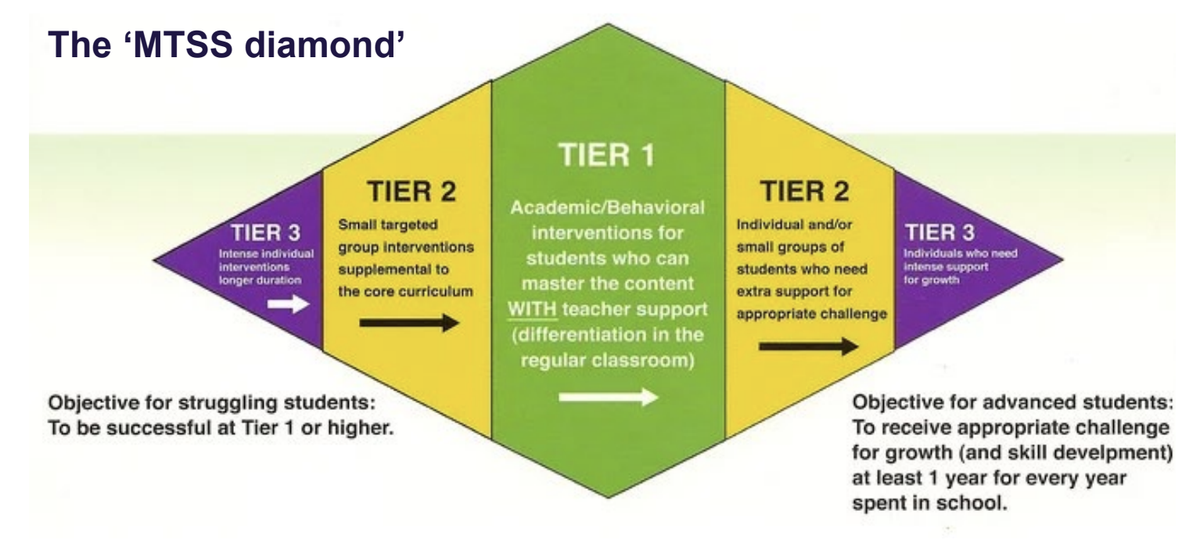
As we engage with professional learning around the MTSS, we will be provided with new guidelines as to which students require an IEP.
Whilst we progress through this professional learning, this term we will focus on developing IEPs and BSPs for students in Tier 3:
| STUDENT PLAN TYPES & REQUIREMENTS |
|---|
| IEP: Individual Educational Plan for learning and/or wellbeing concerns |
| - require 1:1 or very small group support |
| - access external professionals |
| - may have SSGs |
| - have a diagnosis e.g. giftedness, autism, etc |
| - 24 months above or 12 months below |
| - Koorie students |
| - Out of Home Care students |
| - personalised learning plan |
| BSP: A Behaviour Support Plan for ongoing significant behaviour concerns |
| - Provides strategies to address behaviour concerns (e.g. repeatedly hitting others, use of inappropriate language, singing loudly, talking loudly, etc) |
| Safety Plan: A short-term plan to support a child to feel safe and included at school |
| - Provides strategies to maintain the safety and wellbeing of students at school (e.g. bullying concerns, suicidal ideation, preventing potential physical and/or psychological harm, etc.) |
An IEP ensures clear specific goals and frequent monitoring of progress.
Our student profiles have changed over the past few years. Previously, every student who had a diagnosis would require an IEP yet you may have a student who has a diagnosis but responds to Tier 1 strategies responding well to pre-correction and re-direction. Strategies that are used with all students.
You may have a student who, thanks to the targeted strategies recommended by external practitioners and a rigourous IEP, is now functioning in Tier 1 following years of Tier 3 and Tier 2. This student would still require an IEP.
If you have any queries as to whether a IEP is required or not, please discuss with your Sub School PCO.
Janet
SECURITY - everyone makes a difference!
On Monday morning when I arrived at school at 7:15am, the external door to the Junior Campus Language Assistants room was unlocked and ajar, lights were on all over the building, classroom doors were unlocked and the alarm was going off. I thought that I was about to discover a crime scene and moved through the building checking our resources.
Nothing appeared to have been stolen.
We are investigating whether the security company had this on their radar as they had contacted us on Friday night about alarms going off. We were told that the building had been secured.
Whilst I am not sure how the Monday morning situation eventuated, we are fortunate that there appear to be no consequences.
On the Senior Campus, the library has not been armed at the end of the day.
We will speak to the cleaners and ask them to ensure that doors are locked and that the alarms are engaged.
From now on:
- On the Junior Campus DO NOT USE the external door to the Language Assistants Office
- On both campuses, all rooms that are not being used during the day must be locked
When leaving at the end of day, ensure all internal and external doors are locked
This is a great help to ensuring the security in our buildings and of our staff who may still be on site.
Staff support for mental health and wellbeing
DET provides us with excellent mental health and wellbeing services through an organisation called Converge. The services that they offer are:
- Employee Counselling provides support and counselling for various personal and work-related issues.
- Manager Support provides dedicated coaching support to people managers. Principal-class employees, business managers and other school leaders are encouraged to use Manager Support for coaching and advice on staff wellbeing matters, having difficult conversations, leading through change, developing leadership competencies and any other people management matters.
- Career Coaching provides career development advice, interview skills support and vocational counselling.
- Nutrition Support provides specialist advice on nutrition.
- Conflict Support provides strategies, tools and coaching to deal with difficult workplace and personal situations. This is not a replacement for the conflict resolution support service available to staff currently (refer to Further expert health, safety and wellbeing supports).
- Financial Coaching provides money management coaching to help staff address their financial wellbeing.
- Legal Support provides confidential legal advice for personal and non-work-related issues in the following areas of law: personal family law, wills/probate, tenancy/renting, real estate and consumer disputes. Please refer to Legal Support frequently asked questions (DOCX) for further information on the service.
- Family Counselling provides counselling for eligible school staff and their immediate family members (aged 18 and over) needing support with personal concerns. Short-term counselling for small family groups (aged 18 and over) or couples is also available.
To make an Employee Wellbeing Support Services appointment, call 1300 291 071 or book online via the Converge portal entering the organisational code mywellbeing.