Teaching and Learning

EAL/D and Learning Support
This year the EAL/D faculty begins by celebrating the excellent HSC results of 2025. Contrary to popular opinion, the English EAL/D course is an extremely rigorous course, and the standard of excellence is high. Only 4.5% of the candidature receive a Band 6. Since the pandemic the candidature of the EAL/D Course has taken a significant nosedive, which meant that only 1494 students sat the HSC exams in 2025.
With under 70 students receiving a Band 6, we are very proud of Matthew Leung who achieved this with his overall HSC mark of 93. Congratulations are also in order for the significant number in the class who received a Band 5: Chun Hei Chan, Chet Law, Jay Li, Chun Wo Ng, Ho Ming Tsang and Qiaoshi Zhang. Well done to all. Congratulations also to Gina O’Donoghue, the class teacher for producing a class average above the state average in every single exam question. Congratulations also to the rest of the EAL/D faculty who very much embody the ethos of ‘Teamwork makes the Dream Work”. Onwards and upwards for 2026.
Finally, this year Epping Boys High School been successful in gaining a seat at the table at the Department’s annual EAL/D Project. This is a Professional Learning project in which a small team explores areas for growth in our EAL/D teaching and implement these strategies across the school. In 2018 we participated in this project and focused on the teaching strategy of ‘Message Abundancy’. Almost ten years down the track it is time to explore again how our school is currently tracking with EAL/D teaching and what changes we could make to our practices. This year the project will be led by myself as Head Teacher and include a cross-faculty team of Misty Findlay (EAL/D), Rebecca Forrest (History) and Irene Sha (Maths). We begin our planning days at Parramatta in March and will begin sharing with staff at the start of Term 2.
Alison Liard
Head Teacher, Teaching and Learning
Student attendance improvement – SLAM attendance (Student Led Attendance Monitoring) All students to strive above 95%!
Why does attendance matter / What does the research tell us:
Research highlights a clear correlation between student attendance and the achievement of quality academic, socio-economic and health outcomes. This research tells us that students with an attendance rate below 90% are educationally at risk.
Above 95% is our expected student attendance for all students in 2025.
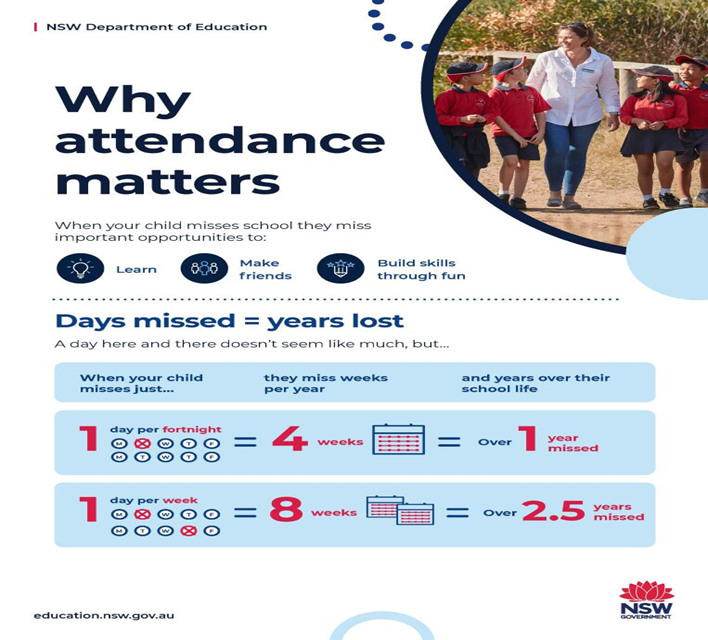
What is the impact of low school attendance on academic, socio- economic and health outcomes?
Various studies have indicated that in students under 90% attendance the educational risk can manifest in the following ways:
● Lower scores and poorer academic outcomes.
● Increased likelihood of dropping out of school earlier.
● Decreased likelihood of engaging in vocational education.
● Poorer long-term mental health and social outcomes.
● Increased likelihood of involvement with criminal activity.
● Increased likelihood of requiring social assistance.
Key structure / strategy initiative:
● This program will focus on supporting all students years 7-12 throughout the year.
● Students will receive information with their overall % attendance data every 5 weeks. (Twice per term)
● Once students have received attendance data, they will complete a reflection and goal setting activity called SLAM attendance (Student led attendance monitoring). This will take about 10 minutes each time and will occur in BTM classes or Extended roll call twice per term.
● This reflection will give students to opportunity to set attendance and learning goals for the next half term, with an opportunity to improve during those 5 weeks.
● Data will be shared regularly with staff and students (Both individually and across year groups - creating some fun competition).
● Regular communication and promotion will take place at school.
● Prizes, rewards and recognition for students with 100% attendance per term, over 95% attendance for the year, or most improved students term to term.
● Other communications, supports and surveys will be implemented to further encourage students to strive for over 95%.