
4. Artificial Intelligence

Who Are the Best Real Estate Agents in [Suburb]?Depends on Who You Ask & What Day It Is!
👓 5.4 minute read
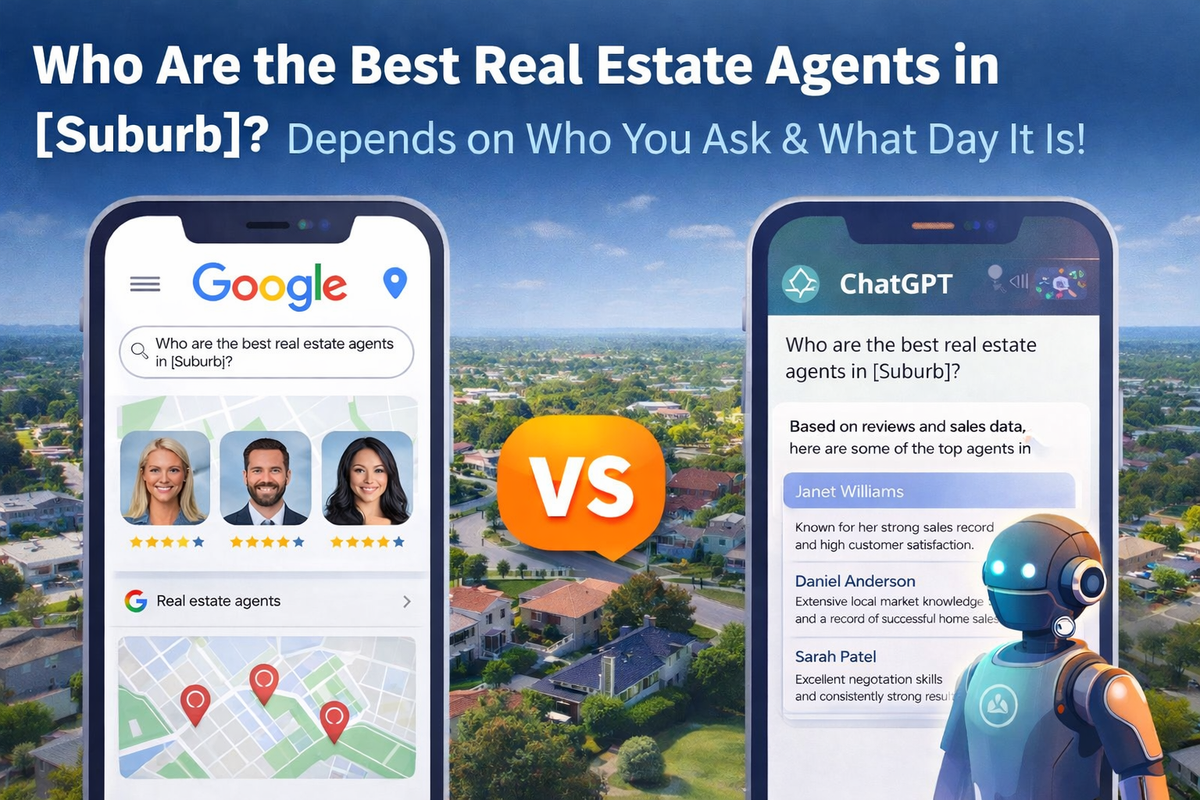
For years, people typed that question into Google, read some reviews, clicked some links, made a shortlist. Logical, boring, effective.
Now? Sellers might ask ChatGPT or Claude or Google’s AI tool and get an answer straight up: ‘Based on reviews and sales history, here are the top agents...’ No clicking, no context - just mysterious recommendations from the algorithmic AI oracle.
So, has everything changed? At conferences and in our inboxes, there’s no shortage of AI evangelists yelling that ‘Google is dying!’ and ‘You need to rank in ChatGPT!’ Cue panic.
But let’s lower the panic meter. A lot of agents are burning cash on AI gimmicks that promise results no one can explain or prove. Because - plot twist - there are no true AI search experts. The tech is too new, the results too inconsistent, and the rules… well, there don’t appear to be any.
Seriously. Run some tests yourself. We have, and every time we ask who’s best, we get different results. And, OK, we know Google’s Map Pack shuffles agency positions as well, but nowhere near to the extent that AI searches do.
AI Search vs Google: Who’s Actually Winning?
Google handles 13.7 billion searches a day. ChatGPT? About 1 billion. So yes, people are trying AI search - but it’s an outrageous stretch of the truth to say they’re dumping Google. And, as we’ve said before, Google isn’t standing lamely by, waiting for OpenAI (owner of ChatGPT) to lay its ship bare. We’ve all noticed its ‘AI Overviews’ dropping in at the top of search, right? That’s Gemini, Google’s AI competitor jumping in to assure Google stays relevant.
While there’s little doubt people are increasingly using AI searches to produce recipes, weight loss programmes, and instructions on how to solve software problems, research last year showed that in Great Britain, 17% of people already default to ChatGPT, but they’re still turning to Google for local real estate agent search. Why? Because they see Google as the place to verify, compare and choose. That distinction matters a lot in real estate. AI answers. Google proves.
While there’s little doubt people are increasingly using AI searches to produce recipes, weight loss programmes, and instructions on how to solve software problems, research last year showed that in Great Britain, 17% of people already default to ChatGPT, but they’re still turning to Google for local real estate agent search.
People will happily accept an answer for writing a dinner recipe, explaining a legal term or drafting an email. But they will not accept it blindly for choosing the person to sell their home, or selecting who manages a $700,000 asset. This is a reputation decision. A financial decision. A personal decision. They want evidence they can see.
In fact, after people start using ChatGPT, their Google usage goes up - from 10.5 to 12.6 Google search sessions per week post-ChatGPT adoption, according to Semrush. Why? Because ChatGPT is like a brainstorming buddy. Google is where you go to check if your buddy made any sense.
Even when sellers ask AI for agent names, they still turn to Google to verify. AI adds a step, not a shortcut.
Can You ‘Rank’ in AI Search?
Here’s where the truth has been revealed, thanks to SparkToro – an audience research company.
The short answer is no. AI doesn’t do rankings - it plays roulette.
SparkToro tested this by asking AI tools for agent recommendations hundreds of times. Result? Fewer than 1 in 100 answers gave the same list. Fewer than 1 in 1,000 gave the same order. How do you plan a strategy for that?
That makes the pitch ‘We’ll help you rank in AI’ about as solid as a horoscope.
What AI Does Use
When AI names agents, it pulls from structured, trusted data: reviews, sales history, and Google listings. It likes things it can verify — and you can’t trick it with paid puff pieces.
So yes, AI might mention your name, but only if you’ve already done the groundwork. Think: glowing Google reviews, a site with legitimate local content, and consistent info across the web. No secret AI handshake required.
Google Is Still the Core
Here’s the bottom line: the agents showing up in ChatGPT are the same ones who dominate in Google. Because the AI’s getting its info from the same places sellers do: your reviews, your site, and your presence.
And while ChatGPT’s user growth has slowed and may be topping out, Google’s still growing — over 20% in 2024 alone. Not exactly what you'd expect from a ‘dying’ platform.
The Final Word
AI search exists. It matters, but not as much as we’re being told. It is random, unrankable, and a fraction of what Google delivers.
Don’t fall for the pitch. If someone says they’ll boost your AI search rankings, ask how they’re measuring something that literally changes every time you ask. They simply can’t.
Instead, double down on what’s worked for years:
Real reviews from real clients (especially on Google)
A helpful, legitimate website
Clear, consistent information online
Content that answers real seller questions
That’s what gets results. On Google, in AI tools, and in actual conversations with real-life sellers. Because despite all the hype, the internet still runs on Google. And Google still runs on trust.
Not convinced? Run some tests…
👓 3.3 minute read

Test how well you're competing by using this prompt
Test how well you're competing by using this prompt
Elite Agent’s Samantha McLean recently shared a prompt designed to help you find what potential vendors are seeing when they AI search your name.
Vendors are asking ChatGPT and Perplexity, ‘who’s the best agent in [suburb]?’ – and AI is either recommending you or it isn’t. She recommends you use AI in a fresh /incognito/ temporary chat session to search for you the way a vendor would – and tell you exactly how it looks from the outside.
Step 1: Open a fresh AI session that can search the web
Important: Don’t use your usual ChatGPT account - it knows you and will be kind to you). Use one of these instead:
- Perplexity (perplexity.ai) – free, no login needed, and built for exactly this kind of research
- ChatGPT in a logged-out or incognito window
- Google Gemini in incognito
The point is to see what a stranger sees, not what your AI thinks you want to see.
Step 2: Ask it to look you up
Paste this prompt in:
Search the web for [YOUR FULL NAME] + [YOUR SUBURB] + real estate agent.
Then search for [YOUR FULL NAME] + [YOUR AGENCY NAME].
Also search for "best real estate agent in [YOUR SUBURB]" and note whether I appear in any recommendations.
Look at everything you can find – Google results, agency profile, RateMyAgent, LinkedIn, social media, any press or media mentions.
Now act as a homeowner who's interviewing 3 agents to sell their property. You've just done this exact research to check me out before our meeting tomorrow.
Based on what you found, give me:
1. FIRST IMPRESSION (2-3 sentences): What's your gut reaction? Would you feel confident calling this agent? Why or why not?
2. STRENGTHS (3-5 bullets): What looks good? What would make a vendor lean toward choosing me?
3. GAPS AND RED FLAGS (3-5 bullets): What's missing, outdated, inconsistent, or underwhelming? Be honest – I need to hear it.
4. AI VISIBILITY CHECK: When you searched for the best agent in my area, did I come up? If not, who did – and what are they doing that I'm not?
5. VENDOR CONFIDENCE SCORE: If I were competing against two other agents who had strong, recent, consistent online presences – how would I stack up? Score me out of 10.
6. QUICK WINS (3 things): What are the 3 highest-impact things I could fix or update in the next 48 hours before my next pitch?
7. PITCH PREP: If a vendor says "I looked you up online" – give me a confident, honest response for each gap you identified. Not excuses – just how to address it directly.
Be specific and direct. Don't be nice for the sake of it – I want to know what a vendor actually thinks, not what I want to hear.