
Gospel

A reading from the holy Gospel according to Luke 23:35 - 43
Lord remember me when you come into your kingdom.

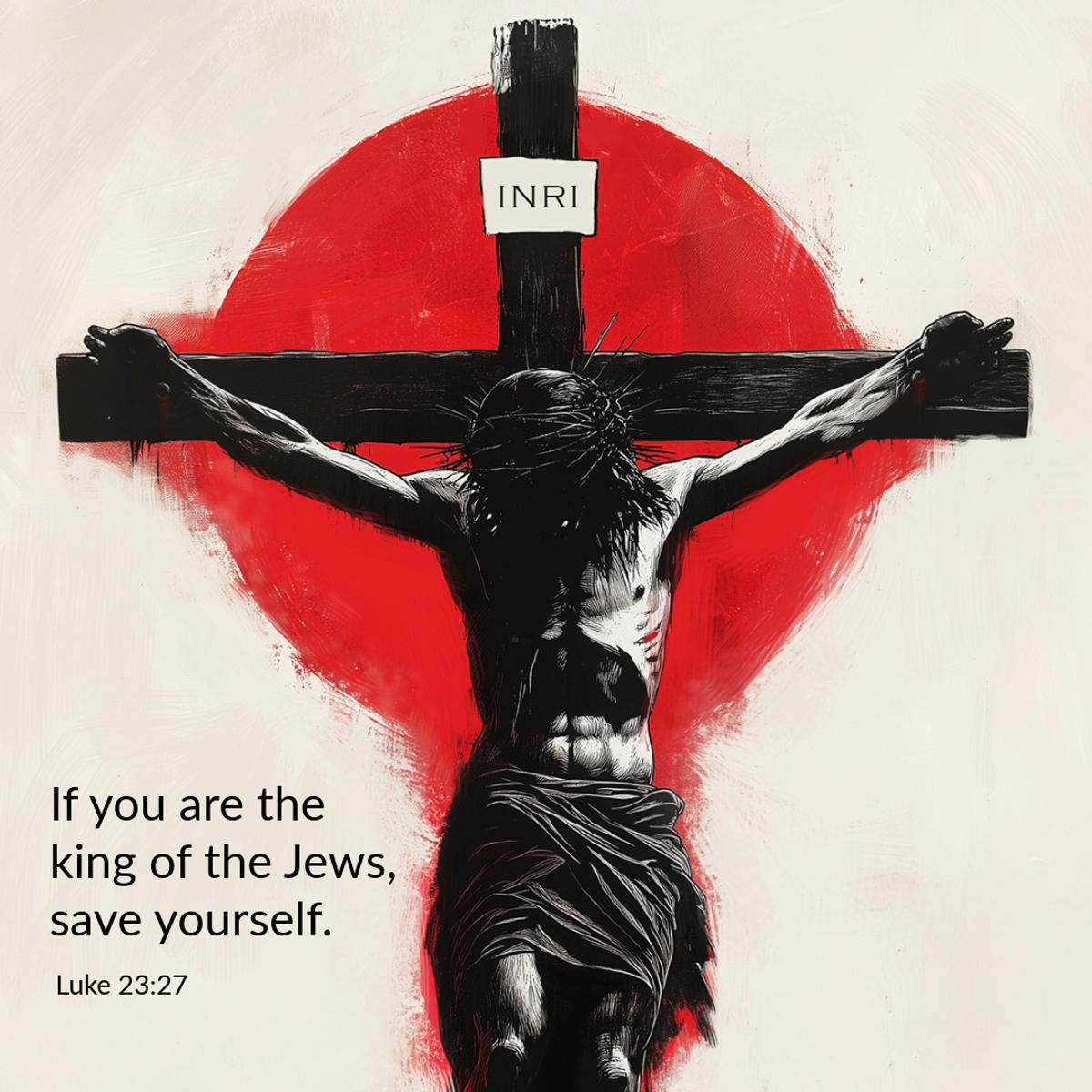
The people stayed there before the cross watching Jesus. As for the leaders, they jeered at him. ‘He saved others,’ they said, ‘let him save himself if he is the Christ of God, the Chosen One.’ The soldiers mocked him too, and when they approached to offer him vinegar they said, ‘If you are the king of the Jews, save yourself.’ Above him there was an inscription: ‘This is the King of the Jews.’
One of the criminals hanging there abused him. ‘Are you not the Christ?’ he said. ‘Save yourself and us as well.’ But the other spoke up and rebuked him. ‘Have you no fear of God at all?’ he said. ‘You got the same sentence as he did, but in our case we deserved it: we are paying for what we did. But this man has done nothing wrong. Jesus,’ he said, ‘remember me when you come into your kingdom.’ ‘Indeed, I promise you,’ he replied, ‘today you will be with me in paradise.’


Gospel Reflection
The choice of today’s gospel passage in the lectionary appears to be twofold. Firstly, the inscription above the crucified Christ reads, ‘This is the King of the Jews’, one of the scriptural references to Christ’s kingship – although that reference is more complicated than it first appears. Secondly, the feast of Christ the King marks the end of the liturgical year and the end of the year-long journey through the gospel of Luke. Given that the second half of the gospel is a physical and psychological journey towards Jerusalem and the death that awaits Jesus there, it is fitting that the final reading for the liturgical year is the crucifixion.
When the feast of Christ the King was first conceived by Pope Pius XI in 1925, its intention was to emphasise the majesty and power of Jesus Christ, King and ruler of the world. However, our understanding of ‘king’ as it can be applied to Jesus has changed significantly in the intervening years. Despite earthly notions of kingship and the role of the Messiah, Jesus completely rejected such expectations and assumed the role of servant to the poor and outcast. As we have seen throughout this year, the gospel of Luke depicts in great detail the emphasis and priority that Jesus gave to the lowly and marginalised.
The theme that flows through the gospel is again captured in the account of the crucifixion. At this most critical point, it is a criminal, crucified alongside Jesus, who responds in faith to Jesus and asks to join Jesus when he enters into his kingdom. The criminal has a much better idea of the nature of the sort of king that Jesus really is than is revealed by the sign that Pilate has had nailed to the cross.
Historical Context – Christ the King
The Feast of Christ the King was introduced to the liturgical calendar by Pope Pius XI in 1925. The establishment of the feast took place in a world that had suffered through the First World War and was unknowingly heading towards the Second World War. In this setting, the world was experiencing a dramatic growth in secularism and an even more dramatic growth in dictators who were rising to power in various states. The introduction of the feast was a call back from the secular and a call to remember Christ as having authority above and beyond any earthly leader.
Scriptural context – Shepherds and Criminals
The gospel of Luke is underlined by a message of hope for those who are afflicted, outcast and poor. In this gospel, the message and ministry of Jesus are directed specifically to these lowly ones. The significance of the role played by the poor is highlighted by the framing of the whole narrative in this gospel: the birth of Jesus is celebrated by shepherds and his death is accompanied by criminals. Shepherds and criminals – two classes of people on the absolute fringe of society; not dignitaries or wise men from afar – are witness to the birth and death of Jesus.
Gospel Focus – A kingdom of inclusion
In response to the criminal’s faith, Jesus assures him, ‘today you will be with me in paradise’. There is a certainty and immediacy about the response. Jesus does not tell him that some time in the future he will be rewarded for his faith. No, it is today that the criminal will join Jesus in paradise. It is an expression of the welcome and inclusion that Jesus has extended to the outsider and undervalued throughout his ministry. It is a clear indication that the Kingdom of God that Jesus has worked to bring about is a kingdom of inclusion and welcome.