
Introducing SEARCH
Bek Tankard

Introducing SEARCH
Bek Tankard
What is SEARCH?
SEARCH is a data-driven, wellbeing framework developed from a multi-year, multi-study project led by Professor Lea Waters AM, PhD. The SEARCH framework has been developed and published in academic journals and has been adopted by schools in Australia, New Zealand, USA, Canada, Hong Kong, the United Arab Emirates, the Netherlands, Brussels and India.
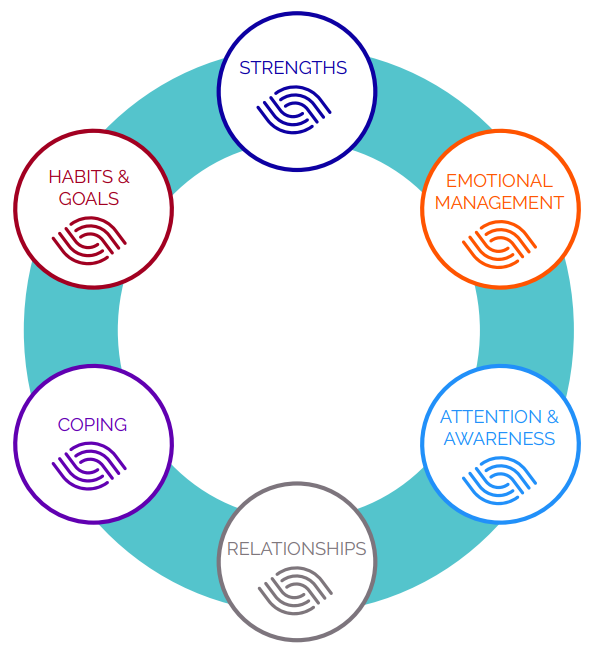
SEARCH covers six over-arching pathways to wellbeing: strengths, emotional management, attention & awareness, relationships, habits & goals.
SEARCH is used by schools around the globe to help teachers and students see and manage their wellbeing more clearly. The approach seeks to provide schools with a range of strategies to support the wellbeing of both staff/teachers and students.
Through using the SEARCH framework in schools, students are taught to use simple techniques and activities to shift wellbeing from a subjective, internal experience to a more tangible, observable phenomenon that is visible for others to see. When wellbeing becomes visible it becomes a resource for learning. By teaching in a way that makes wellbeing visible, students learn how their emotions influence their learning, see patterns in their wellbeing and can draw from a tool-kit of strategies to support their wellbeing during times of need.
Who is Professor Lea Waters?
Professor Lea Waters AM, PhD, is an Australian academic, psychologist, author and
speaker who holds a PhD in Organizational Psychology and is a world expert in School
Psychology and Parenting.
How do we intend to use SEARCH at BNWPS?
Teaching staff have begun exploring the SEARCH pathways. From here, we intend to use SEARCH to support the planning and teaching of Wellbeing through Social and Emotional Learning programs. Additionally, we intend to use the SEARCH pathways to support our pedagogy–that is, how we teach. We can use SEARCH to grow in our ability to nurture student wellbeing through how we instruct students and the learning experiences we create for them. Lots of this is not new to us, but SEARCH does help us name and identify what we already do well, so that we can grow in cultivating learning environments that authentically care for student wellbeing. Using SEARCH also helps us identify areas we can collectively work on to better student learning and wellbeing outcomes. We believe wellbeing and learning go hand in hand, and we hope drawing on SEARCH will better our teaching and learning.