Term 2 Learning Summary
English
Throughout Term 2, students will explore narrative texts through Ochre Education’s English resources, aligned to the Victorian Curriculum 2.0. Lessons are underpinned by evidence-based practices from the Science of Learning, including explicit instruction, checking for understanding, and spaced practise, to support all students in building confidence and success in English.
In Reading, learners will engage in a rich novel study of The Silver Donkey. This novel, by Sonya Hartnett, won a Children's Book Council Australia Award and has been adapted for the stage. Through guided reading and discussion, students will further develop their ability to comprehend increasingly complex texts, identify key themes, and analyse character development. They will practise making predictions, inferring, and responding thoughtfully to the text, developing deeper understanding, critical thinking, and enjoyment of rich reading experiences. Learners will explore the structure and purpose of fables, identifying key elements such as characters, setting, problem, resolution, moral, and comparing themes across different stories.
In Writing and Spelling, learners will consolidate and extend their skills across grammar, literature, and literacy, while continuing to develop fluent handwriting and efficient typing skills. Spelling lessons will focus on suffixes and prefixes such as -ty, -ity, -ify, -ance, -ence, ad-, ac-, hyper-, and hypo-, while developing understanding of morphemes, prefixes, suffixes, and word origins. Grammar will focus on expanding and improving sentences by adding adverbials, using coordinating conjunctions, and identifying simple, compound, and complex sentences. They will practise combining clauses, using commas and semicolons correctly, and recognising how subordinating conjunctions connect ideas. Writing tasks will include sentence expansion, using descriptive language techniques such as personification, similes, pairs of adjectives, and direct speech, as well as planning, drafting, editing, and publishing their own fables with clear structure and a meaningful moral.
In Speaking and Listening, they will discuss messages and themes from the class text, elaborate on ideas, and respond to others. Learners will practice their fluency by reading aloud. They will share their opinions in a variety of settings, including partner shares, small group discussions, and class discussions. Learners will use strategies such as paraphrasing and questioning and select language appropriate for purpose and audience.
Key Vocabulary:
Fable, personification, simile, character, setting, message, moral
How can you support your child’s English learning at home?
- Continue to encourage your child to read regularly and engage with Home Learning reading tasks.
- Ask questions to strengthen you child’s understanding of the text they are reading. Prompting questions you can use during discussions with your child can include:
- What did you read? What did you enjoy about it and why?
- What happened and why do you think it happened?
- Who are the characters? What did they do and why did they do it?
- What is the theme of the text and how do you know?
- Promote curiosity about the world around us and how things work. Your child may like to research areas of interest and share their findings with friends, family and their class at school.
- Share fables from your home culture or your childhood.
- Ask your child about new vocabulary they have learnt from the class novel.
Mathematics
In Term Two Mathematics, students will continue to follow the I Do/We Do/You Do explicit instructional cycle. This approach to teaching Mathematics is based on the science of learning and empowers students to feel confident in their mathematical learning, providing opportunities for frequent revision of past topics, step-by-step instruction when learning new content and topics, and allows for immediate feedback for misconceptions and misunderstandings.
The topics to be covered in Term Two are as follows:
- Decimals, fractions and percentages: Students will represent, compare, and order positive and negative decimals; convert between terminating decimals and fractions; add, subtract, multiply, divide (including writing one number as a decimal of another and finding a decimal of a number). They will then represent percentages, including percentages greater than 100%. Students will convert between decimals, fractions, and percentages; write one number as a percentage of another (including where the percentage is greater than 100%) and find a percentage of a number, including financial applications.
- Statistics: Students will learn to define and classify data and variables as categorical or numerical. They will create displays for categorical data including column graphs and pictograms. Students then will create displays of numerical data including dot plots, stem-and-leaf plots, and line graphs; rich task on percentages and data.
- Algebra: Students will define and use pronumerals to represent constant and variable amounts from worded descriptions.
- Space: Students will deepen their ability to identify prisms, pyramids, cones, and spheres; representing three-dimensional objects in two dimensions including using nets and views (plan and elevations); identifying and illustrate the cross-sections of three-dimensional objects.
Mathematics Key Vocabulary:
Terminating decimals, rational numbers, categorical and numerical data, pronumeral and cross-section.
How can you support your child’s Mathematics learning at home?
- When shopping, ask your child to estimate discounts and check with the receipt or calculator.
- Discuss how data and statistics are used in a range of occupations. What kind of data do they use? How do they gather, represent and use the data?
- Analyse statistics presented within the media.
Inquiry
Question: How do our choices with chemical use impact the world around us?
Global Theme: Social Action, Agency and Social Sustainability
Global Goal: Responsible Consumption and Production.
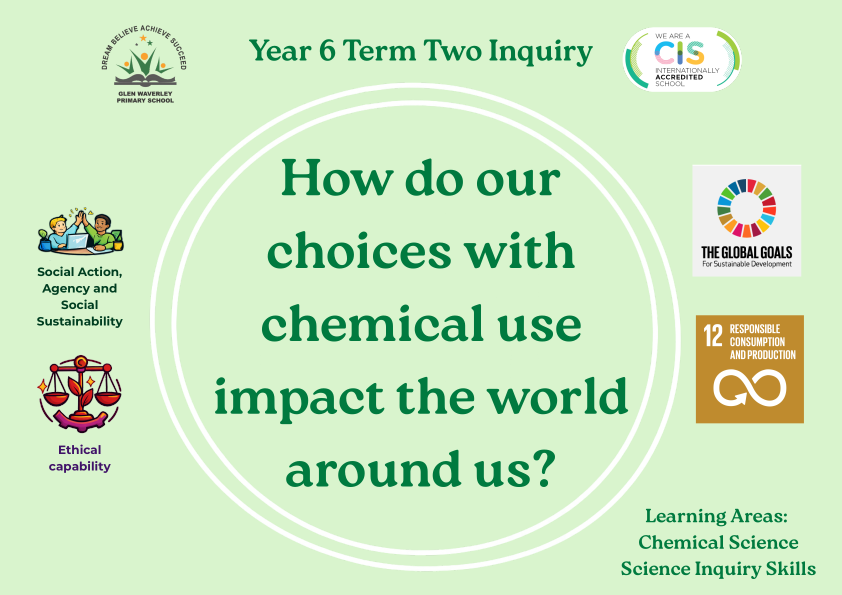
During Term Two, learners will explore the Inquiry question, ‘How do our choices with chemical use impact the world around us?’ and Global Goal 12, ‘Responsible Consumption and Production’. They will examine the role of chemicals in everyday life and their broader social and environmental implications. Students will identify chemicals in familiar contexts, such as cleaning products and clothing manufacturing, before using hands-on experiments to deepen their understanding of chemical science concepts, including states of matter, chemical reactions, and the distinction between reversible and irreversible changes. They will explore the ethical, social and environmental impacts of chemical use, question the motivations behind production choices, and investigate alternatives. As their transfer of learning, students will use the STEAM design process and their scientific understanding to design an environmentally sustainable chemical product.
Inquiry Key Vocabulary:
Chemical, reversible, irreversible, reaction, matter, properties, production, consumption, sustainability.
How can you support your child’s Inquiry learning at home?
- Talk to your child about physical and chemicals changes in your everyday life – for example, metals rusting, water freezing and melting, changes during cooking.
- Identify chemicals around your home, and the potential impacts on people and the environment.
- Discuss your choices for the chemicals and products you use in your home with your child.
- Share your waste disposal systems with your child, such as donating, recycling, and composting.
Wellbeing
The Resilience Project
This term, Level Six students will deepen their understanding of research-informed habits designed to strengthen their capacity to manage the challenges and changes that come with wellbeing and their transition to high school. As a cohort, they will engage in consistent wellbeing practices and routines in line with the four key pillars of wellbeing and positive mental health: Gratitude, Empathy, Mindfulness (GEM), and Emotional Literacy. Building on these pillars, students will continue to engage in a variety of thoughtfully designed learning experiences that focus on topics such as character strengths, positive self-talk, and managing social changes.
We will be covering topics that have a particular focus on Empathy and Emotional Literacy, such as how to respectfully respond to different perspectives when collaborating, making positive assumptions of others, and resolving conflict in group settings.
Cyber Safety Project
In Term Two, our Level 6 students will continue learning about safe online and digital practices through the Cyber Safety Project. This project will help our students develop essential digital literacy skills, while also encouraging them to think critically about their actions and well-being in the online world. This term, we will be covering topics such as, strategies for resolving online challenges and the importance of being an upstander in the online world.
If you wish to support your child’s learning in Wellbeing this term, you can:
- Ensure that your child’s schedule outside of school has a healthy balance of academics, exercise and leisure.
- Conduct daily wellbeing check-ins with your child. Ask them what GEM chat prompts they used at school and see how your family would respond.
- As a family, practice some of the brain break and mindfulness activities that your child has learned at school, such as guided meditation, human knot game and so forth.
- Our families have access to the Resilience Project Home - TRP@HOME portal along with the Cyber Safety Project home Resources - Cyber Safety Project.