Grade 3 News

Dear Year 3 Families,
The Year 3 students have settled in well to their new classroom dynamics of 3A, 3B and 3C and we can't wait to share with you what we have been doing over the last few weeks!
Just a quick reminder that students need to bring their satchel and diary to school every day. This helps with organisation, tracking reading progress, and ensuring teachers can send home any important notes. Also, nightly reading is a big part of our routine. Regular reading at home helps build fluency and comprehension skills. To support this, students can also access extra reading practice on Little Learners.
Please continue to check Compass regularly to stay up to date with any new information, including the release of CATS (Common Assessment Tasks). Our first CATS for this term will be released next week. We encourage you to take the time to view your child’s work and leave a comment in the conversation box. This lets their teacher know that you’ve seen the task and helps maintain a strong home–school connection.
Learning Focuses - Below is what we have been focusing on with our learning at the start of this term.
Phonics
Over the last few weeks, we have been learning sounds with alternative spelling patterns to help strengthen students’ reading and writing skills. The English language has many sounds that can be tricky because they can be spelled in multiple ways. Recently, students have been learning about different ways to spell the /ar/ sound, the /er/ sound and the /eer/ sound.
/ar/ sound | /er/ sound | /eer/ sound |
|---|---|---|
/a/ - class | /ear/ - earth | /ear/ - endear |
/wor/ - worm | ||
/er/ - term | ||
/ar/ - carpet | /ir/ - circus | /eer/ - sheer |
/ur/ - curtain |
Morphology
In our lessons, we’ve been working on the prefixes mis- and in-, and the suffix -ly to help students see how words are built and how their meanings change.
- mis- means that the base word was either wrong or bad. (e.g. mistake - they had a go but it was wrong.)
- in- in, on, onto or upon (e.g. inspect – to look into something).
- -ly means turning the base word from an adjective (describing word) to an adverb (a word that describes the action) (e.g. gracefully - done in a smooth elegant way.).
Grammar & Syntax
One of our key areas has been upgrading verbs. Students are learning to replace simple verbs with more specific ones to make their ideas clearer and more engaging. For example:
- She looked out the window → She gazed out the window
- The dog ran to the door → The dog dashed to the door
We’ve also introduced mental verbs – words that describe thinking, feeling or sensing (like believe, hope, or imagine). These help students express what characters are thinking or feeling, adding more depth to their writing. For example:
- She read the book → She believed the book was exciting
This week, students have been experimenting with –ing sentence starters to add variety and action to their writing. Example: Running through the playground, Sam laughed with his friends.
These strategies are helping students become more thoughtful and confident writers by encouraging them to make deliberate choices in their language.
Writing
This term, we have introduced a new component to our English sessions called Talk for Writing. In this approach, students learn a story through actions and story mapping as a class. While doing this, we also explore the tools that writers use to create engaging and imaginative pieces. Students practise each tool individually before using them together to create their own writing.
We have been learning the story Stone Trolls, which follows characters who have been warned not to do something, but go ahead and do it anyway and must face the consequences of their actions.
We have focused on a series of tools to help students describe the characters in their stories.
- Tool 1 Students identify and write about their character’s wishes, fears, and dislikes. Examples:
- ___ had always hated...
- ___ had always feared...
- ___ had always wished for...
- Tool 2 Students describe their character by placing an adjective before the noun. Example: The wicked witch was brewing a potion.
- Tool 3 Students give their character a hobby or something they enjoy doing regularly. Example: The trolls love to go fishing at night-time.
- Tool 4 Students show how their character is feeling through actions, rather than simply naming the emotion. Example: There were tears rolling down the little girl's cheeks as she looked at her ice cream on the ground.
We’re looking forward to seeing the students’ creativity as they begin crafting their own stories using these tools.
Knowledge & Literature
In Knowledge and Literature, students have been deepening their understanding of the First Australians by learning about the rich history and culture of the Indigenous peoples of Australia. This has included exploring how Aboriginal and Torres Strait Islander communities lived in harmony with the land, animals, and environment, as well as examining the impact of colonisation. We also focused on the concept of reconciliation and what it means for Australia today. Students demonstrated their learning through a formal CAT (Common Assessment Task), where they reflected on these important ideas.
To acknowledge ANZAC Day, we completed a book study on ANZAC Biscuits, which helped students connect emotionally and historically with the events of the past through story. To complement this learning, students also had the opportunity to make ANZAC biscuits in class.
More recently, we’ve begun looking at global history with an introduction to the Vikings, exploring how they travelled the world and what life was like during their time. This comparison of cultures helps students build a broader understanding of how different communities lived in the past and how their histories have shaped the world we know today.
Maths
In Maths, we’ve been focusing on addition within 1000 and building a strong understanding of place value. Students began by exploring mental addition strategies, such as reordering numbers to make calculations easier. They also learned the split strategy, which involves breaking numbers into parts to help add more efficiently, both with and without regrouping. More recently, we have begun working on subtraction, using similar strategies to support their understanding when working with a range of numbers.
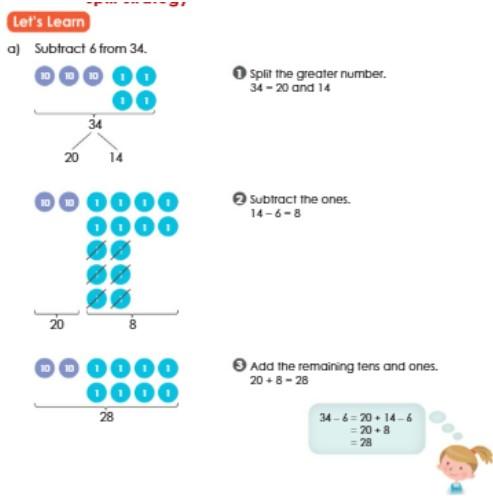
Splitting strategy 1 digit
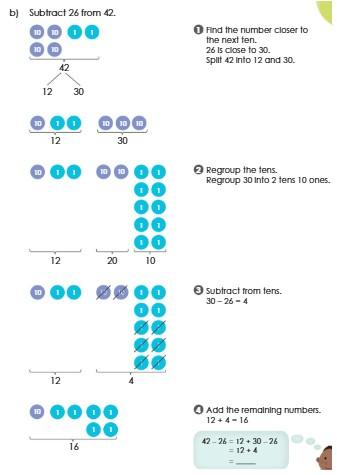
Splitting strategy 2 digit
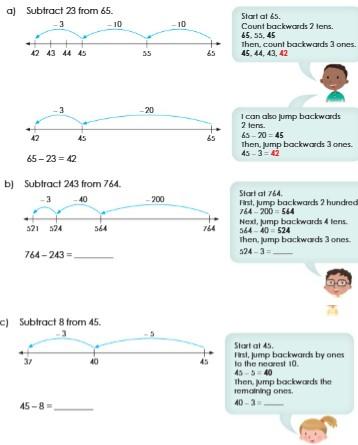
Jumping strategy
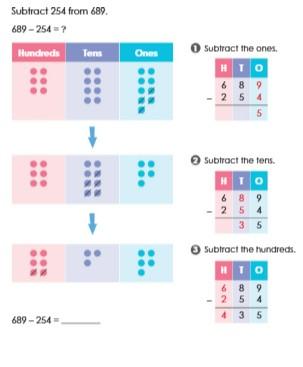
Place value without regrouping
Splitting strategy 1 digit
Splitting strategy 2 digit
Jumping strategy
Place value without regrouping
SEL
In Social and Emotional Learning, students have been learning that everyone is different and that these differences make us special. We've been exploring what makes us unique, our interests, experiences, and ways of thinking, and how understanding and appreciating these differences helps us to get along with others.
Students have also been learning about strong emotions, such as anger, excitement, frustration, and joy. We’ve been discussing how these emotions feel in our bodies, what might cause them, and ways to manage them in healthy and respectful ways.
Through these activities, students are building empathy, learning to celebrate differences, and developing strategies to handle big feelings, both their own and those of others.
Upcoming Events:
- Schools Photos, Tuesday 13th May
- Melbourne Museum & IMAX Excursion, Thursday 15th May
- Scholastic Book Fair, Monday 19th May - Friday 23rd May
- King's Birthday, Monday 9th June
Thank you for your continued support in continuing and strengthening our home and school relationship, which is so vital for students.
Miss Stapleton, Miss Henzell and Mr Francis