
Health & Wellbeing News

Social media age restrictions
Social media age restrictions
From 10 December 2025, the Online Safety Amendment (Social Media Minimum Age) Act 2024 will require social media platforms to:
- prevent children and young people under 16 from having a social media account
- deactivate or freeze existing accounts held by people under 16.
Delaying access to social media protects the health and wellbeing of young people and gives them extra time to build real world connections and digital literacy skills.
The responsibility will be on the social media platforms, not parents, carers, children or schools, to implement these new restrictions.
Most popular social media platforms will be age restricted. These include Facebook, Instagram, Snapchat, TikTok, X (formerly Twitter), Reddit and YouTube.
Messaging services and online games, as well as apps and platforms that support health and education, can still be used.
How to help under 16s prepare for the change
Parents and carers play an important role in supporting their children to be safe online.
To help get under 16s ready for the social media minimum age requirements, you can go to the eSafety website to learn more about the social media age restrictions and find tips on how to talk about social media age restrictions with young people.
At Jackson School, all age-restricted social media platforms are blocked for student use on the school network.
Families can register for the following 30 minute webinars for more information:
For 2026 we have employed a Digital Wellbeing Mentor (Cassandra Steffens) to support our staff, students and families to navigated the challenges of social media and AI.
More information on how to start discussing this with your child please visit: https://www.esafety.gov.au/parents/social-media-age-restrictions

From 25 November to 10 December, people around the world take part in the 16 Days of Activism Against Gender-Based Violence, led by UN Women. The aim is to raise awareness, prevent violence against women and girls, and build safer, more respectful communities.
Violence against women is still a serious issue, with more than one in three women experiencing gender-based violence. Famility violence also affects children. When children see or experience violence at home, it impacts their brain development, emotional wellbeing, learning, relationships and sense of safety. These effects can stay with them as they grow.
In Victoria, the campaign begins with the eWalk Against Family Violence, where thousands of people come togete to show support and call for change.
Everyone is encouraged to get involved by learning more, speakup and promoting respect in their community.
Together, we can help create a safer future for all!
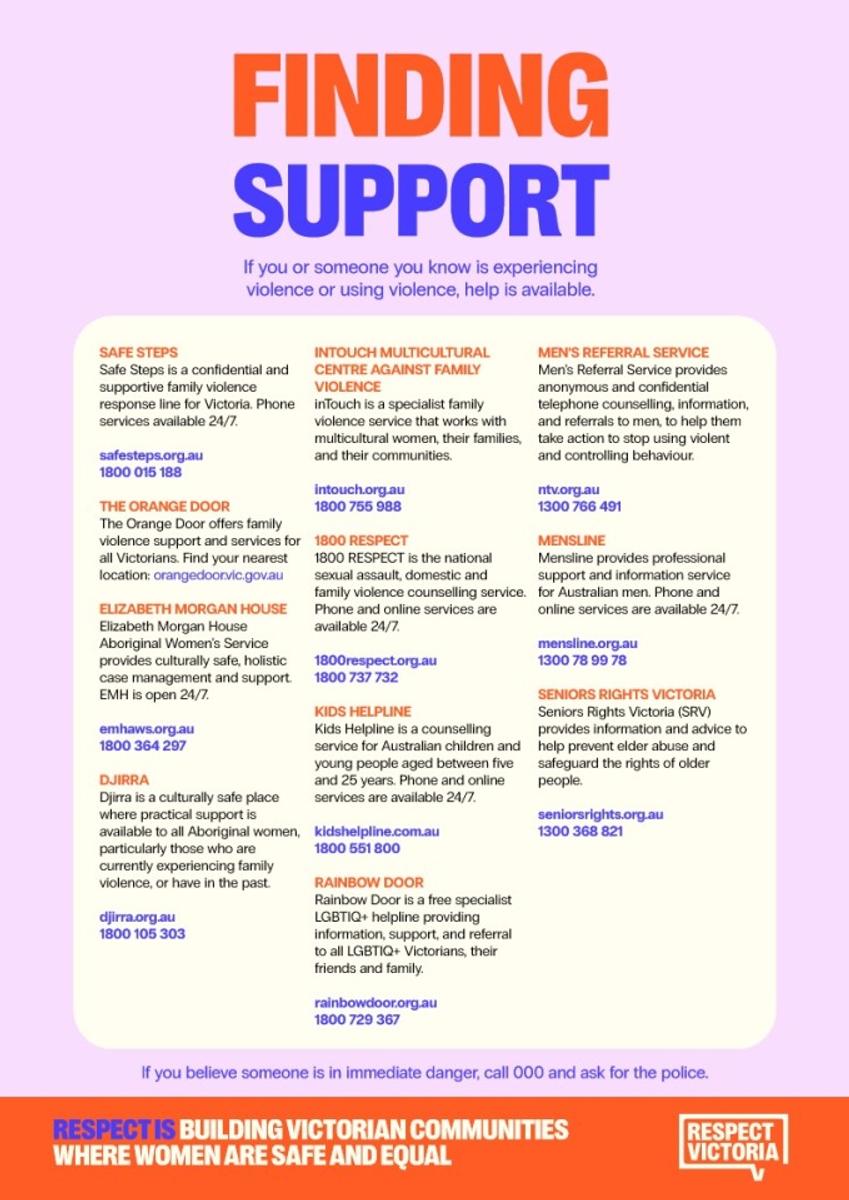
If you are concerned about your own safety or that of your children, see below services that can assist you or check out the Safe + Equal website: Safe and Equal | Standing strong against family violence

Physical activity and brain health
Getting active can give your brain a boost too

Exercising for your brain – sounds strange right? Many of us know that exercise is good for our body but aren’t aware of how exercise impacts our brain health. Exercise can boost your brain in several ways, so let’s focus on these three!
1. Exercise improves your thinking skills (cognition)
Your brain is an organ, and just like our hearts or lungs you can improve its performance through exercise, particularly thinking skills. Thinking skills (cognition) are mental processes our brain undertakes so we can take in information to learn, understand, and interact with the world. This includes our ability to plan, focus, remember and problem solve. In fact, research shows that just 10-20 minutes of moderate intensity exercise (e.g. a brisk walk), can immediately show a positive effect on our thinking and focus. Research also shows those who exercise more regularly have better results in thinking tasks or in controlling certain behaviours (eating an entire block of chocolate, scrolling social media, managing alcohol or substance use).
2. Exercise improves memory
Another skill that can be improved through exercise is our ability to remember and learn. These skills are important for work, study and in everyday life. It is thought that exercise improves the health of the hippocampus, a small brain area deep within the temporal lobes of the brain that plays a strong role in memory. Research shows exercising at a high intensity (e.g. going for a fast run) can increase the size of the hippocampus, increase the healthiness of the hippocampus cells and improve connections within the brain. These increases in hippocampus health are linked to improvements in learning and remembering.
3. Exercise reduces your risk of brain disease
As you age, you are at a higher risk of developing brain-related disorders. The number of people in Australia living with significant disability is increasing, and over 70,000 people are diagnosed with brain-related disorders every year (e.g., stroke, Alzheimer’s, Parkinson’s disease). Exercise can reduce many risk factors associated with these conditions, including obesity, high blood pressure and more. In fact, studies have shown that engaging in physical activity regularly reduces the risk of developing a brain disorder by about 20-30%.
How do I get started?
Consider seeing an Accredited Exercise Physiologist to create a personalised program involving aerobic exercise, resistance training and dual-task balance training that is of moderate to high intensity. This is the most effective for maintaining the brain’s structure and function, and reducing the risk of frailty and falls, which can often accelerate cognitive decline in older age.
Resistance training should be performed with moderate to heavy loads that gradually get heavier. You should aim to do resistance training two to three days per week. A combination of machine weights (i.e. horizontal leg press) and functional movements (i.e. chair stand) should be used to target muscles of the thigh, hip, buttocks, upper back, and the back of the arm, as these muscle groups are crucial for maintaining mobility and independence.


Recipes on a budget - Creamy tuna mornay
Ingredients | Method |
| Step 1 Melt butter in large saucepan, add onion, carrot, celery and capsicum and cook gently until softened.
Step 2 Add flour and cook for 1 minute. Remove from heat and gradually stir in evaporated milk.
Step 3 Return to heat and stir until thickened. Add tuna and springwater, corn, cheese, parsley and mustard. Season with salt and pepper.
Step 4 Cook until heated through and cheese has melted.
|