Assistant Principal's Update
by Mr Greg Breese, Assistant Principal

Assistant Principal's Update
by Mr Greg Breese, Assistant Principal
From 10 December 2025, the Online Safety Amendment (Social Media Minimum Age) Act 2024 will require social media platforms to:
prevent children and young people under 16 from having a social media account
deactivate or freeze existing accounts held by people under 16.
This change acts to delay access to social media by young people, it is not a ban. Delaying access to social media protects the health and wellbeing of young people and gives them extra time to build real world connections, digital literacy skills and strengthen their personal identity.
The risks of social media to young people have been well-documented. ABC Four Corners published several episodes on this theme in 2024.
https://www.abc.net.au/news/2024-05-20/kidfluencers/103871260
https://www.abc.net.au/news/2024-11-04/disconnected/104559834
Age-based restrictions are well-accepted in other areas, such as driving and access to alcohol. In these areas, the risks to young people of having early access outweigh the benefits, and the same principle underpins the new social media minimum age. By introducing a clear, enforceable age threshold, the aim is to reduce exposure to harmful online content, limit opportunities for exploitation, and support healthier developmental outcomes.
The responsibility will be on the social media platforms, not parents, carers, children or schools, to implement these new restrictions. Most popular social media platforms will be age restricted. These include Facebook, Instagram, Snapchat, TikTok, X (formerly Twitter), Reddit and YouTube. Messaging services and online games, as well as apps and platforms that support health and education, can still be used.
How to help under 16s prepare for the change
Families will play an important role in helping young people navigate this transition and understand the reasons behind the change.
To help get under 16s ready for the social media minimum age requirements, you can go to the eSafety website to learn more about the social media age restrictions and find tips on how to talk about social media age restrictions with young people.
What the change means for our school
At our school, most age-restricted social media platforms are blocked for student use on the school network. Our school allows student access to YouTube in a logged-out state. However, this access is restricted so mature content cannot be viewed.
To keep up to date about the new social media age restrictions, visit the eSafety website and subscribe to their newsletter.
Recent improvements to how we keep students safe online
At Box Hill High School, we are committed to building a culture of respect and responsibility. We show this in the way we use technology and interact online.
Our curriculum includes instruction for students on the use of technology. Students learn about safety risks online and how to reduce the risk of harm within our Year 7 to 9 RESPECT program and cybersafety incursions, that ran at the end of Term 2 this year.
We take steps to ensure that the digital learning environment is safe. This includes content filtering on school-provided internet, a ban on the use of mobile phones and conducting a privacy risk assessment on all software and online platforms that students use at school.
The school has recently upgraded our internet safety systems. Because most websites now use encryption, we’ve added an extra layer of protection that lets us safely check this traffic and block inappropriate content. To make this work, students needed to install a small security certificate on their devices. This upgrade also helps prevent students from using tools like VPNs to bypass the school’s content filters.
While strong safety systems protect students online, they also support a learning environment where devices are used meaningfully rather than causing distraction. Learning relies heavily on a student’s ability to focus, and digital devices can both support and interrupt that attention. When used well, devices provide powerful tools for accessing information, practising skills and engaging with interactive learning. However, the constant notifications, multitasking and quick access to entertainment can easily pull students’ attention away from their work. Because attention is a limited resource, frequent switching between tasks reduces concentration and makes learning less effective. Supporting students to use digital devices purposefully—and to minimise distractions—helps protect their attention and improves the quality of their learning.
Supporting safe and focused technology use is a shared responsibility between school and home. Students develop the strongest habits when expectations are consistent, so we value parents partnering with us to reinforce safe, responsible and distraction-free use of digital devices. When families and the school work together in this way, students are better equipped to stay engaged in their learning, make positive choices online and build healthy long-term digital habits.

Semester Two reports will be available on Friday 12 December. These reports give you a clear overview of your child’s learning and progress this semester, including how they’re developing in each subject and how they performed on major assessment tasks.
When reading the report, start by noticing the positives —
the strengths, improvements, and areas where your child has shown growth. This helps set a balanced tone and keeps the focus on their overall progress rather than on any single result.
It can also be helpful to look for patterns in their learning. Are there subjects where they’re consistently improving? Are there areas where they might need a bit more support? This bigger-picture view will help you understand how best to encourage their next steps.
After you’ve read the report, take some time to talk it through with your child in a calm and supportive way. Ask open questions like “What are you most proud of?” or “What would you like to work on next?” Conversations like these help build confidence, encourage responsibility, and support a growth mindset — where learning and improvement matter more than just the grades.
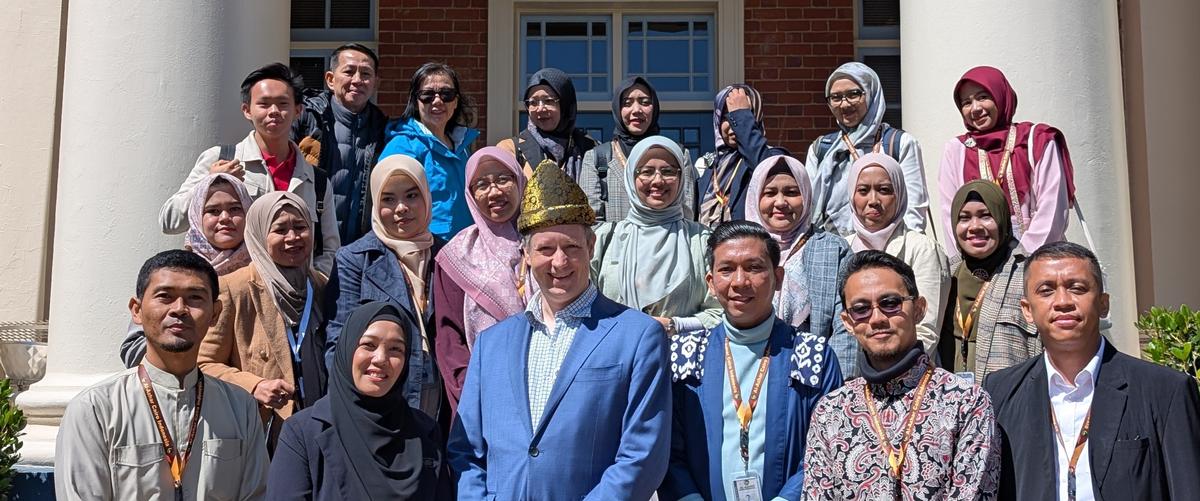
On Thursday 6 November the school hosted 22 teachers from Indonesia as part of a study tour. The tour group visited to learn more about the school’s curriculum, its unique characteristic, observe classroom teaching methods, and see how lessons are conducted. They were also interested in understanding how the STEAM approach is applied, as well as visiting school facilities such as the library, laboratories, gymnasium, and others.