Wellbeing and Inclusion Update

Bicycle Helmets
You must wear a helmet when you’re riding a:
- bicycle - including e-bike
- e-scooter
human powered scooter.
If you don’t follow these rules, you can be fined.
Choosing a bicycle helmet
When choosing a bicycle helmet for you or your child, make sure:
- it is not damaged
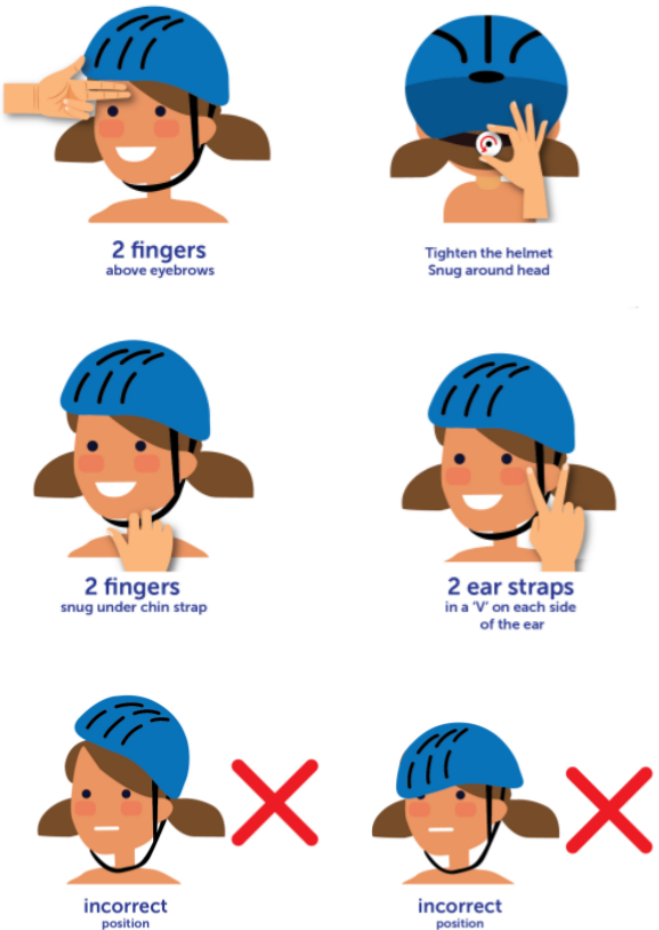
- it fits firmly and comfortably on your head – the gap between your eyebrows and helmet should be no more than two fingers wide
- the helmet doesn’t tilt too far forwards, backwards or sideways – the rim of the helmet should sit just above your eyebrows
- the straps around your chin are firm, not slack, and the straps make a ‘v’ just under your ears
- it has a label showing it meets any of the approved safety standards.
For children’s helmets, measure the size of your child’s head just above your child’s eyes and ears. Select a helmet to fit a head of that size. Helmets should usually be replaced every 5 years because the protective foam can wear out over time. If a helmet is involved in an accident or dropped on a hard surface, it should be replaced immediately.
Helmets reduce the risk of a serious head injury
In 2016, the Australian Health Protection Principal Committee (AHPPC) issued a statement supporting mandatory bicycle helmet laws. The AHPPC is made up of the chief health officers of each Australian state and territory.
Also in 2016, a comprehensive, systematic review of 40 helmet-related studies was published in the International Journal of Epidemiology. The review found bicycle helmets reduce the chances of a serious head injury by almost 70 per cent.
Two years after introducing bicycle helmet laws in 1990 there was:
- a 16 per cent reduction in head injuries in metropolitan Melbourne
- a 23 per cent reduction in head injuries in Victoria
External Allied Health
The school environment can be the ideal location for our students to engage with allied health professionals such as occupational therapists, speech pathologists, behaviour specialists and psychologists. We, at Westbreen Primary School, are keen to build relationships with the allied health professionals who work with our students in order to create a safe and supportive environment in which all adults are working on the same goal(s) and using the same strategies to support each child’s development.
The Wellbeing & Inclusion Team has finalised our External Allied Health - Expectations and Agreements Policy. This policy is available on the school website on the policies page: https://westbreenps.vic.edu.au/wp-content/uploads/2026/02/WPS-External-Allied-Health-Expectations-and-Agreements-2026.pdf
Parents/carers and visiting allied health professionals can complete information and consent forms.
Existing families that have allied health professionals that visit the school, we will email you the policy along with the appropriate forms to be filled out now that it has been finalised.
For future allied health visits supported by the NDIS, we encourage parents/carers to contact Miss Tamie Florence (Disability Inclusion Coordinator) - tamie.florence@education.vic.gov.au
SWPBS

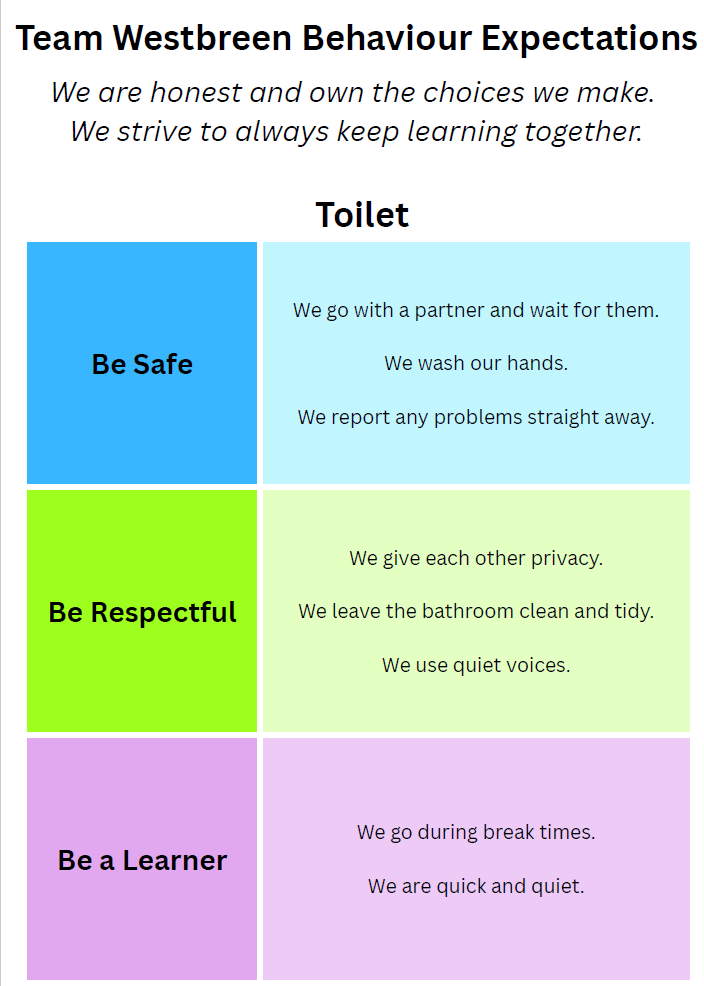
As you are aware, in Term 4 last year, we released our updated Team Westbreen Positive Behaviour Expectations Matrix. Staff have been explicitly teaching these positive behaviours to our students (linking them to our school values) again at the beginning of this year.
The Wellbeing School Improvement Team, which consists of a teacher from every year level and some specialist teachers, have also created various matrix on how these positive behaviours should be displayed in different settings across the school. This week we are sharing the expected behaviours to be shown by students when going to the toilet. Once again, we encourage families to reinforce the appropriate positive behaviours at home.