
From the Principal
Connecting for Christ
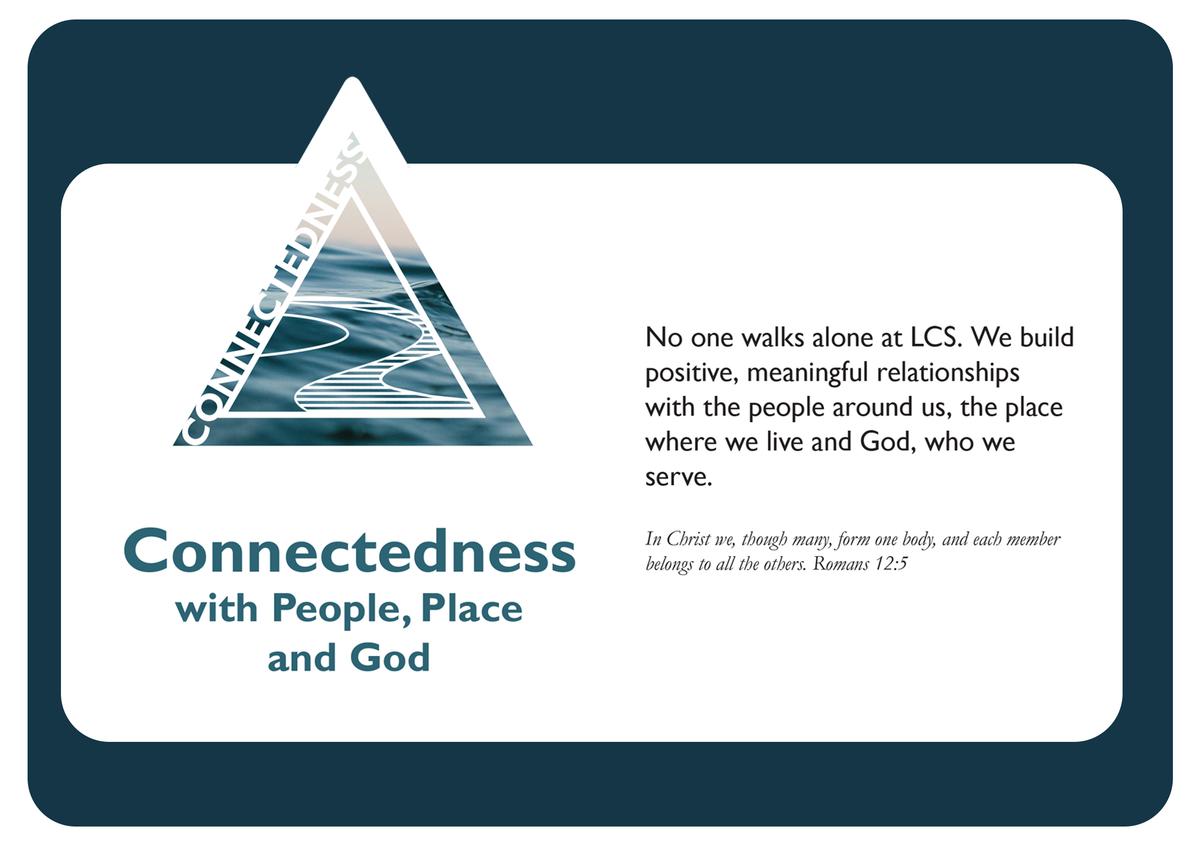
Each term this year we will be focusing on a different LCS core value, and during Term One that value has been Connectedness – with People, Place and God.
I attended the CEN Conference in Sydney in March, and CEN Manager of Biblical Foundations Sam Burrows' session on theology and relationships really stood out to me, especially in the context of our value focus this term.
He began by pointing out that we are relationally constituted, relationally bound, and relationally entangled. We cannot exist without relationship, from the inheritance in our DNA and the environmental factors of our childhood, the way we interact with and depend on the world around us, and the fact that nothing exists in isolation, down to the smallest atomic level – everything is a dynamic web of interrelationships.
Historically, cultures have impacted the way we view the world, essentially as a big container with humanity somewhere inside. But how can an infinite God exist in a finite body? Early theologians wrestled with this cosmology and where we fit.
It was the Scottish Reformed theologian Thomas F. Torrance who described the world as the seat of relationship, where God meets us and makes himself known to us. The world is the arena of God's love, he suggested. And, of course, the trinity is a picture of relationship, not isolated individuals.
“God draws near to us in such a way as to draw us near to himself within the circle of his knowing of himself.”
― Thomas F. Torrance, Trinitarian Perspectives: Toward Doctrinal Agreement
Enter present day.
Sam made the relevant and alarming observation that knowledge and algorithms are replacing wisdom and relationship. Rather than seeing the world through the lens of relationship, we are seeing people motivated more and more by data that is impacting their decision-making.
As a Christian school, how do we navigate this reality?
Sam encouraged us to consider "harmony with Christ" as a tuning fork. But what does that mean, you ask?
- Living in community, we are tuning each other. Sometimes, we are the primary tuning fork pointing others to the True tuning fork, Jesus Christ. The friction of relationship is a learning space and a tuning opportunity. Through connections with others we develop a Christ-shaped wisdom, especially with people we might not choose to mix with (but Christ chooses for us!).
- All of creation is already Christ-centred. We need to help one another to tune into this as a primary reality and not obscure it.
- Jesus places people in relationship. He does not remove disciples who might not get along but leaves them together to wrestle with unity.
As we head into the term break I'd like to frame a question that applies to all Christian communities and groups:
Can we model to the world a place that is deeply relational and difference is not the end of those relationships? In our families, in our workplaces, online, at social gatherings – and in our school.
In Christ,
Stuart Kent
Principal
Launceston Christian School