Wellbeing News
Building Resilience in Children
Resilience is the ability to cope with challenges, bounce back from setbacks and keep going when things feel difficult.
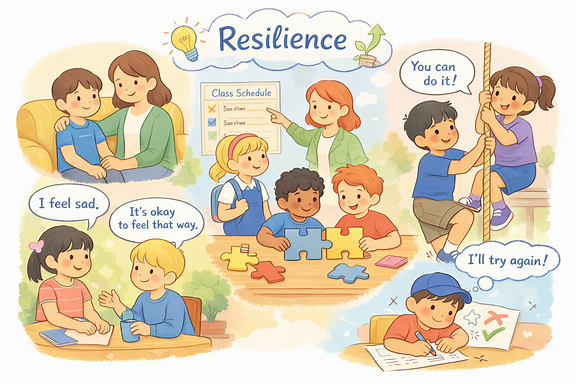
Research from Beyond Blue shows that resilience grows through everyday experiences and supportive relationships. When children feel connected to family, school and community, they are better able to cope with challenges. Predictable routines and clear expectations help them feel safe and secure, reducing stress and supporting emotional regulation. Opportunities for manageable struggle, such as trying again, solving a problem or working through a peer disagreement are essential. Both parents and teachers play a key role in creating these moments. By offering encouragement rather than immediate solutions, adults help children practise persistence, develop problem‑solving skills and build confidence in their own abilities. Developing strong emotional literacy supports children to understand and express their feelings, which is linked to better coping skills. A growth mindset also strengthens resilience by helping children see mistakes as a natural and valuable part of learning rather than something to fear.
Practical strategies for families
Each strategy is simple, realistic and grounded in evidence.
- Guide rather than fix: When your child faces a challenge, resist the urge to jump in with the solution. Instead, offer gentle prompts like “What could you try?” or “How might you solve this?” This builds independence, problem‑solving skills and a belief that they can cope when things feel difficult.
- Let children do things for themselves: Packing their bag, carrying their bag, solving small problems or speaking up respectfully builds confidence.
- Name the feeling: Help your child identify emotions (“You’re feeling disappointed because the game ended”).
- Model calm problem‑solving: Talk through challenges so children see how adults pause, think and choose a response.
- Encourage “try again” moments: Praise effort, persistence and small steps rather than perfection.
- Create predictable routines: Morning, after‑school and bedtime routines help children feel secure.
- Use restorative conversations: Guide your child to reflect, repair and reconnect with others after conflict.
- Celebrate strengths: Notice and name qualities your child shows: kindness, curiosity, courage.
- Limit overwhelm: Balanced routines, healthy sleep and manageable screen time support emotional regulation.
Building resilience is a shared journey. The small, everyday choices made at home and at school such as, encouraging independence, modelling calm responses, celebrating effort and guiding children through challenges rather than solving their problems for them all contribute to a strong foundation for lifelong wellbeing. We thank our families for partnering with us to support children as they learn, stretch and discover what they are capable of, growing in confidence, courage and resilience.