
SCHOOL NURSE UPDATE

ANKLE INJURIES
One of the most common injuries presenting to our First Aid Office, is the sore, twisted or rolled ankle. While students believe every injury to their ankle results it being broken and a reason to go home – there is actually a guideline for medical professionals that we follow to help rule out a possible fracture versus a sprain or strain.
- Primary Survey:
As a student approaches First Aid, as a school nurse I am already observing the student. Are they walking normally, are they guarding their body in any way, are they pale or unwell looking, etc..
- History / Mechanism of Injury:
Once the student reaches the window, we start to discuss why they have presented to first aid? This is the step of gaining a history of what has happened or how they are feeling. When they report they have hurt their ankle, the questions then relate to how they hurt their ankle, what were they doing at the time, did they roll their ankle, trip or fall awkwardly, or get hit in the ankle with an object?
- Inversion/Eversion:
The rolled ankle is quite common, establishing whether the ankle rolled inward (inversion) or outward (eversion) is an important next step and helps to identify specific ligaments or bones that may be involved.
Inversion – the ankle rolls inward, placing stress on the ligaments on the outside (lateral ligaments) of the ankle. Student may report hearing a “crack”, but it is important to note that ligaments can crack as well.
Eversion – the ankle rolls outwards, straining the ligaments on the inside (deltoid ligament) of the ankle. This type of injury is less common and more likely to result in a fracture.
- Examine the foot and ankle, looking for swelling, bruising, obvious deformity, colour, warmth, movement and sensation.
- Ottawa Ankle Rules (OARs) – a set of rules developed to assist medical professionals determine which ankle injuries require an xray or scan. The rules relate to a two-step process of assessing the location of pain and the person’s ability to stand and walk. Pain at A or B or unable to stand and put weight on foot – ankle xray recommended. Pain at C or D or unable to stand – foot xray recommended.
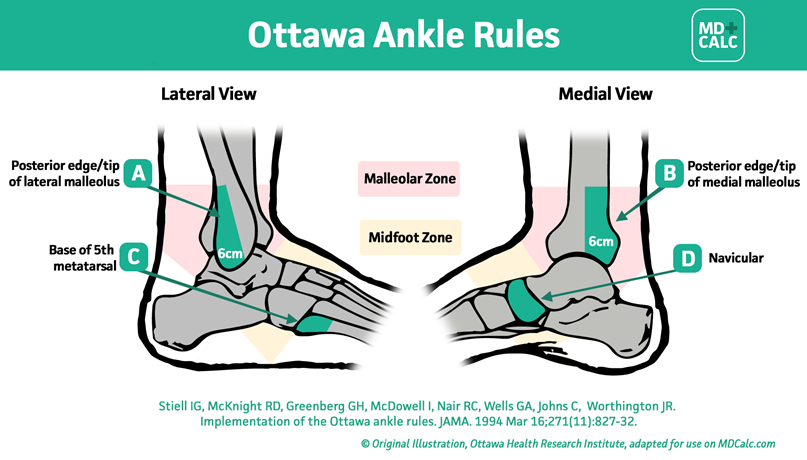
If student able to limp 4 steps or more, it is very reassuring unlikely to be a broken bone.
- Minor sprains and strains can be treated conservatively with RICE – rest, ice, compression and elevation of limb.