Student Excellence Program

PROBLEM OF THE WEEK SOLUTIONS
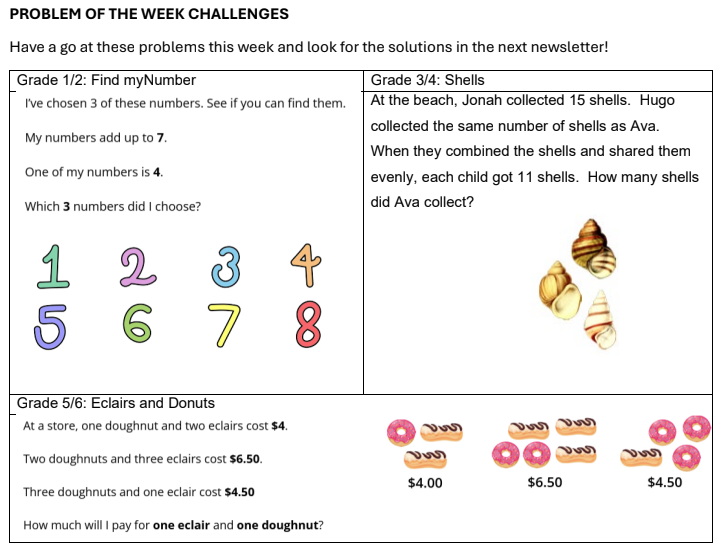
How did you go with the challenges from the last newsletter? See below for the link to the solutions videos.
5/6: Run, Run, Runhttps://youtu.be/4TtC4uTvdBs?si=F2uHzejnq-6ALy9y
3/4: Tower Challengehttps://youtu.be/f4cT0-Sy_oM?si=Cwu8_mA2zZo4lfFe
1/2: Bear Patternhttps://youtu.be/FOGLVIMdN3M?si=dXWxEbImoH59G8qv
NEWS
Our APSMO maths groups are all up and running, and by Wednesday this week Maths Olympiads, Maths Games and Maths Explorer participants will have all completed their first competition paper for this year. Keep an eye on this space for progress updates as we work through the four competitions over this term and next.
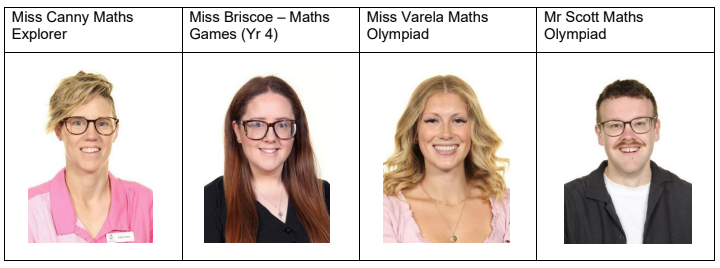
Thank you to our wonderful teacher volunteers (pictured below) for making time in their busy schedules to run these sessions. Without them, we would not be able to offer children this opportunity. Teachers put in a lot of work beyond the session to target instruction to help ensure students can improve on their score between competition papers.
EXTRA READING FOR PARENTS
It is easy to assume that high ability and giftedness relate only to academic achievement. While academic ability is one aspect of giftedness, high potential can also be demonstrated across a range of other domains. Identifying, measuring, and comparing these different areas of giftedness can sometimes be challenging.
The information below, adapted from the Victorian Department of Education, outlines what it means to be a high-ability student and explains the different domains recognised within the Department’s adopted model of giftedness and talent.
About high-ability students
High ability is an umbrella term used to describe high potential and/or performance. High-ability students have abilities that are more advanced in one or more domains of learning than peers of a similar age.
Some high-ability students have a general aptitude that allows them to achieve across a wide range of
subjects. Others may exhibit subject specific aptitude. The ability, aptitude and performance of high-ability students will vary. Students with high ability may also have a disability or learning difficulty,
sometimes known as twice exceptional or 2e.
High ability can manifest in different domains, or in combination. According to Professor FrançoysGagné’s Differentiated Model of Giftedness and Talent, these domains include:
•Intellectual ability: usually manifests in a broad range of academic-focused subjects, speed of learning and complex thinking patterns
• Physical ability: often presents in physical education or dance, through advanced motor skills, coordination, and stamina
• Creative ability: is likely to find expression in the arts, and in advanced creative problem-solving and original thinking
• Advanced social ability: will cut across a variety of subject areas and often finds expression in leadership, and in advanced moral reasoning and ethical thinking.
Gagné and others estimate that at least 10% of the population is highly able in one or more domains. However, for various reasons, high ability students are at risk of underachievement throughout their schooling, and having high potential or being gifted doe not guarantee success later in life. According to the Australian Curriculum, Assessment and Reporting Authority (ACARA), gifted and talented students:
• have individual learning needs, strengths, interests and abilities
• vary in their level of giftedness across and within learning areas
• vary in abilities and aptitudes demonstrated in a single area or across a variety of domains
• vary in level of achievement
• exhibit different learning behaviours
Understanding the different domains of high ability helps schools and families better identify students with high potential. It also supports more informed discussion and planning to nurture students’ strengths, support their development, and maximise opportunities for future success.
If you have any questions regarding your child and their academic development or opportunities forextension, your first point of contact is your child’s classroom teacher. If you have any questionsaround processes or programs on offer, please feel free to reach out to me.
Cobie Canny
Leading Teacher | High Ability Practice Leader
PH: 7002 6580
Email: cobie.canny@education.vic.gov.au