
Principal Message
AEU agreement update and impact on Reports
You may have heard in the media that an in-principle agreement has been reached between the Department of Education and the Australian Education Union. Following the agreement, the AEU informed the department on 18 May 2026 that all industrial action related to negotiations to finalise the new Victorian Government Schools Agreement (VGSA) has been entirely suspended.
The AEU had included a ‘ban on all aspects of work related to the provision of written comments on student reports that will be provided to parents’ in the industrial action.
While this ban has now been lifted, the department recognises that it may now be difficult for schools to provide full written comments for Semester 1.
The reports will be distributed in the last week of the term. The reports will continue to provide important details about student learning attainment, but full descriptive comments will not be included as a result of the industrial action that was taken during the negotiations and time limitations.
We will of course be pleased to discuss with you your child’s progress at our parent-teacher interviews scheduled for week 2-3 of Term 3. This is where any questions you have or feedback you are seeking will be available to you. You teacher will also discuss the next steps for your child's learning.
What did staff do today on the pupil free day?
It is often assumed that we take the day off when there is a curriculum day, but we are all up here working hard.
In the morning the staff workshopped how we can increase passive and structured play out in the yards whilst adhering to the AEU VSGA requirements for staff breaks and workload. We reflected on what is working well at the moment and where we need to find solutions.
After an hour of workshopping and collaborating we have a few new ideas for immediate improvements and then what can be done across the next 6-12 months.
Whilst the leadership team have to take the feedback and come up with a formal plan the ideas were flowing today and as always, the staff came with a positive attitude towards doing their best to improve social and emotional needs in the playground.
In the immediate term (next 3 months) the suggestions included
- displaying signage around the ground to make boundaries clearer and to encourage positive play with expectations for different areas of the school displayed
- Move some of the tables around the school so they are more accessible in other areas of the school
- Allocate particular games on the oval in a rotating roster so that all students are playing the one game and the teacher supervising can actively watch to support the rules and positive play.
- Have some structured clubs such as down ball club on the green courts
- Encourage and expand the colouring in club near the prep building by ensuring balls don't disturb the area being used
- Trial using sport equipment (sign in and out system)
- Create spaces where digging and building can take place safely and with supervision- STEM outdoor
- Lego club - easily implemented in the library
- Podcasting club in the library
- Gardening club
Fridays have a picnic up in the front area of the school (when weather permits) and then run a regular outdoor disco. We have done this a couple of times this term and the children had a great time.
We are also asking the Junior School Council to survey the students to tell us what sorts of clubs or structured play they would like to see.
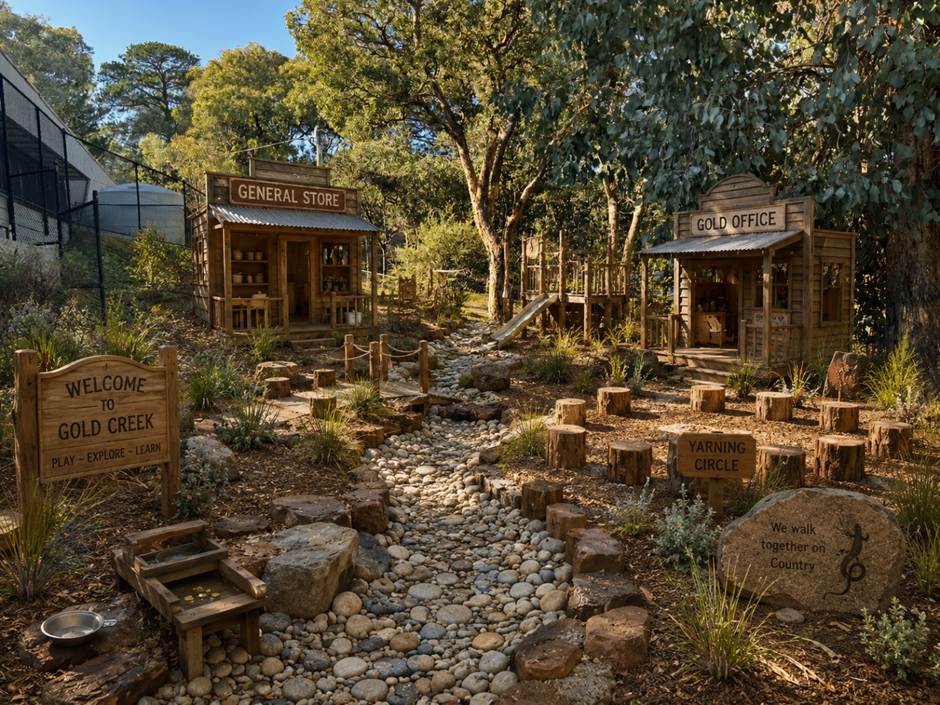
We will work towards some of these ideas in the immediate term. In the longer term the school council and I are working on a project for the implementation of a Playing in Gold Country area down in the junior playground. With a goldrush theme the dry creek bed and gold panning theme with an imaginary shopfront play and fort. Our Prep - 2 students will be able to explore, play and interact with the land and structures.
The proposed project will transform an existing underutilised bushland area within the junior playground into an engaging goldrush-themed play township that supports creativity, wellbeing, connection to Country and inclusive outdoor play opportunities for young children. The concept has been carefully designed around the existing natural landscape and integrates Indigenous storytelling, sensory play and dramatic play experiences. We are approaching community groups for financial support in this planning phase of the project.
After this workshop the staff have met in their teams all day to moderate students work against the new Victorian Curriculum 2.0 to pinpoint each child's point on the continuum. The triangulation of data by using formal summative assessments, teacher observations and anecdotal notes as student work samples is considered best practice when determining a student's achievement against the curriculum. Earlier last week the staff participated in a Teaching and Learning session after school exploring the types of data WPS is using and how it fits with best practices.
Which Fidget?
Last issue I wrote about our approach to bringing toys and items such as trading cards from home and we have asked for your support in not allowing your child to bring items from home. This is being done as part of a deliberate pedagogical emphasis on best practices for enabling learning in a classroom. We know from experience as teachers, but also from the evidence, that if we set the classroom space and culture up to be calm, structured and with clear procedures, all students have a better chance of remaining focused and able to learn. This direction has been communicated to the School Council, who are supportive of the initiative.
Fidget tools can be an effective evidence-based support for emotional regulation, attention, and sensory processing when used appropriately within the classroom environment. Research suggests that some students are better able to maintain focus and regulate their nervous system when provided with subtle sensory input through a quiet fidget device. These tools can particularly benefit students with Autism Spectrum Disorder (ASD), ADHD, anxiety, sensory processing challenges, or students who experience difficulties with attention, self-regulation, or remaining seated for extended periods of time.
Effective fidget tools are small silent sensory items that help students remain calm and engaged in learning. It is important that fidget devices are used as a support tool rather than a toy. To be successful in the classroom, the fidget must not distract the student using it, disrupt other learners, create noise, or become the focus of play rather than learning. Our staff work closely with students to explicitly teach expectations around the safe, respectful, and purposeful use of these tools to ensure they support learning and wellbeing for all students.
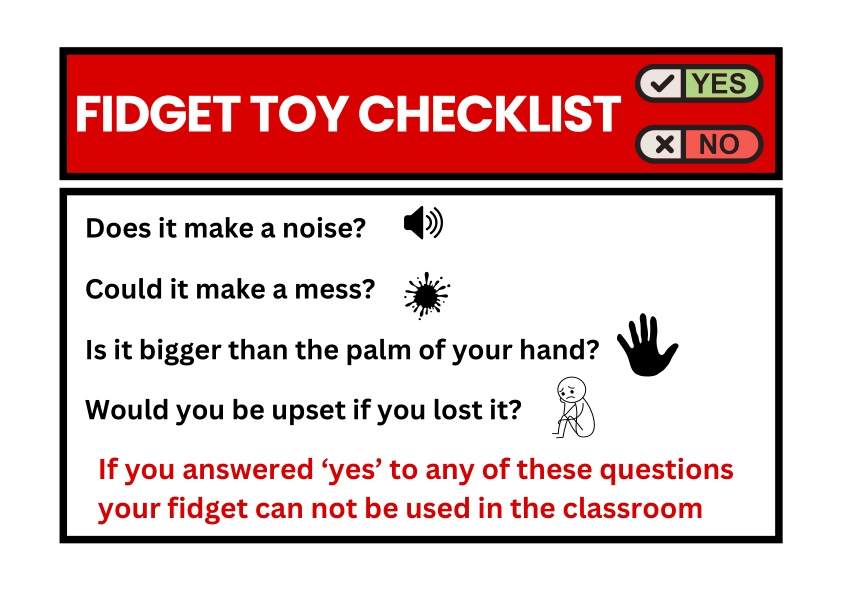
Behaviour expectations are often broad concepts and can be too abstract for many students to grasp effectively. That is why we have rules and are providing this level of detail. We find that without this kind of explicit detail; some students struggle to align with new expectations. The checklist above will be used to provide a very explicit approach to our expectations. We will have a range of approved fidgets that can be borrowed for the day and then returned. We will also have a cleaning protocol to protect from any germs.
If your child and the teacher have an agreed plan where they can bring a different fidget from home to help regulate, they will need to follow this checklist. Fidget toys have themselves become a genre of toys that vary in value and are being used more like a toy. Some of them can be too large, make too much noise, get thrown around and can be messy if broken. Therefore, the ones we will provide will allow for regulation without these distractions. Please talk directly with your teacher if you need to discuss this further to establish what's appropriate. We will be asking students to put anything that is not approved in their bag or confiscating for the day.