
Educational Insight
Education for human flourishing
There is no greater educator than perspective; or at least, I don't think there is.
The past decade has been a turbulent time in human history. Between a pandemic, more conflict than at any time since the end of World War II, and the advent of artificial intelligence (AI), the routines and rhythms of the world which we thought we knew have become increasingly unsettled. Amongst this tumult, a focus on human flourishing has emerged as a new perspective to consider.
Also known as Human Capital Theory, human flourishing has been an area of research and thought since the 1970s that has recently been thrust into a broader focus through the rapidity of technological advancement and what The Future of Humanity Institute at Oxford University has identified as a series of global risks that present through collective inaction (Bostrom and Cirkovic, 2008).
Through this lens, the role of education has been thrust into the spotlight. Where reforms of the 1800s to provide free and comprehensive education to all provided a response to the need for greater education to meet the new needs of industrialisation, it is the contention of the Human Capital Theorists that employment is no longer a sufficient purpose for education. Instead, educational thought leaders such as Charles Leadbeater argue that education for children should go to school to become 'purposeful, reflective and responsible' (2022), and that schools need to ensure that education:
provides opportunity and fulfilment for everyone, respecting and nurturing a broader range of strengths, including dispositions for caring and creativity.
equips people to design and establish the next set of economic, societal and organisational models.
offers new ways of seeing, sensing and interpreting the world, in ways that reconcile competing beliefs and values, re-building meaning and purpose and restoring well-being (OECD, 2025).
Such a focus on 'humanness' is a common response to the advent of AI, but I believe the theory poses more than this responsive need.
Under-pinning this thinking is a return to what Aristotle identified in his Nicomachean Ethics as vital to human flourishing: pleasure, activity, friendship, contemplation, and prosperity. Such a focus, two and a half thousand years in the making, affirms the importance of character development to contemporary education. In short, while the world needs graduates equipped with adaptive problem-solving skills and the drive to find sustainable, practical solutions to complex challenges; it also needs graduates with an understanding heart and sophisticated ethical reasoning abilities able to 'understand, appreciate and act in the world' where they can 'discover their purpose and be capable of realising it' (OECD, 2025).
Through perspective, education invites us to become a beneficial presence in our society; something that we value very deeply at Huntingtower.
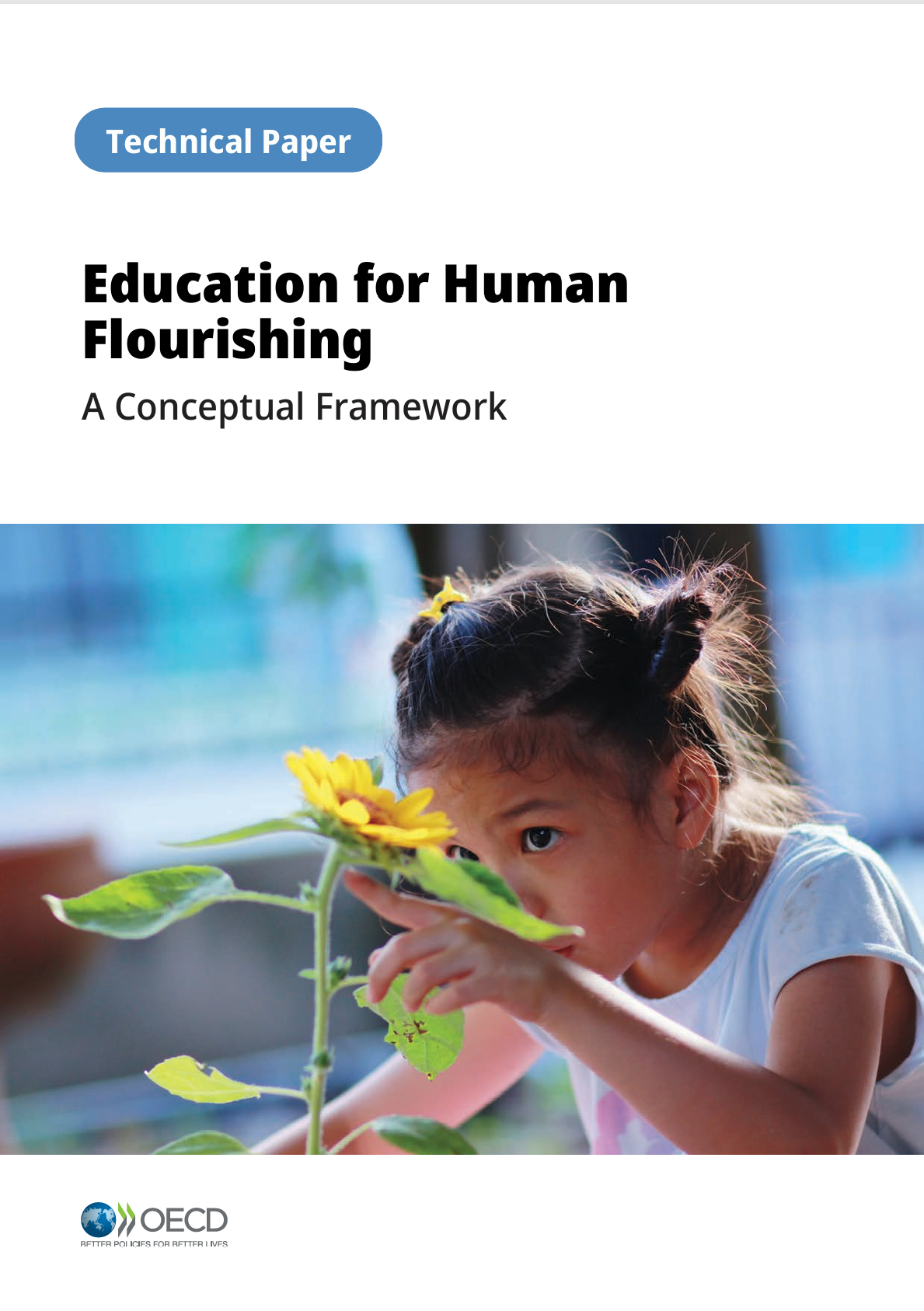
The full OECD report on human flourishing can be found by following this link and is well worth a read: Education for human flourishing.
Mr Cameron Bacholer
Vice Principal of Teaching and Learning
References
Bostrom, N. and M. Ćirković (2008), Global Catastrophic Risks, Oxford University Press.
Leadbeater, C. (2022), Learning on purpose, Centre for Strategic Education, Victoria, Australia.
OECD (2025), Education for human flourishing: A conceptual framework, OECD Publishing, Paris.