
From the Assistant Principal
Not Just a Dot
Every teacher has had to hold their tongue at some point, listening as others confidently explain “what teachers do” - often without the insight, and sometimes without much respect. It’s human nature, I suppose. Many people draw on their own school experiences from years ago, or from what they can see from the other side of the window or even from comments in a Whatsapp group. What is it they say about assumptions?
During the last school holidays, I was out for breakfast at a café when I overheard a parent explaining to their child that their school wouldn’t be back on Monday because “teachers need a day to re-order tissues and pencils.”
I nearly dropped my fork.
It was a neat, simple explanation for a child to explain a school’s Curriculum Day - but it also captured something deeper: how much of our work remains unseen, and how easily it can be misunderstood.
One area where misunderstandings often arise is in each child’s end-of-semester report. And this semester, that confusion may increase somewhat, because our reports will look quite different from those in previous years.
Last term, following a review of our 2025 parent survey data and updated guidance from the Department of Education regarding end-of-semester reporting, a decision was made to adjust our reporting format. One of the key changes is the removal of Key Assessment Indicators (KAIs). Survey feedback showed that these were not particularly helpful for many families, with nearly 60% of respondents indicating that KAIs either did not help, or only somewhat helped, them understand their child’s progress.
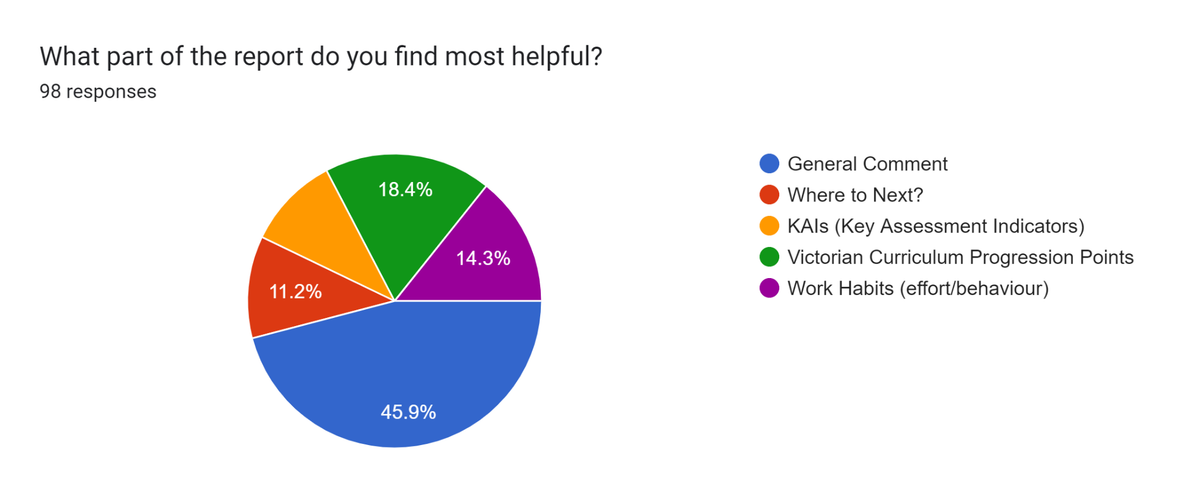
KAIs have been a feature unique to our school, but they don’t align with the Department’s updated guidance on reporting. With that in mind, the decision was made to remove them as the state moves toward a more consistent approach across all government schools.
The more noticeable change - and the one we know may feel significant - is that for many students, there will not be a General Comment or “Where to Next?” section included in this report. While a new in-principle agreement has been reached between the AEU and the department, the stopwork action on providing written comments still stands.
We understand this may feel like something important is missing, and it’s natural to have questions about what this means. It also means those little dots are doing a lot of heavy lifting. But a progression point is not just a dot.
For example, here is what the Year 5 Mathematics progression point actually represents…
(Don’t feel like you need to read it all - it’s a lot!)
By the end of Level 5, students use place value to write and order decimals including decimals greater than one. They express natural numbers as products of factors and identify multiples and divisors. Students order and represent, add and subtract fractions with the same or related denominators. They represent common percentages and connect them to their fraction and decimal equivalents. Students use their proficiency with multiplication facts and efficient mental and written calculation strategies to multiply large numbers by one- and two-digit numbers and divide by one-digit numbers. They check the reasonableness of their calculations using estimation. Students use mathematical modelling to solve financial and other practical problems, formulating and solving problems, choosing arithmetic operations and interpreting results in terms of the situation.
Students apply properties of numbers and operations to find unknown values in numerical equations involving multiplication and division. They design and use algorithms to identify and explain patterns in the factors and multiples of numbers.
Students choose and use appropriate metric units to measure the attributes of length, mass and capacity, and to solve problems involving perimeter and area. Students convert between 12- and 24-hour time. They estimate, construct and measure angles in degrees.
Students connect objects to their two-dimensional nets. Students use grid coordinates to locate and move positions. They perform and describe the results of transformations and identify any symmetries.
Students plan and conduct statistical investigations that collect nominal and ordinal categorical and discrete numerical data with and without digital tools. Students identify the mode and interpret the shape of distributions of data in context. They interpret and compare data represented in line graphs.
Students conduct repeated chance experiments, list the possible outcomes, estimate likelihoods and make comparisons between those with and without equally likely outcomes.
Each dot is the result of hundreds of hours of English and Mathematics sessions, dozens of work samples and assessments that have been reviewed, annotated and moderated. Teachers have spent countless hours discussing student growth, comparing evidence against curriculum standards, and making careful professional judgements about where each child is sitting in their learning journey.
A single progression point may look small on the page, but behind it sits an enormous amount of teaching, learning, observation and care.
Reports, of course, are only ever one snapshot in time. They can never fully capture a child’s curiosity, persistence, humour, kindness, resilience or the small daily breakthroughs that happen in classrooms. Nor can they completely reflect the complexity of teaching itself - the planning, adapting, supporting, encouraging and problem-solving that happens every single day, often unnoticed.
So while this semester’s reports may look a little different, the work behind them has not changed. The care, professionalism and commitment of our teachers remain exactly the same. Much of teaching work happens quietly, behind the scenes. Reports may only show a dot - but behind every dot is deep professional knowledge, careful judgement and an enormous amount of care for each child.
Mat Williamson
Assistant Principal (and doing far less tissue ordering than rumoured)