
National Simultaneous Storytime 2026

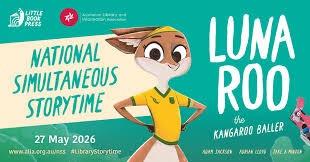
On Wednesday May 27th, our school community paused to participate in National Simultaneous Storytime. This annual event, organised by the Australian Library and Information Association, aims to promote reading by encouraging schools, libraries and families to gather and read the same book on the same day.
This year's title, Luna Roo, the Kangaroo Baller, tells the story of a rookie soccer captain as her team competes against a rival team, Bush United. Through this match, Luna learns to trust her skills and believe in her teammates. A very timely title with the World Cup now upon us!
Students read or listened to this story, and completed book responses following this presentation. A copy of this book is now available to borrow from St Cecilia’s library.
Premiers Reading Challenge update
75 St Cecilia’s students are actively attempting the Challenge
1078 books have already been read
80 days left until the Challenge ends…
It is not too late to join the Challenge!!
To login to your child’s reading record, please go to vprc.eduweb.vic.gov.au/register, and
- Click on School Coordinator or student
- Click on VPRC login
- Use the student login details that the school sent home with your child (username and passcode)
- Click login
This will take you to your child’s home page.
To meet the Challenge
Foundation - Year 2: read/ be read 30 books
Years 3-6: read 15 books
St Cecilia’s Book Bazaar
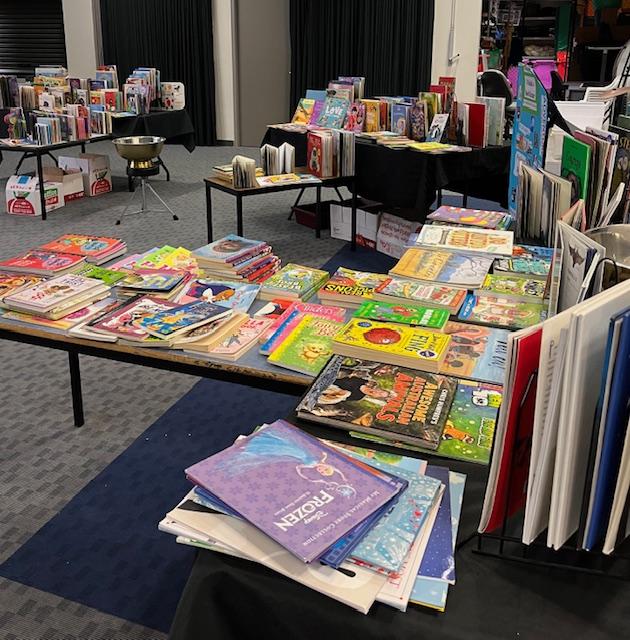
Last week, the school enjoyed a magnificent Book Bazaar run by the Students Representative Council (SRC) where, for a gold coin, a pre-loved book could be purchased. All SRC representatives from Foundation to Year 6 were involved in making posters to promote the Bazaar, collecting donated books each week, speaking to their classes about the Bazaar, helping sort books and set up on the day and being stall holders while their classes visited and shopped. They all did a wonderful job!
The generous book donations from our school families were incredible, and $565 was raised for The Indigenous Literacy Foundation.
A small number of leftover books were also donated to a local charity, 123read2me, who distribute high quality second hand books to children in need all over Australia.
This iniative was a joint project between Literacy and Student Wellbeing, with the goal of providing authentic opportunities for student voice through our Student Representative council (SRC).
Novel Studies in Year 3-6
Here is a selection of summaries and discussions of the events, themes and vocabulary explored during our study of these wonderful novels.
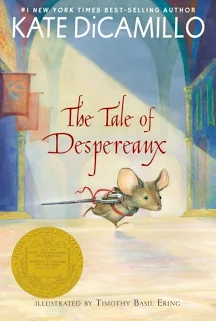
The Tale of Despereaux by Kate DiCamillo
(A summary)
Despereaux is honest and sometimes a bit timid. Despereaux's life suddenly changes when he is laughed at for his weird features. Despereaux loves Pea with all his heart, but when he is caught in the act of breaking a law, will he be saved from perfidy?
The Threadmaster looks up to Despereaux and he looks up to him. More betrayal follows, will Despereaux be brave like the Threadmaster?
A person known as Gregory is a jailor. He offers to help Despereaux but only if Despereaux tells a story to light up his heart while he stays in the treacherous darkness.
Tami White, 3E
A mouse is born. (Book 1)
Despereaux Tilling is a tiny mouse that has experienced many ordeals and challenging moments, mainly betrayal (perfidy) from others and the perfidy usually comes from his family members!
Despereaux is a calm mouse but was born with obscenely large ears. And when Despereaux opened his eyes at birth and looked into the light! Despereaux broke many rules such as reading a book instead of eating it! He sat at the foot of the king and fell in love with Princess Pea!
Despereaux was sent to the dungeon ready to accept his fate but then he realised that his brother Furlough was escorting him to the dungeon! Despereaux asked Furlough if he could let him go but Furlough gave him a hard NO!
Despereaux kept saying ¨Once upon a time…’ ẗo make himself feel braver but then Gregory responded in the dark. Despereaux was picked up off the dungeon floor by the jailer Gregory and was ordered to tell him a story. So he did what he was asked.
Louis Sandilands, 3D

Kensuke’s Kingdom by Michael Morpurgo
(Summary of the relationship between Kensuke and Michael)
In the beginning, Michael and his dog fall overboard from their ship. Kensuke saves both of them and brings them back to the island. Michael doesn’t know where he is and prepares to starve. But surprisingly, the next morning Michael finds fish, fruit and water sitting outside his cave. Michael ate and is very thankful for the food.
Michael lit a fire hoping to attract a ship but Kensuke put out the fire and started haranguing him. Michael and Kensuke were both annoyed at each other so Kensuke drew a boundary line to separate them. Michael thinks of Kensuke as ‘My captor, my persecutor.’
At night mosquitoes torture Michael and he can’t sleep properly. Kensuke hears of Michael’s problems and gives him a bed sheet to stop the mosquitoes from biting. Michael tries to thank Kensuke by writing “Thank you” in the sand.
After that, a storm comes and there are lots of deadly white jellyfish in the sea. Kensuke warns Michael but he doesn’t listen. He starts swimming around and gets two jellyfish stings, one in the neck, and one in the foot. Michael is paralysed and starts drowning but Kensuke saves him.
Kensuke slowly nurses Michael back to life and they develop a silent relationship with each other. Every day, Michael watched Kensuke working in his cave. He admired Kensuke’s ability to focus and he soon learnt lots about Kensuke.
Michael finally recovers and they get to know each other well. Kensuke teaches Michael how to fish and paint. Kensuke even makes Michael his own painting set. They shared stories about their family and spend lots of time together. Michael also teaches Kensuke English.
Even though Michael is happy with Kensuke, he also misses his family and wants to see them again. So he decides to try and communicate with them.
Michael finds a coke bottle and writes a note saying:
To: the Peggy Sue. Fareham. England.
Dear Mum and Dad,
I am alive. I am well. I live on an island.
I do not know where. Come and find me.
Love,
Michael
He rolls up the paper, puts it in the coke bottle, and screws on the lid. Then Michael runs to the very edge of the island while Kensuke is fishing and throws the bottle as far as he can.
That night, Michael feels extremely guilty like he has betrayed Kensuke. The next day, Kensuke and Michael are painting together and Stella suddenly appears with the coke bottle in her mouth. When Kensuke finds out about the note, their relationship diminishes.
Michael feels lonely and unhappy without Kensuke. Kensuke understands that Michael wants to see his family and Kensuke forgives him. Kensuke then offers to play football with him and help Michael to get back to his family.
Daniel Saw, 4J
Kensuke and Michael´s relationship began when Michael fell off the Peggy Sue, but he didn't know this until later.
At the start of the relationship it was just Kensuke providing Michael with raw fish, fresh fruit like red bananas and coconut, and water in an old and rusty metal bowl.
The first time Michael saw Kensuke face to face,while he was conscious, was when he lit a fire. Kensuke came screaming ‘Damadi, fire Abunai!’ The next time Kensuke got angry at Michael was when he swam in the ocean. Michael never disagreed but he never did understand why.
Their relationship was not a happy one, all they did was scream at each other. When Michael didn't listen he got stung by a giant jellyfish. Michael became paralysed, unconscious from the pain and toxins. Kensuke pulled him out of the water for the second time.
For a long time Michale had said that ¨Kensuke was his captor, his persecutor¨ but now he referred to Kensuke as ‘his captor, his savoir’. Michael was paralysed from his neck all the way down to his hands. Kensuke, in the end, fed him hot soup and poured vinegar on his body to kill the poison.
As Michael recovered ,he and Kensuke became closer. They started fishing together, painting together and being together. Kensuke became like a father to Michael like Michael became just like a son to Kensuke.
The only problem was that Michael missed his mum and dad. So when he found a coke bottle buried in the sand he jumped at the opportunity and started to write a letter to his parents back in England. He didn´t have anything to write on so he wrote on a shell instead.He threw the bottle as hard as he could because he didn´t want Kensuke to see it.
Soon enough Stella, Michael's dog [that had fallen off the boat with him] came sprinting into the cave with that very same bottle in her mouth. Kensuke knew what it was immediately and his whole face dropped.
After that they stopped talking altogether. Kensuke wrapped himself up in his thoughts and went into his own cocoon. Michael started to regret his lost friendship, but soon enough Kensuke started talking again.
Kensuke opened up and said that he understood. Michael was relieved and stopped walking on eggshells around kensuke. Together they agreed to light a fire to find a ship to take them home together, for Kensuke home was scary but he was brave and decided to give it a chance.
Ella Barrett, 4K
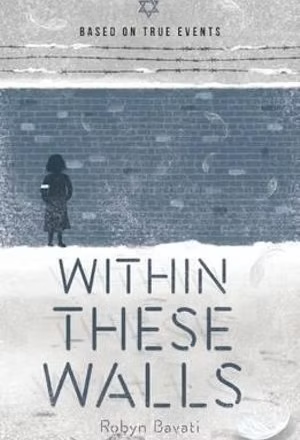
Within these walls by Robyn Bavati
(Discussion on themes)
Reading Within these walls has given me a deeper understanding of the hardships Miri and her family faced throughout the war. Even though Miri is a fictional character, her story very much was not, and was reality for so many people. The book demonstrates her freedom deteriorating as the war continues and how each string is cut as she slowly loses hope.
Chapter 3 depicts the strong bond between Miri and her cousins, particularly Sol, due to their closeness in age and the depth of their friendship outside of purely being related. In the chapter A day with Sol, the two cousins spend the day in the field, enjoying this sudden freedom with Sol's new bike and Miri's ¨coloured ball¨ as she always calls it. Normally they're not allowed to be out for hours at a time, so this was sort of special to them. It was their day. Even though the occasion is innocent, there's still the underlying fact that this may be one of the last times they get to experience the world through a child's eyes- carefree.
Miri has never hidden her love of open spaces and freedom. In the earlier chapters of the book, where their everyday life in Warsaw still exists, she spends the majority of her spare time outside, never missing an opportunity to socialise and enjoy the fresh air. To her, it's almost as if the ghetto exists for the sole purpose of her discontent. It's against everything she loves to do.
Imagine Miri has a bar above her head, and when she first enters the ghetto, it's about 95% full. The bar represents her hope. Everyday in her new ¨home¨ there's always something, whether it's big or small, that snatches away a little bit of hope from the bar. Every loss, every time there's not enough food to go around, her hope subsides ever so slightly.
Suffocation. Suffocating. Suffocated. The life cycle of the ghetto. As life goes on, Miri slowly begins to feel trapped, with every new prohibition against jews that's established, the concept of 'freedom' gradually becomes non-existent. My experience of freedom is obviously very different to hers..
Throughout the story it's as if everyone's life is a ticking time bomb. Eventually the timer will end. It's inevitable. All Miri can do is sit and watch, her family's fate just out of reach. Picture you're Miri, and for longer than you remember there's been the same thought lurking in the back of your mind- You know ultimately you'll end up alone. Clearly there's better possibilities, but when there’s a war going on, what’s the point of being rational?
I can't even begin to imagine what Miri- or anyone at all with those circumstances- would trade to live like us, with guaranteed meals and a safe place to sleep every single night. The bare minimum for us is considered luxury to them.
Other than history, Within these Walls has taught me so much about how incredibly fortunate I am, not having to spend every moment of my life living in fear that something so precious to me could be so suddenly taken away.
Society has already caused this once, how can we as a whole prevent this plight from happening again?
Luella King, 5/6 H
You stand there knowing that one of you is going to die and you get the chance to save your baby sister, but it would mean you are alone. Alone getting your own food, money, shelter and a lot more at just 8yrs old. So that's why I think that Miri did the right thing by giving Hinda to Mrs Kowalski even though it was an incredibly difficult and heartbreaking decision. Miri knew that Hinda would have a much better chance of surviving outside the ghetto. By making this courageous sacrifice, Miri puts Hinda's safety before her own feelings. This shows how much she loved and cared for her younger sister.
Normally, an eight-year-old gets to just be a kid who relies on her parents. But in this extreme distress, Miri has to change her whole future in a split second. By staying behind alone, she stops being a protected child and becomes the protector. She doesn't get to grow up naturally, doesn't get to go to school, doesn't get to see friends and the hardest one doesn't get to see the people she loved, her family.
Throughout Within These Walls, many characters make brave and selfless sacrifices to save others lives. If I was Miri watching my whole world fall apart and everyone I loved taken away from me, I would have no other choice than to say yes, if I got the opportunity to save my sister. Although I don't know much about Mrs Kowalski this far into the book, I think that Hinda will get love and support from her but most likely not as much as her own family. I decided that because Mrs Kowalski came to the ghetto willingly to make the offer and Miri must have trusted her since she took the risk and went back to Mrs Kowalski
When she, Mrs Kowalski, made her first proposal the ghetto wasn't closed meaning they didn't know about the fear and isolation they would all have to go through, so that might be why Mama and Tateh didn't say yes.
As our group keeps reading this outstanding but sad book I realise how wistful every character's life is and I start to notice how extremely lucky and grateful I am for everything and everyone I have around me. Every character seems to uncover another heartbreaking struggle that makes me feel sad, shocked and wondering ¨whats going to happen next¨. It's so difficult to imagine living with so much fear and not being able to step foot out of your house without either getting beaten, looking out for the Nazis making sure none of them will find you or getting shot dead!
Overall, Miri made a heartbreaking, courageous decision but she made the right one.
Olivia Moore, 5/6 H
While reading ‘Within these walls’, I start to feel as though my life is like living in heaven. Reading as Miri´s life slowly turns to misery, I imagine what I would feel like. If a life where I felt safe and happy, slowly enclosed into one, where I was scared to leave my house. Where I needed food but I knew I wouldn't be able to get any. Where I was discriminated against in my own town. I imagine how much Miri would give to swap lives with us, even just for one day. I read as Miri slowly loses everyone she loves, while fighting to stay alive herself. Losing one family member is hard enough, losing them all at the same time must be impossible, and yet Miri is brave enough to continue, to be strong for the family members that are left. Miri could give up, lie down and let fate decide what happens next, but yet she stands tall and keeps on walking, just that is something I could never do.
Miri´s bond with her cousins was so tight, she was always excited to see them and finally be able to go to their house for the weekend. The first time she rode a bike was at her cousin's house, on her cousin Sol´s bike. They spent ages together teaching Miri to ride. Watching them getting ripped apart is heart breaking, knowing that they will barely ever see each other again, if they even make it out of the ghetto alive. I personally have a strong bond with my cousins, and being forced away from them would be excruciating, especially knowing that I would never see them again.
Miri loved outdoor areas and freedom, but she was forced into a cramped, smelly ghetto, full of starving families and tiny homes. At first Miri thought it would be a new home similar to her last, that the Nazis would finally leave her and her family alone, that maybe she could have some freedom. But no…. things just got worse. Soon viruses started spreading, lice started to multiply, jumping from anything onto people walking by, and corpses started filling the streets. Miri was tripping over the bodies as she walked. Soon the corpses belonged to people Miri loved, her Buba and Zedeih. Miri wanted to cry every time she went outside. It was as though Miri's freedom and happiness had been crushed like a potato chip, under the Nazis dirty boots.
At first Miri's mum tried to stop her and Ruchell from looking at the bodies, saying that kids shouldn't be exposed to death like that, but soon she gave up, knowing that there were too many bodies to hide them all. Miri longed to be outside in fresh air again, like she used to be. She wondered if she would ever make it out, if the war would ever stop. Maybe she would never smell a flower, or just freshly cut grass, maybe she would never feel a green leaf, or see a wild animal, or anything that she loved, ever again. Miri stopped trying to look for her friends from school, or even just a familiar face like a neighbor. She was worried that they had ended up wrapped in old newspapers in front of their house´s too. She wondered what was happening outside of the ghetto. Were the Nazis being cruel there too? If her friends were still alive, were they living better than her? Did they have food to go home to? She really hoped they did.
Soon more of Miri´s family members were gone. Zalman and Tateh had been taken by the Nazis. Ruchell had died of typhus. Mama broke her ankle and was unconscious. And Miri took Hinda back to Mrs Kowalski. Any little spark of hope she had, for freedom, for happiness, maybe to just see her friends and family again, was gone.
Mae Pearce, 5/6 H