
Family Feature

HOW FAITH AFFECTS OUR WORK
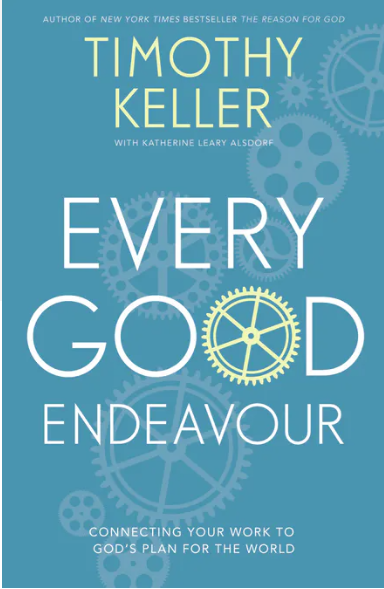
Author: Timothy Keller
I’ve had some busy people pick up Every Good Endeavor: Connecting Your Work to God’s Work, look at the subtitle, and ask: “OK, so, in a nutshell, how does God’s work connect to our work?” Always a good exercise for an author, to be asked to explain your book in just a few minutes! Here are four ways Christian faith influences and shapes our work.
First, the Christian faith gives us a moral compass, an inner GPS giving us ethical guidance that takes us beyond merely the legal aspects or requirements in any situation. A Christian on the board of a major financial institution—recently publicly embarrassed by revelations of corruption—told me about a closed-door meeting there between top executives. Someone said, “We have to restore moral values.” Immediately someone asked, “Whose values? Who gets to define what is moral?” And there’s our problem. There once was a habitus of broadly felt moral intuitions that governed much behaviour in our society. It went well beyond the legal. Much of the ruthlessness, the lack of transparency, and the lack of integrity that characterizes the marketplace and many other professions today come because consensus on those moral intuitions has collapsed. But Christians working in those worlds do have solid ethical guidance and could address through personal example the values-vacuum that has now been recognized by so many.
Second, your Christian faith gives you a new spiritual power, an inner gyroscope, that keeps you from being overthrown by either success, failure, or boredom. Regarding success and failure, the gospel helps Christians find their deepest identity not in our accomplishments but in who we are in Christ. This keeps our egos from inflating too much during seasons of prosperity, and it prevents bitterness and despondency during times of adversity. But while some jobs seduce us into over-work and anxiety, others tempt us to surrender to drudgery, only “working for the weekend,” doing just what is necessary to get by when someone is watching. Paul calls that “eye-service” (Colossians 3:22–24) and charges us to think of every job as working for God, who sees everything and loves us. That makes high-pressure jobs bearable and even the most modest work meaningful.
Third, the Christian faith gives us a new conception of work as the means by which God loves and cares for his world through us. Look at the places in the Bible that say that God gives every person their food. How does God do that? It is through human work—from the simplest farm girl milking the cows, to the truck driver bringing produce to market, to the local grocer. God could feed us directly but he chooses to do it through work. There are three important implications of this. First, it means all work, even the most menial tasks, has great dignity. In our work we are God’s hands and fingers, sustaining and caring for His world. Secondly, it means one of the main ways to please God in our work is simply to do work well. Some have called this “the ministry of competence.” What passengers need first from an airline pilot is not that she speaks to them about Jesus but that she is a great, skilful pilot. Third, this means that Christians can and must have a deep appreciation for the work of those who work skillfully but do not share our beliefs.
Fourth, the Christian faith gives us a new world-and-life view that shapes the character of our work. All well-done work that serves the good of human beings pleases God. But what exactly is “the common good”? There are many work tasks that do not require us to reflect too much on that question. All human beings need to eat, and so raising and providing food serves people well. But what if you are an elementary school teacher or a playwright? What is good education (i.e. what should you be teaching children)? What kinds of plays should you write (i.e. what kinds of stories do people need)? The answers to these questions will depend largely on how you answer more fundamental questions—what is the purpose of human life? What is life about? What does a good human life look like? It is unavoidable that many jobs will be shaped by our conscious or semi-conscious beliefs about those issues. So, finally, a Christian must think about how his or her faith will distinctly shape their work.
How wonderful that the gospel works on every aspect of us—mind, will, and feelings—and enables us to both deeply appreciate the work of non-believers and yet aspire to work in unique ways as believers. Putting all of these four aspects together, we see that being a Christian leads us to see our work not as merely a way to earn money, nor as primarily a means of personal advancement, but truly a calling—to serve God and love our neighbour.
"HOW TO HELP OUR KIDS MASTER DISAPPOINTMENT"

(Partially adapted from Maggie Dent), November 2021
The past two years have been filled with many disappointments from employment, travel, education, celebrations, etc. and it can be tempting for parents to want to protect their children from moments of discomfort. However, to do so would be to create more long term emotional distress.
In Lisa Feldman Barrett’s book, 'How Emotions Are Made', she explored research and discovered that there are no universal emotions as such. Instead, we create our own unique emotional responses based on our brain’s capacity to construct and predict what we experience.
This is called the theory of 'Constructed Emotion' which states that from birth we are creating a version of our environment and experiences. We create our own concepts about our emotions like what they are, where they come from, what they mean and then we create our own unique way of managing our emotions.
This means that if we allow our children to experience authentic moments of disappointment (with our guidance and support of course), they will gradually create neural pathways that will help them manage and cope. For example, not being allowed lollies before dinner, not being given the latest iPhone, unlimited internet use or going to bed at any time they choose - the list goes on from toddlerhood to adolescence of many wonderful opportunities to practise understanding and navigating disappointment.
As humans, we are largely reacting and responding to things that happen around us and Barrett theorizes that together with our children, we can help them to become the architects of their own experiences and to effectively navigate disappointments in a positive way.
Two different ways we can be disappointed
One way we can be disappointed is through things that are out of our control such as changes made by the government with lockdown restrictions. For example, cancelled events like weddings, sports games, family get-togethers, etc.
Secondly, there are disappointments that can come from things we do have control over like forgetting your lunchbox, losing a school jumper, causing a friendship conflict because we said something mean or failing a test we never studied for.
It is important to teach our children – early and often, that there are some things we can fix and some things we just have to learn to accept and adapt to.
Angela Duckworth in her book 'Grit: Why Passion And Resilience Are The Secrets To Success' argues strongly that talent alone is not enough to reach a high level of success in life. Sustained practice and effort, when combined with an interest that has a sense of purpose to it, are the keys to genuine success in life. The more our children practise overcoming setbacks in moments of disappointment, the better they get at it. Rather than avoiding moments of disappointment, we need to be embracing them as a form of training for life.
As parents, we can be enthusiastic and encouraging about recovering from life’s challenging moments by looking for the learning experience that’s often hidden under each moment of disappointment. For example, the failed test was a chance to explore gaps in their learning or perhaps taking responsibility for a lack of preparation! Setting a new goal following a moment of failure can also be helpful as it refocuses a child towards a future possibility of success, rather than leaving them stuck in a pile of disappointed muck!
Emotional buoyancy is only learned through experience and by adapting to these experiences. Our children need to be experiencing moments of autonomy where they stretch and grow themselves in their own way, and in their own time in order to develop authentic competence and confidence.
Like falling off bikes, grazing knees when we run too fast, losing a game or missing a goal, recovering from these moments is what matters the most. Every one of those moments has a gift of grit for our children.
Some tips to help your children grow from disappointment
- Don’t avoid or minimise the emotions that arise.
- Validate your child’s feelings of disappointment and acknowledge that it feels unpleasant - temporarily.
- Ask questions like: “How can you make it right?” or “What else can you do?” or “Do you need my help or can you try to solve this on your own?”
- Remind them of previous moments of disappointment and what strategies they used to overcome their disappointment.
- Teach strategies to shift their emotional energy – deep breathing, walking, playing basketball, patting the dog, playing music, doing a different activity.
- Celebrate effort and persistence.
- Help them to choose an affirmation, for example; “I have got this” or “I am, I can, I will,” or “I am more than this…”
- Reassure them of your love, care and confidence for them.
- And most importantly, reassure them of God’s unconditional love for them, of His perfect plan for their future which does not change when things go badly or when they feel disappointment.
“So we have come to know and to believe the love that God has for us. God is love, and whoever abides in love abides in God, and God abides in him.”
I John 4:16
“For I know the plans I have for you,” declares the Lord, “plans to prosper you and not to harm you, plans to give you hope and a future.”
Jeremiah 29:11
“For great is his steadfast love toward us, and the faithfulness of the Lord endures forever. Praise the Lord”!
Psalm117:2
We cannot leave it to chance or society to raise our children to believe that this rollercoaster of life will ever be a peaceful field of daisies without any prickles or challenges. When those times of challenge and disappointment do arise, we put our firm trust in God, the Creator and author of life, our Heavenly Father who created us, who knows that disappointment is a part of life and who wants to meet us in our disappointments, so that we may grow to live meaningful and abundant lives.
*Note - Remember, persistence and practice can improve performance and failure is just a part of life, not a sign that we are lousy parents!
Mrs Sally Cahill (Student Wellbeing Coordinator, NWS)